Reporter's notebook Manners matter in coverage of host nation
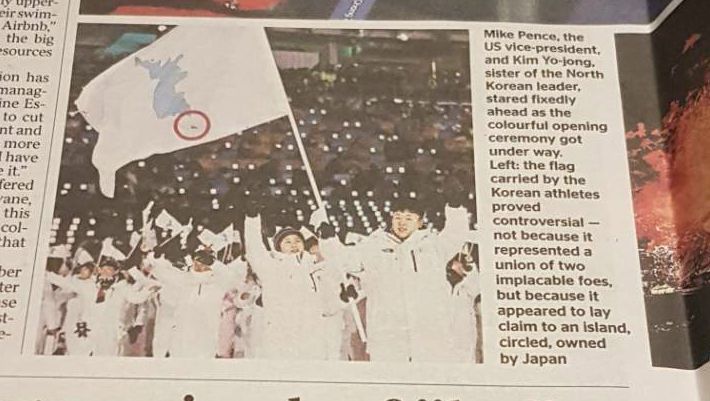
Seen above is the U.K. newspaper The Times' photo caption on Korean athletes holding a flag depicting the Korean Peninsula during the PyeongChang Olympic Games' opening ceremony. The caption stated that Korea's Dokdo island belongs to Japan, while highlighting the wrong island in the photo. / Yonhap
By Nam Hyun-woo

A series of blunders by foreign news outlets covering the PyeongChang Olympics are casting doubts about their manners by the host country, as their reports don’t even show a basic understanding of the background of Korea.
On Saturday, the U.K.’s The Times reported in a photo caption for its PyeongChang Games opening ceremony article that Korea’s easternmost islets of Dokdo were owned by Japan and Korea is laying a territorial claim to them.
“The flag carried by the Korean athletes proved controversial -- not because it represented a union of two implacable foes, but because it appeared to lay claim to an island owned by Japan,” it wrote.
What was worse was it highlighted Jeju Island, a southern resort island of Korea, instead of Dokdo, which was not even on the flag the athletes were holding. According to the Korea Sports & Olympic Committee, they provided the flags that do not have Dokdo on them.
“In order to comply with the IOC statues, we provided a Dokdo-less version of the Korean Peninsula flags,” a KSOC official said.
Dokdo is occupied by South Korea, but Japan has long been making claims to it. Ample and abundant historic evidence suggest that the rocky outcropping has historically belonged to Korea.
Soon after the report, the Korean embassy to the U.K. issued an official protest to The Times and the newspaper issued an apology stating that Korea was in control of Dokdo and Japan was making claims on the island, calling it Takeshima.
This is not the first time that a foreign media outlet covering the PyeongChang Games angered Koreans with senseless reporting about the relations on Korea and Japan.
NBC Sports analyst Joshua Cooper Ramo triggered harsh criticism from Koreans by saying “Japan occupied Korea from 1910 to 1945. But every Korean will tell you that Japan is a cultural and technological and economic example,” during his PyeongChang opening ceremony coverage.
Unlike his comments, countless Koreans suffered, often from rape, forced labor, torture and death, during the brutal colonial rule, with most Koreans demanding Japan issue a proper apology.
NBC, the main broadcaster of the Olympics, soon issued an apology and relieved Ramo from his coverage post. However, the commentator himself did not apologize.
Newspapers make mistakes. Despite efforts to uphold the highest standards of journalism, conditions are harsh, deadlines are always pressuring and fat fingers constantly cause problems. Sadly, however, The Times’ problematic coverage, which is well-written based on a distorted understanding of Korea-Japan relations, does not seem to have been caused by a mistake.
At least one quick search on the internet with keywords of “Korea, PyeongChang, flag, and island” could have informed the caption writer that Korea is occupying the island and Japan is making claims on it. We don’t expect the writer to judge which country is right, or what he or she believes. We expect the writer to find out what the facts are.
So is Ramo’s comment. Had he heard of every Korean’s opinion on Japanese colonial rule, or the victims of Japan's wartime sexual slavery?
The Times, established in 1875, is one the world’s oldest newspapers. Based on the confidence of their rich history, it even publishes a world history book, titled “The Times Complete History of The World.” NBC, founded in 1926, is one of the most respected television networks in the United States.
Rather, this reporter hopes Ramo’s comment and the photo caption were mistakes caused by the pressures from broadcasting and deadlines, not a display of distorted recognitions that Korea is a small country sandwiched between Japan and China and swayed by them.
If media outlets of their stature have such a poor understanding about the history and the current affairs of the subjects they cover, the authenticity of the past NBC is reporting is in serious question. And so are future events they will cover.