Underhand pitchers under spotlight again three decades after golden days
By Kang Hyun-kyung
In baseball, there’s a common saying about left-handers _ leftie batters have a harder time hitting pitches thrown by same-side pitchers.
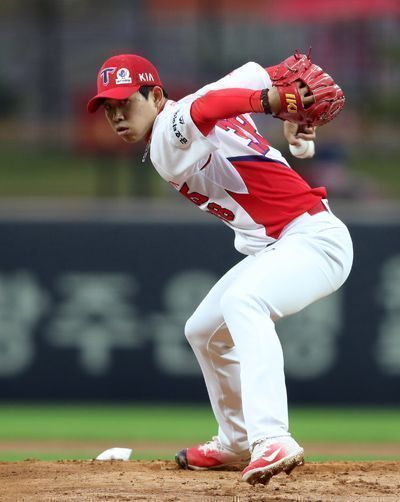
With his powerful change-ups, Kia Tigers underhand pitcher Im Gi-yeong has struck out 44 players in the 12 games in which he has pitched so far this season. His ERA this season is 1.82, and he has seven wins and two losses. / Korea Times photo file
In the past few years, baseball clubs had sent left-handed pitchers to the mound in case leftie batters of opposing teams appear at the home plate. As batters have had more experience with leftie pitchers, however, they have adjusted to the pitching patterns and learned how to hit their pitches.
Thus, the popular belief about left-handers no longer holds true in the Korea Baseball Organization (KBO) League.
Baseball clubs are now looking for other rare baseball talent _ underhand pitchers _ to outperform opposing teams. Six KBO clubs _ the Kia Tigers, SK Wyverns, Samsung Lions, Nexen Heroes, Hanwha Eagles and the KT Wiz _ have underhand starters in their rosters, and most baseball clubs have one or two underhand relief or closer pitchers.
The pitches of underhand pitchers move differently from those thrown by overhand pitchers because their upside-down release and gravity affect the ball’s motion. Baseball analysts call underhand pitchers “submarines,” as they throw at or below sidearm delivery.
Compared with other seasons, there has been a noticeable increase in the number of underhand pitchers this season. As of May, 18 underhand pitchers had taken to the mound.
Park Myung-hwan, a former pitcher who played for the Doosan Bears, the LG Twins and NC Dinos before retiring after the 2015 season, said “rarity” is the rationale behind baseball clubs giving more opportunities to submarines.
Batters are not familiar with the pitches thrown by underhand pitchers, and even sluggers are fooled by them, Park said.
“This season is kind of unique in that we’ve seen so many underhand pitchers,” he said. “There were a few sidearm pitchers when I played in the KBO League. Some of them were starting pitchers. But in general, sidearm pitchers were rare in the 2000s.”
There are many types of underhand pitchers according to how they release their pitches. Sidearm pitchers throw the baseball with their arm perpendicular to the body at 3 or 9 o’clock for the right- or left-handed thrower, respectively. Those who deliver pitches with their right arms at a 10 or 11 o’clock position or left arm at a 1 or 2 o’clock position are called three-quarter pitchers. Their balls tend to tail and sink as they approach the batter. Unlike overhead pitchers, underhand pitchers release balls from below the elbow, and their balls in general are slower than those of overhead pitchers.
In the face of an increase of underhand batters in the league, batters are learning how to hit their pitches. Kia Tigers slugger Choi Hyeong-woo, considered one of the greatest players of our time, admitted he had a hard time dealing with underhand pitchers.
He was very excited after producing an upset two-run homer off Nexen Heroes sidearm pitcher Han Hyun-hee in 2014.
“I have never been excited like this before,” he said in an interview after hitting the home run. “I had a hard time dealing with underhand pitchers, but today I produced a two-run homer off the slider thrown by the underhand pitcher, which is unbelievable.”
An increase in underhand starters stirred speculation about their future _ will their heyday return to the league?
The late 1980s were the golden days for underhand pitchers. In 1989, for example, five of the top 10 pitchers by wins were sidearm pitchers. The boom for underhand pitchers had continued until the early 1990s, and starting pitchers who threw pitches below their sidearm were common in those years. In the 1980s and 1990s, each baseball club had one or two sidearm pitchers in their rosters.
Underhand pitchers have since become rare in the KBO League. In the 2000s, a handful of underhand pitchers served as either relievers or closers of their teams and there were very few underhand starters. Some experts said underhand pitchers were almost extinct.
During those years, underhand pitchers were not hailed. They were portrayed as less effective pitchers than their overhand counterparts, partly because their balls generally were slower than the pitches thrown by overhand pitchers. Also, they were not well received because their pitching styles apparently make it easier for base runners to steal bases.
Underhand pitchers have been back in the spotlight since 2010 owing to two exceptional underhand starters _ Lotte Giants’ Lee Jae-gon and LG Twins’ Park Hyun-joon. With their superb delivery of fastballs, they proved underhand pitchers can be as effective starters as overhand pitchers.
This season, several young underhand pitchers, like Tigers starter Im Gi-yeong, have stolen the show.
With his powerful change-ups, the 24-year-old has struck out 44 players in the 12 games in which he has pitched so far this season. His ERA this season is 1.82, and he has seven wins and two losses. The sidearm pitcher became a newsmaker in April for his first shutout against the KT Wiz.
Wyverns starter Park Jong-hun earned the nickname “nuclear submarine” for his unique but powerful pitching style. His average release point is 28 centimeters above the ground, the lowest among the KBO League pitchers. He pitched 27 and 1/3 innings in five games in June and got the top ERA of the month with 1.65.
Park was one of the six MVP candidates in the league in June, along with LG Twins starter David Huff, SK Wyverns ace pitcher Merrill Kelly, Doosan Bears slugger Kim Jae-hwan, Wyverns third baseman Choi Jeong and Hanwha Eagles hitter Wilkin Rosario. Kelly was chosen MVP of the Month after winning the most votes from sports journalists covering the KBO.
“A possible explanation for why this season has more underhand pitchers than ever before is that there were more young underhand pitchers in school and they’ve just begun to join the league in recent years,” Park said.
He said a players’ physical condition is one of the factors that determine what kind of pitchers young baseball talents are going to be. “Young pitchers who are shorter than average pitchers of their age, or who are not physically fit for pitching overhead, choose to throw at or below sidearm,” he said.
Baseball analyst Jung Sung-ho said sidearm pitchers are popular this season because they have become more competitive with their superb delivery of various pitches. Generally speaking, he said, overhead pitchers are great at fastballs, whereas underhand pitchers have change-up pitches as their weapon.
“A left-handed batter finds it tough to hit the change-up thrown by a sidearm pitcher because the baseball veers off to the side,” he said. “The batter has little time to prepare for such a pitch.”
Jung said the adjusted strike zone also makes it easier for underhand pitchers to pitch longer innings. “The pitches that were considered balls in the old strike zone are now counted as strikes because of the expanded strike zone,” he said. “Underhand pitchers are gaining under such a strike zone change.”