Korea ends up winning nine golds

South Korean athletes react after their wins at the 2016 Rio de Janeiro Olympics which have been running since Aug. 5. As of Saturday, the country has collected nine gold medals, three silvers and nine bronzes. In Rio, the country’s archers won all four archery events for the first time in Olympic history and female taekwondo athletes bagged two golds. Golfer Park In-bee, shooter Jin Jong-oh and fencer Park Sang-young each clinched gold in their sports. / Yonhap
By Nam Hyun-woo
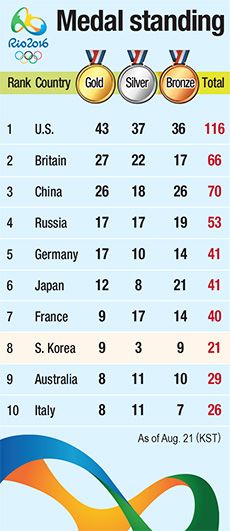
Team Korea is unlikely to achieve its Rio Olympics goal of making a top 10 finish with 10 gold medals as the odds are low that it will win the men’s marathon ― the only event left for them.
As of Saturday (local time), South Koreans bagged nine gold medals, three silvers and nine bronzes to be ranked eighth on the Rio Games medal table. It will be the first time in 12 years since the 2004 Olympics in Athens that South Korea has failed to achieve the “10-gold, top 10 finish” target.
On the day, female golfer Park In-bee won gold in the sport’s return to the Olympics after a 112-year hiatus and taekwondo athlete Cha Dong-min wrapped up his competitive career with a bronze in men’s +80 kg class.
The only South Koreans whose competitions are yet to begin are marathoners Son Myeong-jun and Shim Jung-sub. However, chances for winning a medal remain low.
Medal favorites such as Kenya’s Eliud Kipchoge and Stanley Kipleting Biwott have 2:03.05 and 2:03.51, respectively, as 2016 best records. Ethiopian runners Tesfaye Abera and Lemi Berhanu also have 2:04.24 and 2:04:33, respectively, as their best records this year.
Son’s best record is 2:12.34 set on Feb. 7 this year in Japan and Shim’s best is 2:13.28 set on March 15 last year in a domestic race. Though the Olympic record, 2:06.32, is three minutes slower than Kipchoge’s season best, the record is still six to seven minutes faster than Son’s and Shim’s.
With the chance of winning more medals being slim, South Korea will likely have the first Games in which they failed to collect more than 10 golds since the 2004 Athens Games.
At Beijing 2008, the country finished seventh with 13 golds, 10 silvers and eight bronzes. Four years later in London, the South Koreans snatched up 13 golds, eight silvers and seven bronzes to make a fifth-place finish, the highest rank they have reached since the 1988 Olympics in Seoul.
South Koreans fell short of their initial bid after judokas and wrestlers failed to collect a gold medal.
In judo, South Koreans competed in seven men’s weight classes and five women’s weight classes. Of them, four male judokas topped world rankings, but the result was two silvers and one bronze. Except for the 2000 Games, South Korean judokas have collected at least one gold medal since the 1984 Games. At the 2000 Games, there were two silvers and five bronzes.
Watchers say it seems to be a strategic failure. Before the Rio Games, South Koreans raised their world rankings in order to get a good seed and avoid meeting Japanese athletes in the early stages.
During the process, however, they had to participate in many international competitions and naturally their skills and tactics were heavily exposed to rivals. Consequently, they suffered eliminations against European judokas, such as Russians and Belgians, not against their feared Japanese.
Wrestlers also underperformed. Wrestling has been one of South Korea’s gold-winning sports in the Olympics, but only one bronze came from five weight classes in Rio -- one of the worst results in the South Korean wrestlers’ Olympic campaigns.
The fall of South Korean wrestling came from the Korea Wrestling Federation’s corruption. The federation lost its corporate sponsorship in 2011 following a former chairman’s embezzlement scandal. In June, police raided the federation’s office on a fresh embezzlement allegation over 3 billion won.
Under such circumstances, athletes lacked proper support. Only three ― head coach and two assistant coaches ― accompanied the Rio athletes. The federation did not send personnel to handle off-the-mat issues.
The wrestlers’ situation comes in stark contrast to the cases of the U.K. and Japan, which prevailed at the Rio Games.
The U.K. marks No. 2 with 27 golds, 22 silvers and 17 bronzes in the Rio medal haul as of Saturday. It is a great jump from their dismal 1996 Atlanta Games campaign in which their countrymen marked 36th place on the medal table with only one gold medal.
The Guardian reported that Britain’s Rio success came after the decision to divert National Lottery funding into professional sports after the Atlanta campaign, adding that each medal at the Rio Olympics cost 5.5 million pounds ($7.2 million).
Japan has shifted its focus from grassroots sports to elite sports amid its winning of the right to host the 2020 Summer Games in Tokyo. Last October, the Japanese government established the Japan Sports Agency, a ministry-level organization, to nurture professional athletes.
Calls are growing that South Korea, which will host the PyeongChang Winter Olympics in 2018, should come up with a more comprehensive program to nurture professional athletes.