Can Korea compete in sprint sports like Japan?
.jpg?w=728)
Japanese sprinters Ryota Yamagata, Shota Iizuka, Aska Cambridge and Yoshihide Kiryu after winning the silver medal in the men’s 4x100-meter relay final at the Olympic Stadium in Rio de Janeiro on Saturday. / AP-Yonhap
By Park Jae-hyuk, Park Si-soo
Japan’s unexpected runner-up in the men’s 4x100-meter relay at the Rio Olympics has taken many Asians by surprise. It has shattered a long-held belief that Asians cannot compete against Western and African athletes in field and track sports, especially sprints.
So how did it happen? Can South Korea also make it at the next Olympics?
These were among questions in minds of sports experts here who watched Japan’s unprecedented feat with a mixture of envy and jealousy.
The four Japanese sprinters who rewrote Olympic history are Ryota Yamagata, Shota Iizuka, Yoshihide Kiryu and Aska Cambridge.
Details of their training programs are unknown. But experts said their achievement would not have been possible without consistent investment, regardless of records, and athletes’ hard work.
And related organizations need to make greater efforts to find the“hidden recipes” that helped lift the Japanese runners to today’s level.
Secrets of the baton change
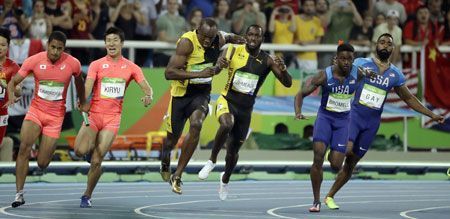
Japanese sprinters improved their times after training hard to pass the baton from “under-hand”, which is faster but riskier than the normal “over-hand” changes. / AP-Yonhap
Experts here credit Japan’s success to its smoother baton change. Although the Japanese team does not have success sprinters who can run 100-meter in 10 seconds, the four improved their times after training hard to pass the baton from “under-hand”, which is faster but riskier than the normal “over-hand” changes.
Japanese authorities also sent young sprint prospects to the U.S. for advanced training.
The success of the Japanese sprinters has taught a lesson to South Korean sprinters and the authorities.
South Korean authorities said they would develop talented young sprinters for the sprint relay after the 2014 Incheon Asian Games. But South Korea sent only one sprinter, Kim Kuk-young, to Rio, as it failed to qualify for the sprint relay.
China, as well as Japan, showed the possibility of Asian success, finishing fourth in 37.90 seconds in the sprint relay. Only South Korea has been left behind alone, while its neighbors are aiming for gold in the next Olympics.