Olympic fever wanes
By Nam Hyun-woo
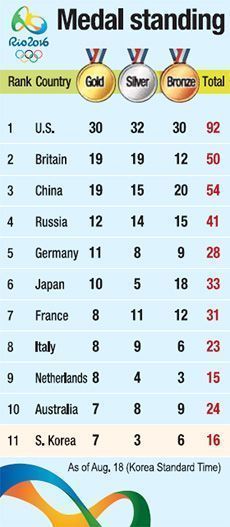
More and more South Koreans are finding the Rio Olympic Games not as interesting as previous games.
Before the Games, there were expected reasons that the Rio Games might not be popular among South Koreans — the 12-hour time difference between Seoul and Rio de Janeiro and South Korea’s “star drought” delegation. South Koreans also cited those reasons, but some said they are losing interest in the Olympics itself.
Park In-seong, 43, a bank worker in Gwangmyeong, Gyeonggi Province, said the time difference was the biggest reason for him to give up watching the Games.
“Most of the matches are past midnight. I can’t watch them all and be in the office on time with fresh mind and body, so I just check the results through articles on my way to the office,” he said. “As most of my colleagues are doing the same, we don’t talk about the Olympics much. When you don’t watch the matches live, you don’t have many things to talk about.”
Kang Keon-tae, a 22-year-old collegian who said he is a huge sports fan, said many matches became less thrilling for him after the South Koreans were eliminated in early stages.
“I tried to watch as many matches as possible, but couldn’t help falling asleep after games got less tight,” he said. “When it comes to professional sports, I don’t root for a team or an athlete because he or she is Korean. But the Olympic Games features many sports that I don’t usually watch and then I found myself becoming a patriot.”
In previous international sporting events, many South Koreans have gathered together and rooted for their athletes, but that was not the case for the Rio Games.
In Gwangju, local residents gathered at Kwangju Woman’s University, where archer Ki Bo-bae and Choi Mi-sun are based, to watch their archery competition together. Except for that group, there were no other public events held there. According to Yonhap News Agency, the situation was similar in North Chungcheong Province, home to archer Kim Woo-jin, judoka Cho Gu-ham, fencer Jung Seung-hwa and other Olympians, as they were eliminated earlier than expected.
There were also those who cited that stories of corrupt athletes or sports associations distanced them from the Olympics.
Kim Tae-ho, 28, a Seoul-based interpreter, said an online posting criticizing the Korea Volleyball Association for poor support for the athletes made him lose interest in the Games.
The posting, which has gone viral after the South Korean women’s quarterfinal loss against the Netherlands, claimed that the association has been poorly supporting the women’s team. The women’s team is better than the men’s team in international competitions, but the association decided not to send the women’s team in order to save costs for the men’s team, the posting wrote.
The writer argued that the team’s after party for their win at the 2014 Asian Games was held at a cheap restaurant and the team’s star Kim Yeong-koung later threw a separate party at her own expense.
Also at the Rio Games, the association’s support of the women’s team caused controversy, as the team had to hold games without an interpreter or a team doctor. Without an interpreter, a Korean announcer who was there for TV broadcasting helped them.
The association said through a press release Thursday that that was an inevitable situation because of the limited number of accreditation cards given to the volleyball team.
“Along with the volleyball controversy, Park Tae-hwan’s doping scandal also discouraged Koreans from taking interest in the Olympic Games,” Kim said.
Kim So-yeon, 23, a Seoul-based university student, said that she was affected by articles questioning the safety, preparedness and feasibility of the Rio Games.
“With media pumping out stories criticizing Rio’s lack of preparations and its massive costs, I started to question whether the Olympic Games were worth hosting,” she said. “The question is what would be the benefit of hosting the Olympics. How many countries can guarantee that the cost of hosting such a massive event does not surpass the expected profit from it?”
Others said that there are livelihood matters more important than paying attention to the Olympics.
“What I cared about was talks on improving the electricity rate system,” said Choi Soon-young, 55, a housewife in Daegu. “The Olympics have no relation with our livelihood, so I paid more attention to what is going to happen with the problematic billing system.” South Korea currently uses a progressive electricity billing system for households. Criticisms have been mounting because the system is not applied to industries, which account for over half of the country’s energy consumption.
Son Jung-hun, 26, a job seeker, said that the Olympics are no longer a distraction helping people to forget about daily challenges. “It is not the 1980s anymore, when people gave up what they were doing and cheered for Olympic athletes,” he said. “The wider perception is that the Olympics are more about the athletes’ personal glory, not ours. Expecting people to root for the Olympic athletes based on nationalism seems to be an anachronism to me.”