Fencer wins S. Korea's 1st gold in epee
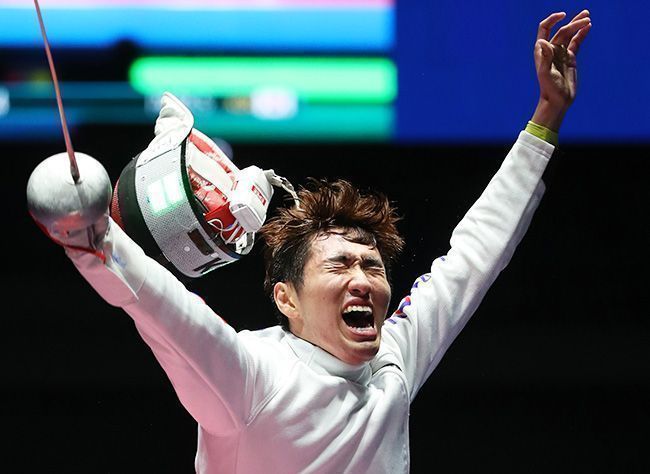
South Korean fencer Park Sang-young reacts after winning the final of the men’s epee event against Geza Imre of Hungary at the Carioca Arena 3 in Rio de Janeiro, Tuesday. / Yonhap
By Baek Byung-yeul
South Korean fencer Park Sang-young won the country’s first-ever gold medal in the men’s individual epee, Tuesday.
At Carioca Arena 3 in Rio, Park defeated the world No.3 Geza Imre of Hungary 15-14 for South Korea’s third Rio Olympics gold and the only medal on day 4 of the Games.
Park, the youngest competitor in the event at age 20, was losing against the 41-year-old Imre by 10-14 when he pulled off a wild comeback, succeeding to score five consecutive points.
In fencing, there are three different weapons — epee, sabre and foil — with each one having its own rules. Among them, epee fencers can hit their opponents anywhere from head to toe.
Park defeated No.2 Enrico Garozzo of Italy in the round of 16. He advanced to the final after wins over Max Heinzer of Switzerland (No.10) in the quarterfinal and Benjamin Steffen of Switzerland (No.13) in the semifinal.
The world No.21 said he hadn’t even thought about trying to win a gold medal.
“I wasn’t even thinking about trying to win a gold medal,” Park said. “Since this is the festival for everyone, I wanted to enjoy myself. When will I ever compete at theOlympics again? I didn’t want to have any regrets, and I think it showed.”
Park was an up-and-coming fencer, being ranked third globally, and was considered a strong medal contender in Rio until March last year when he had a serious knee injury. Making his return last December, he didn’t have much time to prepare for the Rio Olympics, but he never gave up on his dream to compete in them.
“It was very hard for me to recover from my injury. I kept thinking about the Olympics and taking part in it. That’s what got me back on track,” Park said.
Despite the loss, Imre became the second-oldest fencer to win an Olympic individual medal following Aladar Gurevich of Hungary, who won the silver in the men’s sabre at the age of 42 at the 1952 Olympics.
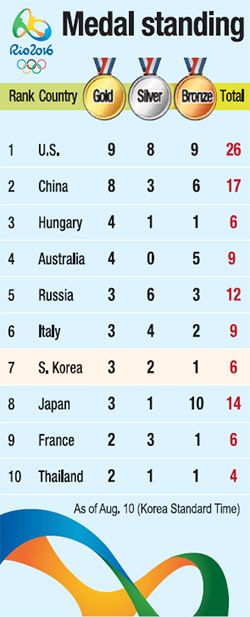
Thanks to Park’s gold, South Korea is ranked seventh in the medal standing with three gold, two silver and one bronze. The United States continues to lead with nine gold, eight silver and nine bronze, followed by China with eight gold, three silver and six bronze, and Hungary with four gold, one silver and one bronze.
Park’s gold also ended South Korea’s fencing medal drought. The South Korean fencers were expected to perform strongly in Brazil as they had clinched six medals at the 2012 London Olympics, including two gold.
In other events, shooter Kim Jang-mi, the 2012 Olympic champion in the women’s 25-meter pistol, placed ninth in the qualification round, missing the final by one spot.
Swimmer Park Tae-hwan, who already missed the finals of the 200- and 400-meter freestyle, failed again to advance to the semifinals of the 100 meters after posting a time of 49.24 seconds to place 32nd among 59 swimmers.
When asked about his future, Park denied speculation about retirement and said that he would like to seek another chance at the Tokyo Olympics in 2020, the year he will turn 30.
In archery, Lee Seung-yun and Chang Hye-jin both advanced to the round of 16 in the men’s and women’s individual event. Chang is drawing attention in Rio for the upcoming first match between South and North Korea. She will take on North Korea’s Kang Un-ju in the next round, Thursday night.
South Korean judokas suffered early exits again as Lee Seung-su was eliminated in the round of 16 in the men’s 81kg, falling to Bulgaria’s Ivaylo Ivanov, and Bak Ji-yun was knocked out in the round of 32.
South Korea had three top-ranking judoka — An Ba-ul in the men’s 66-kg, Kim Won-jin in the men’s 60-kg and An Chang-rim in the men’s 73-kg class, but only garnered one silver medal from An Ba-ul, Monday.