Cupping therapy in the limelight
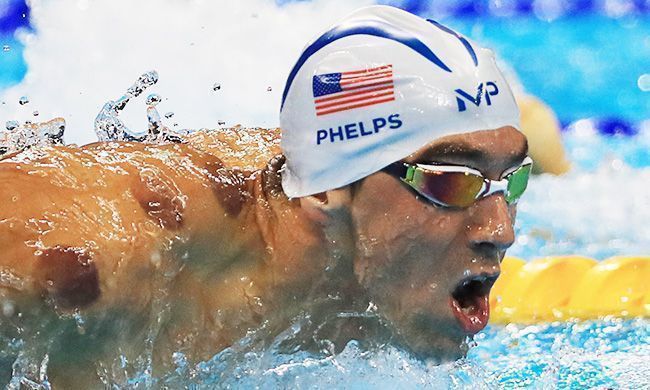
Purple marks from cupping are conspicuous on the shoulder of U.S. swimmer Michael Phelps during a swimming competition at the 2016 Rio Games, Monday (KST). /AP-Yonhap
By Choi Ha-young
Some round purple marks on the shoulder of U.S. swimmer Michael Phelps made headlines when the athletic superstar bagged his 19th Olympic gold medal at the Rio Olympics, Monday (KST).
“The trainer hit me pretty hard with one and left a couple of bruises,” Phelps jokingly said after the competition.
Those were marks of “cupping,” the traditional Oriental treatment, which Phelps is known to have used from for years.
This treatment is common in Korea and other Asian countries, where it is used as a way to help relax muscles and ease soreness.
Practitioners put cups on a patient’s skin and create a mechanical vacuum.
Sometimes, the cups are heated and placed on the skin. As they cool down, the air inside the cup contracts to make a negative pressure.
This Oriental treatment is widely used in Western countries and enjoyed by athletes including U.S. gymnast Alex Naddour and Belarusian swimmer Pavel Sankovich.
“That’s where I hurt the most,” Phelps told reporters after the competition. “I have done it for awhile but I haven’t had bad ones (marks) like this awhile though.”
Although the medical community has been unable to find evidence of health benefits of cupping, the treatment aims to resolve “bold stasis.” It refers to the status that blood or qi is not properly circulating due to blockages or other causes.
“It’s like unclogging the clogged sewer,” Lee Sung-hun, who runs the U.N. Oriental Medical Clinic in Seoul, told The Korea Times. “If medical painkillers conceal the pain temporarily, cupping relieves muscle pain immediately.”
There are various types of cupping. Dry cupping simply applies negative pressure on the skin while wet cupping is a form of bloodletting in which incisions are made in the skin so the vacuum will draw blood out of the patient.
Lee claimed cupping is a safe treatment for athletes as well as ordinary people without side effects. “While acupuncture requires sophisticated application on the exact spot, cupping is applied for broader spots. However, it’s recommended to visit a professional Oriental medicine practitioner.”
The Korean Oriental medicine community recommends cupping and acupuncture as “doping-free therapies,” to attract the international sports community.
A Korean Oriental treatment clinic was set up at last year’s Gwangju Summer Universiade. During the event, 532 athletes from 100 countries visited the clinic, mainly for acupuncture on their ankles, knees and waists to relieve pain.
In the 2014 Incheon Asian Games, the Olympic Council of Asia endorsed the Oriental treatment for the first time. The 2017 Taipei Universiad and 2020 Tokyo Olympics are also considering establishing Oriental medicine centers.
“As medical experts in international sports communities are usually medical doctors, it’s true that they are unsure about Korean Oriental medicine,” Kim Ji-ho, PR director of the Association of Korean Medicine (AKOM), told The Korea Times. The association is gearing up to be officially endorsed by the International Olympic Committee for the upcoming 2018 PyeongChang Winter Games.