Jeongseon course finishes showcase 'successfully'
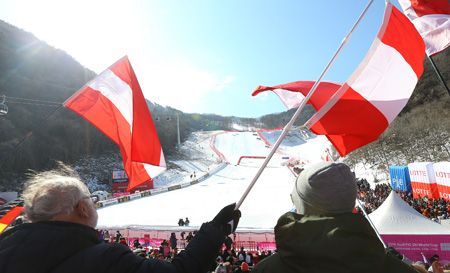
Crowds cheer before a men’s World Cup downhill race, also a test event for the PyeongChang 2018 Winter Olympics, at the Jeongseon Alpine Centre in Jeongseon, Korea, Saturday. / Yonhap
Debate over keeping new course after Olympics to spark
By Nam Hyun-woo
JEONGSEON, Gangwon Province -- The new downhill and Super-G course for the PyeongChang Olympics has finished its showcase event before the Winter Games to come in two years.
After hosting the two-day Audi FIS (International Ski Federation) Ski World Cup this past weekend as the first of 28 Olympic and Paralympic tests, PyeongChang organizers are satisfied with the “success” of the first test event and with the course, which is 60 percent completed, a fact that has dogged them with the slow progress of the construction.
After the first day’s downhill race, Gunilla Lindberg, the International Olympic Committee’s coordination commission chair, said, “I should give the event 100 points (out of 100 for the first day of competition).” Though her remark was deemed rhetorical, this came as a reward for the organizers who had worked hard getting the course ready, as well as giving the grim-faced PyeongChang chief organizer Cho Yang-ho a rare, huge smile.
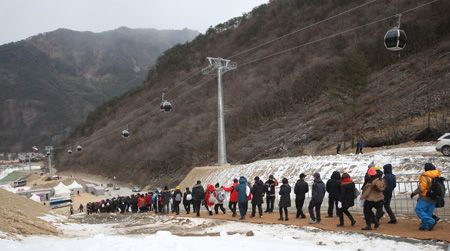
Crowds walk down a steep heel to leave the Jeongseon Alpine Center in Jeongseon, Korea, after a men’s World Cup downhill race, Saturday. / Yonhap
Building this course, Jeongseon Alpine Center, has been full of doubt from the beginning. In setting the location a few years ago, the organizers and Gangwon Province decided on the middle hill of Mount Gariwang near the remote town of Jinbu, given its contour. However, they faced severe opposition from local environmentalists over the plan of cutting through the middle of a virgin forest on the mountain to build a one-off ski course that is not even open to the public.
The uproar was soothed only after Gangwon Province agreed with the environmentalists that they would restore the area to its natural state, as well as replant the trees that were cut down during construction.
Thus, unlike other ski courses, Jeongseon Alpine Center is a competition-only venue and does not have adjacent resorts meaning it has no accommodation, no restaurants and other amenities within walking distance and is some 30-40 minutes driving time from the Alpensia resort in PyeongChang.
The already delayed construction faced another setback last year as heavy rains slowed down construction of the gondola lift. Due to the rainfall, the foundation of a pillar for the lift was built in the wrong place which forced the organizers to rebuild it. Then the weather caused more problems. The unseasonably warm weather hampered the organizers from making snow, with the slope remaining green even a month before the test event. Despite this, the organizers managed to complete the gondola lift for the athletes just last month in the nick of time.
Due to this, spectators, mostly from Gangwon Province, had to hike some 500 meters up the mountain to get to the finish line. But this seemingly caused no problem for them.
“You don’t really have a chance to enjoy this kind of ski event in Korea,” said Kim Won-jong from Gangneung, a sub-host city for the 2018 Games. “Worth the effort, worth the effort,” he said.
Before the races were started, traditional percussion music and dance performances were held. Whether this was the intention to blend Korea’s traditional and original taste into a European-dominated event or the idea of the local government, as they usually do so to celebrate at the beginning of a local festivity, it provided a unique scene and local flavor to this European-dominated international sports event. There were even cheerleaders.
Boosting interest in skiing in Korea
Despite the logs of the downed trees still scattered on the sidelines of the course, and the clamor about restoring Korea’s only alpine speed venue back to the state of nature after the Games, voices for keeping the new course after the Olympics as a legacy are getting louder, as Gangwon Province gets into the Olympic mood with the start of the first test event.
On Saturday, chief organizer Cho told reporters that it was a moment when the PyeongChang organizers’ “vision to expand new horizons of winter sports (in Korea) is being realized.” The organizers have long said that building Olympic venues will be a legacy for Korea where there are not many winter sports facilities, resulting in its skiers naturally being underdogs at international ski competitions.
FIS President Gian-Franco Kasper also said that “I dream of some kind of a tour of World Cup downhills in Asia. We have many downhill courses in Japan and we finally have one in Korea and very soon we will have one in China. That will be an ideal World Cup tour in the future and I really hope that it will be possible to have that in few years.”
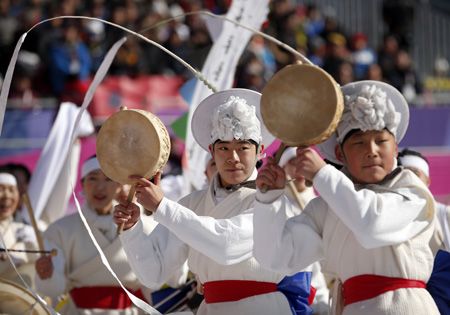
Korean drummers and dancers perform before the start of a men’s World Cup super-G race, also a test event for the Pyeongchang 2018 Winter Olympics, at the Jeongseon Alpine Centre in Jeongseon, South Korea, Sunday. / AP-Yonhap
Though it is slow, the “Olympic effect” is affecting the Korean sports community. On Saturday, Kim Hyeon-tae made his debut to World Cup Super-G racing. Kim specializes in alpine technical (slalom and giant slalom), but competed in Super-G. Also the Korea Ski Association established an alpine speed national team last year.
And this effort is also welcomed by international peers. Christof Innerhofer, the 2014 Sochi Olympics silver medalist in downhill and bronze medalist in combined, told the Associated Press that “I’m sure it’s a big opportunity for the Korean people to gain more passion for skiing, to train and nurture more athletes. That must be one of the goals of hosting the Olympic Games in new countries -- to have more countries that follow the sport.”
Another question, though, is the amount of money it will require to restore the venue. Gangwon Governor Choi Moon-soon said it will be difficult to “restore the area 100 percent.” The organizing committee and Gangwon Province will conduct a feasibility study that will continue until the end of next year.