IT'S GOOD FOR YOUR GAME

This pitch of about 25 yards requires a high, soft trajectory with lots of wrist cock and a full but slow, low-power body turn. At the finish, I’m facing the target just like a full-power swing.
Difference between a chip and a pitch
Surprising as it sounds, many golfers don't know when to pitch and when to chip. They're two different shots with different techniques, and knowing when to use each can lower your scores.
Arnold Palmer was a very good chipper, but a poor pitcher of the ball; in his early career, Jack Nicklaus was just the opposite. It's quite possible that you also are better at one technique than the other and should use the technique you perform best whenever feasible.
Think of the pitch shot as the air route to the flag, while the chip travels mostly on the ground. Since it's easier to judge a rolling ball than a high-flier, you should chip the ball if you're within six paces of the green. If you're more than six paces from the green and there's trouble, such as rough, between you and the green, pitch the ball.
Once you know how to chip and pitch, you'll be able to tell which technique to use quite easily, but remember that 6 yards is a general guideline. You might chip from 30 yards (with nothing between you and the hole), and sometimes you'll pitch from 3 yards (when your ball is buried deep in the Bermuda grass).
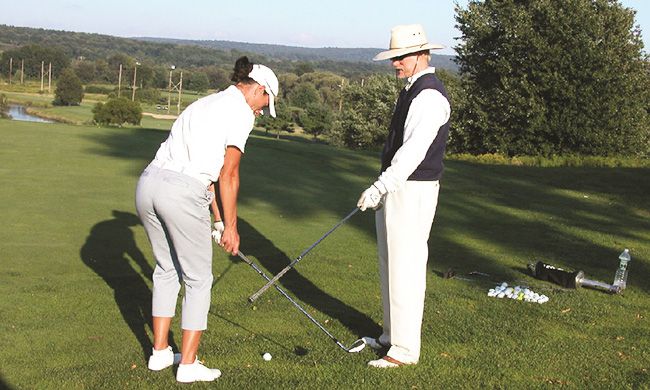
This player is using a 7-iron for this chip, so she keeps the clubhead low and runs the ball. To ensure that she accelerates crisply, I’m restricting the length of her backswing.
The pitch
Choose your most lofted club for pitch shots. No matter how long the pitch, always line up the butt end of the club with the center of your body at address. Not only does this maintain proper loft on the clubface, but it also gives you a simple goal while you swing: Keep the butt in the center of the body.
When you pitch, the body turns and the wrists cock, just like in the full swing. The amount of weight shift and knee action depend on the length of the shot, and it's something you learn through practice. Your ball position moves back of center for low-flying pitches, middle for normal height, and forward, off your front heel, for the lob shot.
The chip
When you chip, you change clubs the same way you do in your full swing, and with practice, you'll be able to eyeball the distance and choose the right club, say a 5-iron for a long run and a 9 for a short one. Pick a landing area about 1 yard onto the green where you want your chip to land. This way, every chip you hit flies a short distance, lands about a yard on the green, then rolls to the hole like a putt.
When you putt, you keep your body still and simply move your arms and shoulders with no wrist action, and it's the same with the chip. Position the ball off your back heel with the shaft vertical and inclined toward your front shoulder; keep your weight anchored on your front foot and use only your arms and shoulders to move the club.