PyeongChang Olympics will create once-in-a-lifetime memories
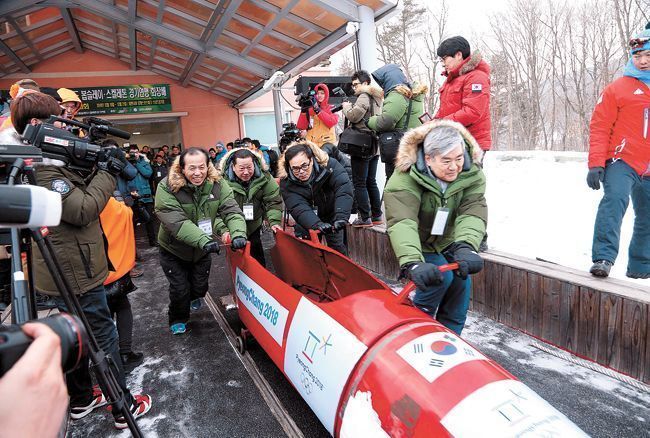
POCOG President Cho Yang-ho, right, pushes a bobsled during an event marking the three-year countdown to the 2018 Winter Olympics in PyeongChang on Feb. 9, 2015. From left are Gangwon Province Gov. Choi Moon-soon, Korean Olympic Committee President Kim Jung-haeng and Culture, Sports and Tourism Second Vice Minister Kim Jong. / Yonhap
.jpg)
By Cho Yang-ho
President of the PyeongChang Organizing Committee for the 2018 Olympic & Paralympic Winter Games
I can still vividly recall the steps we took to win the right to host the 2018 PyeongChang Olympic Games as if it were yesterday. After three attempts, we finally achieved the “miracle of PyeongChang.” I cannot forget our excitement as the world took notice.
Hosting the PyeongChang Olympic Games has a special significance for Korea. It will have been 30 years since the country last hosted the world’s greatest sporting event ― the 1988 Summer Olympics in Seoul. The 1988 games highlighted Korea’s growth, and the PyeongChang Games would be another priceless opportunity for the country to promote its achievements to the world.
Successfully hosting the PyeongChang Games will also help Korea join the ranks of sports powerhouses; the country would be one of a handful to host the so-called “sports grand slam” or four major international sporting events ― the 1988 Summer Games, the 2002 World Cup, the 2011 World Championships in Athletics and the 2018 Winter Games. Only five countries in the world have achieved such a feat so far. Korea will be the sixth to do so and it would give the country greater credibility.
The Winter Olympics will result in the establishment of world-class sports stadiums and operating systems and accumulation of experience and know-how in successfully organizing international sporting events, all of which will be part of Korea’s valuable assets.
Our plans for the Olympics are gradually being realized. As our preparations progress, my faith and confidence that hosting the games will bring political, economic, social and cultural paradigm shifts are reaffirmed.
The success of the Olympics hinges, in part, on how much economic effect it would create. As the president of the PyeongChang Organizing Committee for the 2018 Olympic and Paralympic Winter Games, my priority is to stage an economically beneficial and efficient Olympics. But at the same time, I believe the true economic effect is not only quantified into hard numbers but also assessed by potential value.
I believe the biggest economic effect of the PyeongChang Games is making Korea one of the world’s premier tourist destinations by improving our “hardware” or tourism-related infrastructure, such as hotels and restaurants, and our “software” or our awareness and attitudes, such as with regard to cleanliness and friendliness. If PyeongChang makes the list of the top 20 tourist destinations in the world, I would say the Olympics is a success. My primary responsibility is to turn PyeongChang and Gangwon Province into a sustainable legacy for Korea.
The world is relying on Korea to make the PyeongChang Games successful, especially in terms of information technology (IT). The PyeongChang Games will provide visitors with state-of-the-art IT services, hopefully the best in the history of international sporting events. The world’s fastest fifth-generation mobile network and Internet of Things services will be available throughout the event, offering unprecedented access to the games not only to Olympians but to people around the world.
The 1988 Summer Olympics has produced significant economic benefits to Korea. By hosting the Seoul Games, Korea Inc. has made the world aware of its capabilities and of the so-called “Made-in-Korea” products. The successful hosting of the games was also followed by a slew of ties and pacts with Russia and other Eastern European countries, which later helped Korea become one of the world’s economic powerhouses.
Thus, an international sporting event not only elevates the host’s status in the international society but also contributes significantly to its economic growth. The economic impact of the PyeongChang Games will be enormous. With the unified support of the Korean people, I believe the games will leave an indelible mark on Korea’s economic history in the 21st century.
The Olympics provides a stage for a global celebration. The prestigious event will be an opportunity not only to showcase the culture and humanity of PyeongChang and Korea to the world but also for the world to celebrate camaraderie and sportsmanship. We must show Korea’s unique culture through the PyeongChang Olympics.
Last September, during the celebration of the 130th anniversary of the establishment of the diplomatic relations between Korea and France, the people of France expressed their sincere appreciation and admiration of Korea’s royal ancestral rituals and other traditional performances that represent Korea’s spirit and values. This example illustrates the power of cultural exchange.
In addition, it made me realize that the PyeongChang Olympics needs to become a cultural event as well. We need to create a cultural legacy through an upgraded cultural program comprised of traditional ingenuity and globalized qualities. Through various cultural and artistic performances, we can touch the hearts of people around the world and encourage them to interact with and understand each other. I am confident that the PyeongChang Games will be one of the most successful editions when the spirits of determination and creativity are combined with Korea’s unique cultural heritage.
The 1988 Seoul Olympics imprinted Korea in the hearts and minds of people around the world. The PyeongChang Games will be the “completion of Olympics in Korea,” promote the country’s brand value and advance winter sports in Asia. Moreover, it will lay the grounds for Korea’s great leap forward in the next decade.
I can already hear the roars of the crowds in PyeongChang. I look forward to the day when PyeongChang gives everyone once-in-a-lifetime memories they will forever treasure.
The writer is President of the PyeongChang Organizing Committee for the 2018 Olympic & Paralympic Winter Games. Translated by Nam Hyun-woo.