IT'S GOOD FOR YOUR GAME
Balancing act
When you swing a golf club, a force is exerted on your body that can cause you to lose your balance. To withstand these forces at high speeds (long hitters swing the clubhead more than 120 mph), you must be in perfect balance, both before and during your swing.
To establish proper balance at address, it's important to stick your fanny up and out behind you because, as your swing reaches maximum speed, your posterior acts as an anchor that allows your arms to swing at full force on a constant arc. As you assume the address position, imagine that you are about to sit on a high bar stool, and make sure that your rump is well behind your heels. In addition to better balance, you'll gain the benefit of a straight spine, which gives you a true axis to swing around.
In the proper position, you'll be in the same posture all great athletes assume for action ― a quarterback waiting for a snap, a basketball player preparing for a free throw, a shortstop ready for a grounder. The muscles of your thighs are taut, but not tense, and if you needed to, you could jump without repositioning your weight.
But setting your derriere in the correct position is not enough. For great dynamic balance, you must also create proper weight distribution. Your weight should be distributed from the balls of both feet back along the arch and through to the heel, with the majority between the ball and arch.
You also should be in a knock-kneed position, with your weight on the inner rim of both feet and the knees slightly inclined inward. This gives an inward pinch to all your force that provides maximum stabilization.
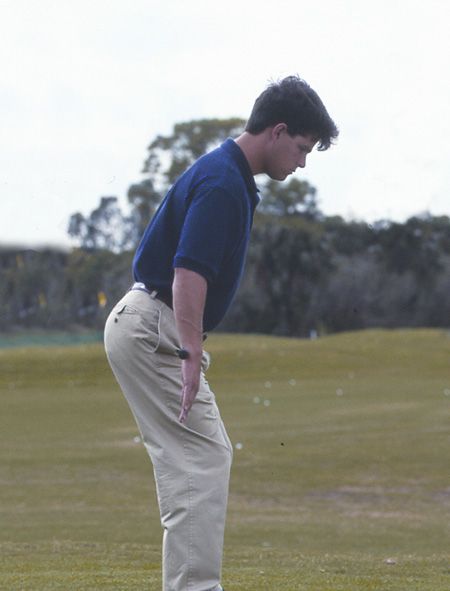
To help get the feel of good balance, assume your address position, then take the club you’re using, lay it across your pelvis and simply push on it until your fanny protrudes. From knee to foot, the leg is perpendicular with the ground, and your back is straight.
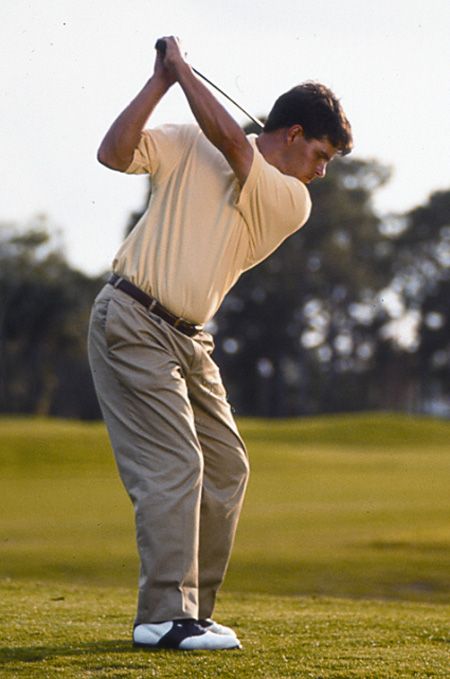
Here’s the same player (different shirt) in perfect dynamic balance at the top of his swing, with his fanny counterbalancing his head. The lines show that he’s kept the geometry of his address position.