Fires, rescues — and hornet's nests? Korean firefighters face growing burden
Summary
A Seoul firefighter said hornet nest removals are becoming a growing burden in Korea as calls rise in urban areas. Seoul firefighters handled 2,913 hornet nest removal calls in June, up about 71 percent from a year earlier. Nationwide, annual hornet nest removal operations rose from 133,131 in 2020 to 225,120 last year, and they made up 28 percent of all rescue operations. Firefighters and a professor warned the workload can delay responses to fires and life-threatening emergencies.
Key Facts
- The Seoul Metropolitan Fire and Disaster Headquarters said firefighters responded to 2,913 hornet nest removal calls across Seoul in June.
- That Seoul figure was up about 71 percent from the same month last year.
- The annual number of hornet nest removal operations nationwide rose from 133,131 in 2020 to 225,120 last year.
- Hornet nest removals accounted for 28 percent of all 808,100 rescue operations carried out by firefighters nationwide last year.
- The article says the yellow-legged hornet is an invasive species native to subtropical regions and is believed to have entered Korea through the port of Busan from China in 2003.

A firefighter removes a hornet's nest from a residential area in Sinsa-dong, Eunpyeong District, Seoul, July 21. Courtesy of Seoul Metropolitan Fire & Disaster Headquarters
A Seoul firefighter surnamed Lee, 33, has good reason to dread hornets.
Earlier this month, while removing a hornet's nest in a residential neighborhood, he was stung on the ring finger of his right hand. At first, it felt like a leaf lightly brushing against his skin. But the pain soon became so severe that he could barely tolerate it unless he kept his finger submerged in ice water.
"As hornet's nest removal calls increase, the burden on firefighters in the field is also growing," Lee said. "The hornets seem to have become even more aggressive."
Removing hornet's nests has long been a routine part of firefighters' work in Korea, but a growing hornet population in urban areas is placing an increasingly heavy burden on emergency crews.
According to the Seoul Metropolitan Fire & Disaster Headquarters on Friday, firefighters responded to 2,913 hornet nest removal calls across Seoul in June, up about 71 percent from the same month last year.
The trend is also evident nationwide. According to the 2026 Fire Statistical Yearbook, the annual number of hornet's nest removal operations rose from 133,131 in 2020 to 225,120 last year, nearly doubling in five years.
Hornet's nest removals accounted for 28 percent of all 808,100 rescue operations carried out by firefighters nationwide last year.
Firefighters say the yellow-legged hornet, an invasive species native to subtropical regions, has become particularly common amid increasingly severe heat waves. The species is believed to have entered Korea through the port of Busan from China in 2003.
Yellow-legged hornets have highly potent venom and can aggressively attack people in groups. Unlike Asian giant hornets, which typically build their nests in mountainous areas, yellow-legged hornets often establish colonies under the eaves of apartment buildings and houses, bringing them into frequent contact with people in cities.
A lodging operator, surnamed Lee, discovered a yellow-legged hornet nest inside a ventilation duct while cleaning his property in Seoul's Seongdong District earlier this month.
He initially thought the buzzing noise indicated a mechanical problem and opened the vent, only to be startled by the nest inside.
"I never expected to find a hornet nest in a residential neighborhood rather than in the mountains," Lee said. "I immediately called the fire department, and they removed it."
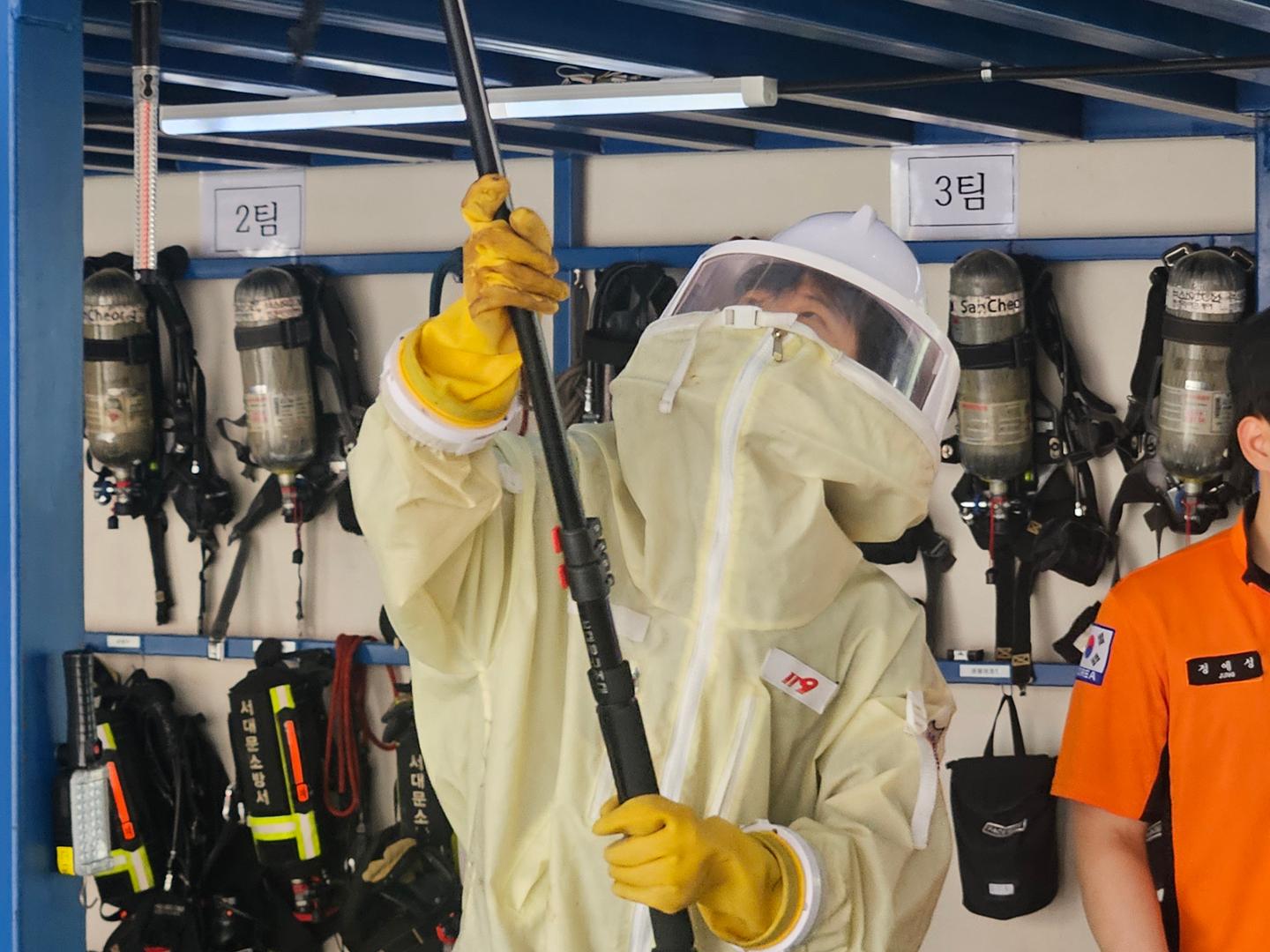
Hankook Ilbo reporter Gong Byung-sun wears protective gear and a helmet while taking part in a hornet's nest removal exercise at Seodaemun Fire Station in Seoul, Aug. 20. Korea Times photo by Gong Byung-sun
The rapidly growing workload is taking a physical toll on firefighters, who can receive as many as 10 hornet-related calls a day.
To avoid being stung while removing nests, firefighters must wear thick protective suits and large helmets. The equipment provides virtually no ventilation, making the work particularly exhausting during Korea's hot and humid summer.
This reporter tried on the protective suit and helmet and was soaked in sweat in less than five minutes. The heat and restricted airflow made breathing difficult and even caused dizziness.
"Firefighters generally don't fall behind anyone when it comes to physical fitness, but after removing a hornet's nest, we're sometimes so exhausted that it affects our ability to respond to the next call," said a 29-year-old firefighter surnamed Jeong.
Firefighters are also concerned that the surge in hornet's nest removal calls could interfere with their ability to respond quickly to fires and life-threatening rescue emergencies.
"It's common for us to be sent directly to a fire or rescue operation after handling a hornet's nest," Song, a 34-year-old firefighter, said. "We keep firefighting equipment in the fire truck in advance, but it is true that we arrive later than we would if we were dispatched directly from the fire station."
Yeom Geon-woong, a professor of police and fire administration at U1 University, said the current system is overloading fire departments by requiring them to respond to virtually every hornet's nest report.
"Fire departments have reached a state of overload because they are handling all hornet's nest removal calls," Yeom said. "Cases should be classified according to the level of danger to human life, with firefighters responding to serious situations while other cases are handled through a separate public safety system."
This article from the Hankook Ilbo, the sister publication of The Korea Times, was translated by a generative AI system and edited by The Korea Times.
Explore More
- Q.
- Q.
- Q.