Hangeul education for multicultural children emerges as urgent priority
Summary
Multicultural children in Korea are facing growing Hangeul literacy gaps that can hinder schoolwork, daily life and relationships. Han Seo-yeon and Kim Tae-hee made rapid progress after receiving targeted Korean-language instruction through schools and support centers. The number of multicultural students reached 202,208 last year, up 37 percent from 2020. Experts and officials are calling for earlier, customized literacy education within the public school system.
Key Facts
- Multicultural students accounted for 4 percent of all elementary, middle and high school students nationwide last year.
- Han Seo-yeon learned to read Hangeul after moving from China to Korea last July and receiving lessons at South-North Love School and reading-comprehension classes from Friends of Hope.
- Kim Tae-hee mastered most of Hangeul within six months after Joy Center joined a literacy program, although some final consonants remained difficult.
- Schools where multicultural students make up more than 30 percent of enrollment are required to open Korean-language classes.
- The Ministry of Education plans to expand intensive Korean-language courses through local universities and regional government agencies and broaden access to the AI-based Korean for Everyone program.
Learning to communicate in Korean crucial to happiness, stability of children from multicultural backgrounds: experts

Han Seo-yeon speaks during an interview with the Hankook Ilbo at South-North Love School in Seoul’s Guro District, March 27. Photo by Kang Je-jin
“Now I can study on my own,” 10-year-old Han Seo-yeon said, beaming proudly.
A student at South-North Love School, an alternative school in Seoul’s Guro District, Han then opened a Korean language textbook and read aloud in a clear voice without hesitation. Her textbook page was filled with "red circles" marking right answers to many questions requiring comphrension of long passages correctly.
She still finds grammar bit tricky, but when it comes to writing simple sentences, she can do it with ease. As she explained how much her Hangeul had improved, a proud smile spread across her face.
Han is a child from an immigrant background who lived in China with her Chinese-Korean parents until she came to Korea last July. Back then, she could not read Hangeul, but thanks to Hangeul lessons at school and reading comprehension classes provided by the NGO Friends of Hope, she has now fully mastered the letters of the Korean alphabet. Her growing confidence among friends at school has been a bonus.
“I was sad and frustrated at first because I couldn’t read signs, textbooks or exam papers,” Han said.“Double final consonants are still a bit hard, but I’m happy that I can now read all the words.”
Park Mi-sook, a 56-year-old teacher at South-North Love School, said Han seemed withdrawn at first because she could not keep up with classes, but became increasingly bright and confident as she started learning Hangeul.

Han Seo-yeon shows a Hangeul literacy workbook. Courtesy of Kang Je-jin
Korea is considered a country that has effectively eradicated illiteracy, with its illiteracy rate below 1 percent and related statistical surveys discontinued. But as multicultural families increase, literacy gaps among children from migrant backgrounds — who often struggle to learn Hangeul at home — are emerging as a new social issue.
According to Ministry of Education data, the number of multicultural students attending elementary, middle and high schools nationwide reached 202,208 last year, accounting for 4 percent of all students. That was up 37 percent from 147,378 in 2020.
Without basic literacy skills, children can fall progressively behind in school and struggle in everyday life and social relationships, making swift intervention at an early age crucial, experts said.

Han Seo-yeon’s gratitude journal from March. Although she still makes occasional spelling mistakes, she is now able to write simple sentences on her own. Courtesy of Kim Na-yeon
A telling example of the efficiency of early literacy education is Kim Tae-hee, an 8-year-old with a Vietnamese mother and Korean father. Despite being born in Korea, she wasn't able to read Hangeul until the first semester of first grade a year ago.
Her Korean lessons began after Joy Center, the migrant support center where she had been receiving support, was selected for a literacy program. Within six months, she had mastered most of Hangeul, with only a few final consonants still posing difficulty.
“I can now read the names of products at Daiso,” Tae-hee said with a smile.
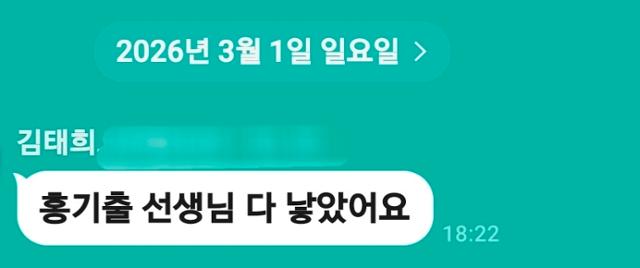
A message Kim Tae-hee sent to Hong Gi-chul, head of external relations at Gimhae Joy Center, saying she was feeling better after being ill. Hong said Kim’s spelling was not perfect, but her literacy had improved quickly enough for her to communicate in writing. Courtesy of Hong Gi-chul
Hong Gi-chul, an external affairs manager at Joy Center, recalled being surprised when he received a text message from Tae-hee, despite a few grammatical errors.
“She wrote, ‘I’m fully recovered.’ It was a pleasant surprise to see her send a text message, knowing that she used to feel stressed just looking at letters,” Hong said.
According to the NGO Korea Food for the Hungry International (KFHI), ages 7 to 9 are a crucial period for children to develop literacy skills through education. Both Han and Kim began learning Hangeul at that age.
“Children from immigrant backgrounds tend to be in environments that put them at a disadvantage in learning to read. But once they are given proper education, they tend to learn very quickly, sometimes leading to dramatic changes,” said Yoo Gi-won, a staff member on KFHI’s domestic project team.
The government has also taken steps to address the issue. It has supported Korean language programs at local community centers and required schools where students from multicultural backgrounds account for more than 30 percent of enrollment to open Korean language classes. But budget disparities between regions are hampering the effort, and providing tailored education suited to each student is proving difficult.
“It is true that basic infrastructure for providing this kind of education remains insufficient,” a Ministry of Education official said. “The ministry plans to expand educational opportunities by designating local universities and regional government agencies as sites for intensive Korean-language courses.”
The ministry also announced that it will bolster online Korean-language education opportunities by simplifying the sign-up process for “Korean for Everyone,” an AI-based Korean learning program, and expanding eligibility for the courses.

Han Seo-yeon shows the Hangeul literacy workbook she used in her studies. After learning to read Hangeul, she became able to answer even questions that required understanding long passages. Courtesy of Kang Je-jin
Experts further noted the importance of a structured education program to foster basic reading comprehension skills within the regular public education curriculum. Ahn Sung-hee, an education professor at Hongik University, said language serves not only as a tool for communication but also as the basis for understanding school life, culture and relationships with peers.
“Children who struggle with literacy skills face difficulty adapting to classes and building relationships with peers, which can lead to a lack of self-confidence,” he said.
“And with much of Hangeul education left in the hands of alternative schools or local community centers, the level of support given to children in need is often decided by how aware their parents are. Language learning support must be provided within the public education framework.”
Another matter in need of attention is the establishment of language support programs for students from multicultural backgrounds who enter Korea during adolescence, as they face even greater difficulty learning Korean language skills.
“We need to build a customized education system based on age and learning stage, and teach students by distinguishing between ‘everyday language’ needed for daily conversation and ‘academic language’ needed to read textbooks and interpret questions,” said Kim Hee-joo, a professor of social welfare at Hyupsung University.
She added that support programs and policies, which remain divided between the Ministry of Education and the Gender Equality and Family Ministry, also need to be brought under a single organization.
This article from the Hankookilbo, the sister publication of The Korea Times, is translated by a generative AI system and edited by The Korea Times.
Explore More
- Q.
- Q.
- Q.