Say “That’s not my job” and you may be out: AI ushers in age of voluntary overwork
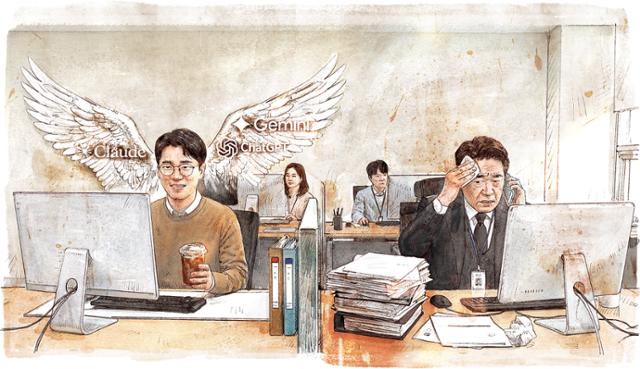
Illustration showing the diverging paths of office workers in the age of artificial intelligence (AI): those who use AI tools in their workflows gain a wing-like boost in productivity, while those who remain tied to conventional methods struggle under expanding workloads. Illustration by Shin Dong-jun
Nam Dong-deuk, 42, a 15-year veteran at his company, sat at his desk and turned on his computer. As his fingers moved across the keyboard and his eyes darted between the monitors, he looked as if he were casually chatting with a colleague.
Ninety minutes later, he leaned back with a relaxed smile, like a student relieved to have finished his homework. In that time, he had created an artificial intelligence (AI) chatbot that could answer coworkers’ questions on the company’s internal messenger, from how to use vacation days to how to spend company reward points, using information drawn from internal manuals.
Nam is not a seasoned developer fluent in code. A business administration major who has worked at both large corporations and startups, he is now an HR manager at an online commerce platform. The reason he was able to build the chatbot in under two hours, he said, was “vibe coding.”
Nam described vibe coding as a way to create software simply by telling AI what function is needed, instead of learning complex programming languages.
Employees in each department can build the programs they need on their own, rather than relying on a development, he said. The approach can dramatically cut the time spent on repetitive work.
“When employees have a question, they usually send a message to HR through the company’s internal messenger. Most of them are simple, repetitive requests, such as how to obtain a certificate of employment. I was spending too much time answering the same questions over and over,” Nam said.
“So I decided to build the chatbot myself. If I had asked the development team, I had no idea when my turn would come.”
Some might wonder why an HR manager would bother with this kind of work. Nam sees it differently.
“The boundaries between roles are disappearing,” he said.
At a time when AI is moving rapidly into offices and anxiety is spreading among workers who fear they could be replaced by machines, Nam believes the answer lies in broadening his professional identity.
HR is often seen as one of the fields most vulnerable to replacement by AI, since much of the work — screening resumes, calculating payroll and explaining internal regulations — consists of repetitive tasks carried out according to set guidelines.
Nam, however, is restructuring his own job around that reality. By automating repetitive tasks, he is trying to focus his energy on what he considers more essential work, such as redesigning HR systems to match different stages of a company’s growth.

gettyimagesbank
AI lowers job barriers, making flexibility a matter of survival
Expanding the scope of one’s role has become one way for office workers to ensure their survival. As AI begins handling work once done by humans faster and more efficiently, saying “that’s not my responsibility” no longer works as an excuse.
In 2023, the World Economic Forum predicted that AI would reshape up to a quarter of existing jobs within five years. Workers, then, are being pushed to find roles they can perform better with the help of AI.
Nam Yeon-ji, an 11-year office worker who asked to be identified by a pseudonym, is adapting quickly to that shift. A product manager responsible for service planning, he now also handles simple development and design tasks.
When preparing a new service, for example, he builds prototypes himself using vibe coding. What once took an entire day of back-and-forth with developers and designers can now be done in just an hour.
He said a friend of his, a developer at a startup with about 20 employees, also handles work that would traditionally fall to a junior designer.
“More jobs in the future will require people to play multiple roles at once, especially in smaller organizations,” he said.
His way of working is fast becoming a new norm in office life. Experts say the concept of a lifelong workplace vanished long ago, and now even the idea of a lifelong job is beginning to disappear. The position someone starts out with may change two or three times over the coming decade.
“From now on, only those who have the insight to identify problems within an organization and the ability to solve them will survive,” said Lee Jung-hak, a business administration professor at Dongguk University and HR adviser to major Korean conglomerates including Samsung, LG and GS.
“Overseas, it is already not uncommon to see a single freelancer equipped with the business sense to handle everything from public relations and negotiations to market development and client management, while taking on several projects at once,” he said.

Kim Kyung-soo, chair of the Presidential Committee for Decentralization and Balanced Development, delivers congratulatory remarks at the launch ceremony of the Industrial Complex AX division at Changwon National University in Changwon, South Gyeongsang Province, Feb. 26. Yonhap
Office workers who are not used to taking on broader roles may face a harsher reality.
“AX, or artificial intelligence transformation, is ultimately aimed at cutting costs by reducing positions deemed replaceable,” said an employee in charge of AX initiatives at one of South Korea’s five largest conglomerates.
“But because companies here cannot lay off regular workers as easily as in the United States, some of the staff affected by restructuring are being reassigned to positions far removed from their original roles.”
That could mean, for example, sending a developer to a sales post outside Seoul.
Midlevel workers have the edge
Some workers are finding it easier than others to navigate the changing office environment.
Employees at the assistant manager and manager levels, typically those in their sixth to 14th years in the workforce, have built up enough experience to adjust relatively easily to AI and demonstrate their value.

OpenAI and Microsoft logos are seen with a robot hand in this photo taken Sept. 12, 2025. Yonhap
Kang Hyun-sup (a pseudonym), a developer with 10 years of experience at the Korean branch of an overseas tech firm, said seasoned workers with more than a decade of experience are often the ones who use AI most effectively.
“These days, what matters more than simply being good at coding is the insight to design structures and spot errors,” he said.
By contrast, less experienced developers can be more vulnerable when problems arise, often struggling to identify errors in AI-generated code.
“Famous American developer Kent Beck once said, ‘With the spread of AI, the value of 90 percent of my skills just dropped to $0. The leverage for the remaining 10 percent went up a thousandfold.’ I agree with that 100 percent,” Kang said, emphasizing that the remaining 10 percent, the insight built over many years as a developer, is what truly stands out at every stage of AI-assisted work.
Nam, who is a midlevel worker, described a similar experience. He said many senior workers with more than seven years of experience use AI with striking efficiency and produce remarkable results. Watching them, Nam said, sometimes makes him feel as though AI has given them wings.
“They map out the workflow and choose strong reference materials for AI to learn from. In the end, people who are good at giving instructions to humans are also good at giving instructions to AI,” he said.
For people who have accumulated solid experience through working with many different kinds of colleagues, AI becomes a tool that enhances their performance.
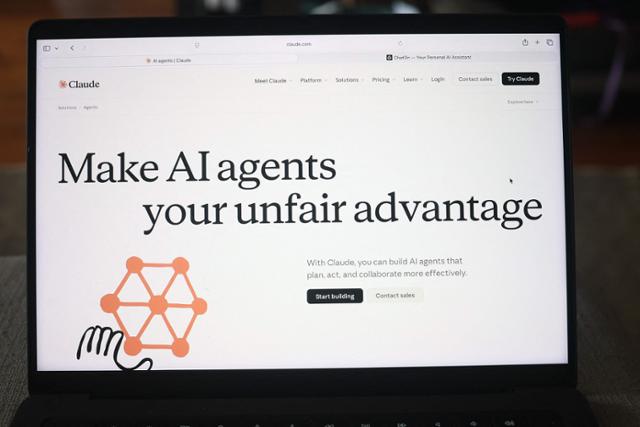
A window for Claude, the artificial intelligence model developed by Anthropic, is open on a user’s computer screen. Yonhap
That, however, does not mean midlevel office workers are in the clear.
AI can become an entirely different tool depending on how it is used. Simply typing commands such as “summarize this” or “write code” is unlikely to make AI truly useful over the long term. Treating it instead as a thinking partner and exchanging ideas with it every day can significantly improve the quality of the results, Nam said.
“The key to unlocking the full potential of AI is to organize the context of your work clearly before putting anything into the system,” Lee added.
To do that, workers must first break down their tasks step by step and identify which parts are better suited to AI and which require more human judgment. That kind of ability, he stressed, does not come automatically with years on the job.
If AI boosts productivity, does that mean it lightens the load for workers on the ground? Evidence from the field suggests the opposite. In many cases, individual workloads are actually increasing, making overwork an increasingly visible phenomenon.
Kang said his company reduced headcount after adopting AI, even though the overall volume of work did not decline. He suspects management concluded that, with AI in place, fewer employees could handle the same amount of work.
Research findings point in a similar direction. In February last year, Harvard Business Review published the results of an eight-month study tracking how AI affected work patterns at a tech firm with about 200 employees. The study found that after AI was introduced, workers began taking on a broader range of tasks at a much faster pace — and ended up working longer hours, even without explicit instructions to do so.
The study attributed the phenomenon to several factors. Workers were able to take on tasks in other departments or job functions that they might not previously have attempted; the barrier to starting work fell, allowing tasks to spill into lunch breaks, commutes and other parts of daily life with the mindset of “I might as well run one more task through AI”; and companies began to expect employees to deliver results more quickly.
If this pattern of “voluntary overwork” continues, it can eventually lead to burnout and mistakes as concentration begins to wear down.
Report-shuttling managers are first in line to be replaced
There is also a growing view that those likely to be hit hardest by the AI revolution are middle managers — department heads and team leaders among them. In particular, so-called “delivery-type” managers look especially vulnerable.
They are the ones who have long survived by passing down instructions from above to junior staff, then packaging reports from below into neatly formatted documents, complete with polished fonts and spacing, for their own superiors.

A person walks in shadow during an "Autonomy and AI day" event in Palo Alto, Calif., December 2025. Reuters
The shift is already underway in the United States. Across Silicon Valley’s largest tech companies, middle managers are being laid off or reassigned as organizations reshape themselves into flatter structures, with executives setting strategy and frontline workers carrying it out — a phenomenon often described as “the great flattening.”
What first appeared to be a reluctant response to AI is now solidifying into what many see as an irreversible organizational structure for the new era.
South Korean companies, too, are beginning to show signs of change. They are expected to speed up organizational restructuring by trimming team leader roles and shifting toward project-based staffing.
Professor Lee said the shift is being driven by a widening gap between middle managers and frontline workers in how quickly tasks can now be completed.
“Suppose a supervisor who is used to doing things the old way says a certain task will take about a month. If you bring that same task to a worker using AI, the answer may be three days at most. As this begins happening in the real world, managers who simply sit behind workers and evaluate the results will realize that their positions are disappearing.”
In Lee’s view, the managers most likely to endure are those who step onto the front line and work through problems alongside their teams — what he called “coach-style managers.”
“One of the questions team leaders from overseas tech companies hear most often is, ‘Why do you keep coming out of your office to talk to your team? Doesn’t that hurt your authority?’”
That, Lee said, is about to change. From now on, only those who stay out on the floor will survive. Seniority and rank will no longer matter.

Women seeking jobs take part in artificial intelligence-powered mock interviews at Seobu Women’s Development Center in Yangcheon-gu, Seoul. Courtesy of Seobu Women’s Development Center
Younger workers were among the first to take the direct hit from AI-driven hiring cuts. But there is also a more optimistic view: Depending on how they use AI, they may be able to turn it into a source of new opportunity.
Some companies have recently begun saying they want to recruit “AI-native talent.” There is also a growing possibility that, in the future, job applicants and people seeking to change jobs will be asked to present an “AI portfolio.” What kinds of AI agents they have built for work, and what kinds of results they have achieved using AI, are likely to become major criteria in hiring and evaluation.
Resumes submitted by younger job applicants are already increasingly filled with examples of AI-related experience. Song Ki-sup, 33, who is currently attending graduate school for interpretation and translation while looking for a job, said six or seven out of 10 companies hiring interpreters and translators now ask whether applicants have used AI translation tools.
“In the past, it was considered a preferred qualification,” he said. “Now, it is basically a requirement.”
Jung Se-hoon (a pseudonym), 28, recently joined a major food company as a data analyst. In his resume, he highlighted his experience using AI tools while writing his master’s thesis, along with an Amazon Web Services Certified AI Practitioner credential.
“What interviewers were most interested in was whether I could immediately apply my AI skills to real-world data analysis work,” Jung said. “These days, building a resume around AI-related skills is an effective way to get through the narrow gate of hiring.”
Nam said that while some criticize AI for taking away junior workers’ chances to learn through trial and error, the reality inside workplaces is not all that different. The subject who people talk to and learn from, he said, is simply shifting from humans to AI.
“If, instead of just accepting easily produced results, someone develops their logical thinking by asking for the sources and reasoning behind a given answer, they can absolutely carve out a place for themselves at work,” he said.
Experts say younger generations may need to rethink their career strategies altogether. Lee Jae-yul, a sociology professor at Seoul National University, said that when people in their 20s and 30s choose a career in the future, the first thing they should avoid is pursuing certifications earned by passing exams built around fixed correct answers.
Traditional licensed professions, such as doctors, lawyers and accountants, no longer guarantee job security, he said.
“People need to boldly abandon the model answer from 10 years ago,” Lee said. “They can survive in this fast-changing era only if they learn with the assumption that the job they first choose may change within two or three years.”
Paradoxically, the capabilities likely to be valued more highly in the future lie in deeply human domains.
Oh Sam-il, head of the Employment Research Team at the Bank of Korea and author of the 2025 report “AI diffusion and the weakening of youth employment,” said that an analysis of the labor market’s compensation structure over the past 20 years showed little change in wage premiums for cognitive analytical ability, while rewards for “social skills” such as persuasion, negotiation and conflict mediation have continued to grow.
That suggests social intelligence — the ability to untangle complex human interests and rally an organization toward a common goal — may be the last uniquely human advantage that cannot easily be taken away.
This article from the Hankook Ilbo, the sister publication of The Korea Times, is translated by a generative AI system and edited by The Korea Times.