High costs fail to deter early English education in Korea
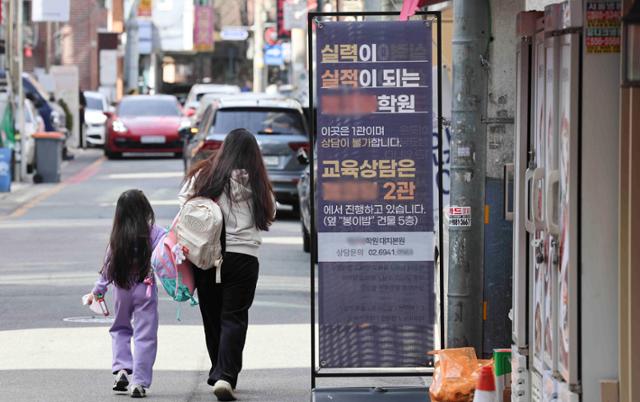
A child and her mother arrive at a private tutoring academy in the Daechi-dong neighborhood of Gangnam District, southern Seoul. Newsis
For a Seoul mother in her 40s, bypassing public kindergarten for an English-immersion preschool, commonly known as "English kindergartens," was an easy choice for her 6-year-old. At orientation, the director called the three-year program a "gift." Having worked at a foreign company, the mother agreed, believing early immersion justified half-day classes.
With more toddlers entering the private tutoring at ever‑younger ages, families’ spending on private education is growing. Yet, in a country known for intense academic pressure, the parents paying these high fees share a surprising consensus.
Despite average monthly tuitions reaching 1.54 million won ($1,070), nearly half of Korean parents do not consider English-immersion preschools a financial burden. Parents treat the tuition as an upfront investment to spare children the trauma of learning English through the public school system.
A Ministry of Education report obtained Thursday by Rep. Kang Kyung-sook detailed this widespread acceptance. The Korea Institute of Child Care and Education surveyed 13,241 children under 6 between July and September last year, finding 47.6 percent participate in the private education market.
Across the general preschool population, physical education was the most popular private subject at 24 percent, followed by Korean at 18.2 percent, art at 16.2 percent, math at 15.5 percent and English at 14.6 percent.
However, a distinct sub-sector dominates full-time private education. Among children receiving childcare allowances instead of attending standard public daycare centers or kindergartens, 17 percent attend intensive half-day private academies. Within that group, an overwhelming 85.7 percent are enrolled in English-immersion preschools.
Even with tuition fees rivaling university costs, only 25.6 percent of surveyed parents felt the financial burden. The largest segment, 43.1 percent, reported the cost was not a burden at all, while 31.2 percent described the expense as average, only households earning less than 3 million won a month reported feeling significantly pressured.

The graph, translated and generated by artificial intelligence, shows Korean parents' perception of private tutoring costs for young children and toddlers. Courtesy of the office of Rep. Kang Kyung-sook
Researchers attributed this contradiction to a powerful desire for bilingualism mixed with parental anxiety. Many parents struggled to learn English in the public education system and want a smoother path for their children
"I think what is learned when young in languages or sports lasts a long time," said another Seoul mother who participated in the survey. "My husband and I said if there are private education expenses to be spent over a lifetime for the child, let's rather spend most of it during the preschool years"
A civic group warns the trend is developmentally harmful. The civic group No Worry issued a statement February 11 criticizing preschools for forcing 5- to 7-year-olds to master phonics, reading and essay writing.
"The early competition lowers self-esteem, increases stress and fundamentally conflicts with the essence of early childhood education," the group said.

Buses wait to pick up children at an English-language academy, known as "English kindergartens," in Gangnam District, southern Seoul, Feb. 8. Korea Times file
Parents argue that government efforts to simply regulate the academies will fail without comprehensive public school reform.
"Simply regulating private tutoring won't be effective under the current system," the surveyed Seoul mother said. "If the government creates a specialized English curriculum and it becomes the standard in public education, the fever for private tutoring will naturally die down."
Educators echo this demand for systemic overhauls rather than patchwork bans, noting a severe lack of continuity in the public track.
"Reliance on private tutoring will only decrease when the kindergarten and elementary school curriculums are systematically linked," a kindergarten teacher said. "Parents need to develop the perception that public kindergarten is better preparation for elementary school than a private academy."
A Ministry of Education official said the concerns are valid and forwarded the opinions to the National Education Commission. Overhauling the curriculum requires long-term review, the official said, adding the government is currently expanding play-based, after-school English programs tailored to young children.
This article from the Hankook Ilbo, the sister publication of The Korea Times, is translated by a generative AI system and edited by The Korea Times.