Korea's older adults pushed aside in bid to beautify public park
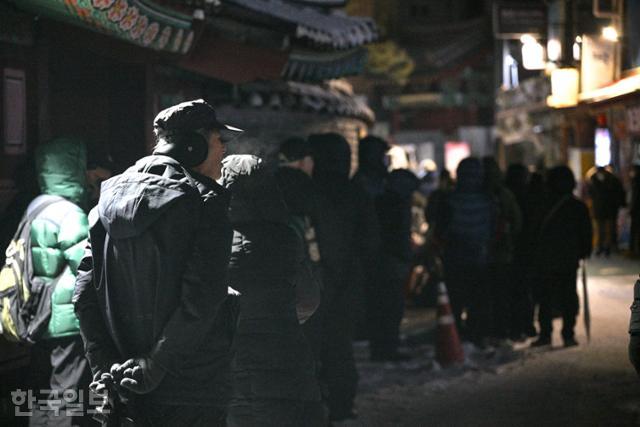
Older adults line up along the wall of Tapgol Park, waiting to receive meal tickets from the Jogye Order’s Wongak Temple. Korea Times photo by Choi Ju-yeon
Last year, Seoul’s Jongno District announced plans to remove all janggi (Korean chess) and baduk (Go) tables at Tapgol Park — a decision that sparked controversy, with critics viewing it as a de facto policy to push older people out of the public spaces surrounding the park.
The move was not an isolated incident. City authorities pursued what they called a “sanctification project” at Tapgol Park 25 years ago, during which older people were pushed aside in the name of improving the park’s appearance.
Now, critics say little has changed in how the city treats its older residents. While disruptive behavior should be addressed, they argue, enforcement must be more carefully calibrated — one that respects seniors’ autonomy rather than simply displacing them.
Lee Kang-won, a professor of Japanese regional culture at Incheon National University who conducted field research in the Tapgol area in the early 2000s, says older people have repeatedly been pushed aside by administrative measures.
In 2001, the Seoul Metropolitan Government launched the “sanctification project” at Tapgol Park, citing the goal of attracting foreign tourists.
Green space was expanded, benches were drastically reduced and replaced with uncomfortable stone seating, and games such as janggi and baduk were banned — measures critics say effectively swept older people out of the space.
The so-called “story circle,” once a vibrant gathering spot that symbolized Tapgol Park’s social life, gradually disappeared. Many older people relocated to Jongmyo Square Park, only to be displaced again when a similar “sanctification project” was launched there in 2007.
Shop owners around the park also remember the gradual shrinking of space for older adults. Kim Young-bin, 73, who has shined shoes along the park’s outskirts since the Asian financial crisis of the late 1990s, recalled a similar period of exclusion.
“Back then, the Seoul government had little control over homeless people gathering in the park, so older people were singled out as the problem. The park was closed, forcing the elderly to seek shelter elsewhere.”
Park Son-seo, 74, who lends janggi and baduk boards at Tapgol Park, said that after each “sanctification project,” trees replaced the spots where older people once gathered. “Old people are treated worse than trees,” he said.
The name still lingers today. Last year’s measures targeting older users of Tapgol Park were part of a “second-phase sanctification and environmental improvement project” that Jongno District Office has promoted since 2023.
According to administrative plans, removing game tables was presented as an initial step toward reshaping the park to better reflect its status as a sacred site of the March 1 Independence Movement.
As criticism mounted, the district office moved to open an indoor space where older people can play janggi and baduk, setting it up in a corner of the nearby Nakwon Musical Instrument Arcade.
The space is scheduled to open on Feb. 2. While many older residents welcome the idea, some have expressed concern that if the new space is subject to tight controls and heavy-handed management, participation may remain limited.
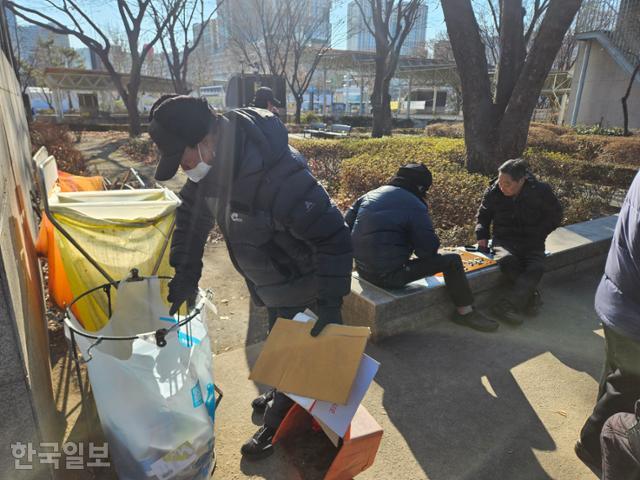
Jo Yong-geun disposes of trash he collected with a litter picker into a garbage bag in Jongmyo Square Park. Korea Times photo by Na Gwang-hyeon
To avoid excluding older people from Tapgol Park, some point to a self-management model that has taken root at Jongmyo Square Park as a possible reference. There, a group of older people has for decades relied on an informal system overseen by a man in his early 70s who brings and lends out game equipment each day.
Participants pay a small daily fee of 1,000 won ($0.75) to spend time in the area. Problematic behavior — including gambling, drinking, smoking or fighting — is strictly regulated not only by the organizer but also by fellow park users.
Some regulars, including Cho Yong-geun, 72, make a point of picking up trash around the game area each day. The rules are largely unwritten but widely respected.
Lee Ryun-gu, a Jongno district council member, said Tapgol Park once operated under similar norms. "There were implicit rules — if you lost a game, you gave up your seat; if you offered unsolicited advice, you were told not to,” he said.
“In the new space, the district should set only minimal guidelines, such as using respectful language, and let seniors manage the rest themselves.”
This article from the Hankook Ilbo, the sister publication of The Korea Times, is translated by a generative AI system and edited by The Korea Times.