Elite professional licenses no longer guarantee jobs in Korea
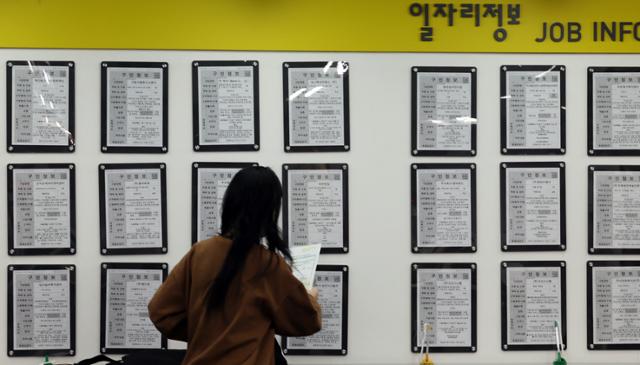
A job seeker looks over employment-related documents in front of a job listings board at the Seoul Western Employment Welfare Plus Center in Mapo District, Seoul, Dec. 10. Yonhap
Even Korea’s most prestigious humanities-track professional licenses — lawyer, certified public accountant and tax accountant — are no longer a safe path to employment, as oversupply and rapid advances in artificial intelligence squeeze entry-level hiring.
Kim, 29, who began preparing for the CPA exam in his fourth year of university, finally passed last year after four years of study. But more than a year later, he is still unemployed. To work as a licensed accountant in Korea, candidates must complete at least one year of practical training at an accounting firm or similar institution. Kim said he applied to more than 30 firms and was rejected by all of them.
“Hundreds of people apply for positions that take just one or two trainees,” Kim said. “Getting hired as a trainee accountant feels much harder than passing the exam itself.”
As job prospects for humanities graduates continue to deteriorate, even those who pass what are often called the “big three” humanities professional exams — law, accounting and tax — are finding themselves at a career dead end. Industry experts point to a growing mismatch between supply and demand, combined with artificial intelligence (AI) systems increasingly replacing tasks once handled by junior professionals.
According to the Korean Institute of Certified Public Accountants, of the 1,200 people who passed the CPA exam this year, 443 — or 39.6 percent — had not been assigned to a training institution as of late October. The figure excludes those who entered military service or returned to school. As concerns over so-called “unassigned accountants” grow, the Financial Services Commission has begun discussions on easing training regulations and expanding eligible institutions.
Tax accountants face a similar reality. Although their mandatory training period is relatively short at six months, competition remains fierce. Those unable to secure placements at private firms may train at local tax offices, but such positions are unpaid and often involve routine civil complaint handling, offering limited professional development.
Kim, 28, a trainee tax accountant, said he applied to more than 130 tax firms and offices without success. “If this keeps going, I may have no choice but to go to a tax office, even if it’s unpaid,” he said.
Lawyers, once seen as virtually guaranteed employment, are also struggling. Of the 1,744 people who passed this year’s bar exam, only 28 percent secured positions at major law firms, became public prosecutors, or were appointed as court research judges. The remaining 1,251 largely compete for jobs at small and midsize firms or corporate legal teams, where competition is intense. Many continue job hunting while attending training programs run by the Korean Bar Association.
“It’s not the job I dreamed of as a student, but given the job market, I’m just grateful to have a place to go to work," said Jung, 27, who found work at a small nonprofit organization.
With entry-level demand shrinking, calls are growing to adjust the number of exam passers. Jung Hyuk-joo, spokesperson for the Korean Bar Association, said AI now handles tasks such as drafting initial legal documents, reviewing legal theories and searching case precedents, reducing the need for trainee lawyers. Kim Beom-jin, a professor of accounting at the Catholic University of Korea, said major accounting firms have heavily invested in AI systems for reconciliation and verification work, cutting back on new hires.
Despite this, interest in professional licenses remains strong. Data from the Human Resources Development Service of Korea show that from 2023 to 2024, first-stage exam applicants increased by 11.7 percent for lawyers, 6.1 percent for accountants and 33.5 percent for tax accountants. Applicant numbers this year have remained at similar levels.
Lee Byung-hoon, a sociology professor at Chung-Ang University, said the trend reflects desperation rather than optimism. “The phrase ‘mun-song-hamnida,’ meaning ‘sorry for being a humanities major,’ exists for a reason,” he said. “Students in humanities and social sciences cling to professional exams as a lifeline. Society needs to find ways to protect young people facing job insecurity driven by structural change.”
This article from the Hankook Ilbo, the sister publication of The Korea Times, is translated by a generative AI system and edited by The Korea Times.