Remembering the Maryknoll nun who brought light to Korea’s darkest alleys
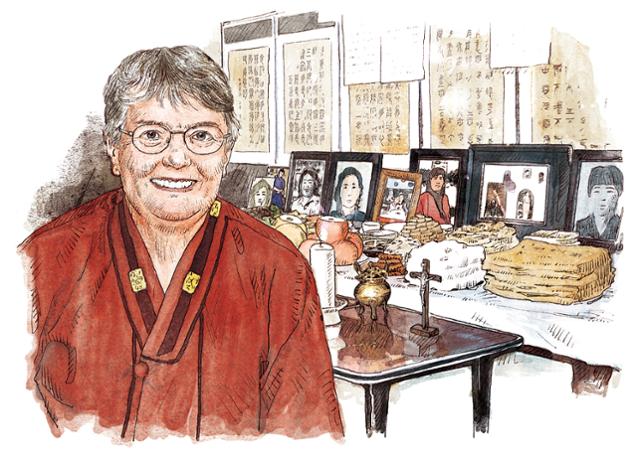
Portraits of women who died alone in the red-light district are displayed on the ancestral table at Magdalena House. The late Sister Joanna Moon Ae-hyeon and Lee Ok-jung, head of the Magdalena Community, stood by them until the end. Illustration by Shin Dong-jun
When staff at Seoul’s municipal crematorium saw the small figure of an elderly nun with blue eyes walking in again, one of them sighed softly.
“Oh no, our regular is here again,” he murmured, half in jest, half in sadness.
At her side stood Lee Ok-jung, director of Magdalena House — Korea’s first shelter for women in prostitution. She gave a faint smile.
The staff member wasn’t wrong. For decades, Sister Joanna Moon Ae-hyeon had come here time and again to say her last goodbye to women who had died alone in Seoul’s red-light district.
In July 2025, over a hundred people gathered at the Franciscan Education Center in Jeong-dong, Seoul, to mark the 40th anniversary of Magdalena House. On the altar stood Sister Moon’s portrait — a gentle face framed by silver hair and round glasses.
“She was with us for the 10th, 20th and 30th anniversaries,” said one of her companions. “But this time, she couldn’t make it. We miss her dearly.”
Sister Joanna Moon, co-founder of Korea’s first shelter for women seeking to leave prostitution, died on Nov. 29, 2024, at the Maryknoll Sisters’ nursing home in New York. She was 94.
From New York to postwar Korea
Born Jean Marie Maloney in Syracuse, New York, on Jan. 16, 1930, she was just a girl when she saw a film about a nun caring for patients with Hansen’s disease. That simple story shaped her entire life.
“I wanted to live like her,” she once said.
After working as a nurse, she joined the Maryknoll Sisters in 1953. Her first assignment took her halfway across the world — to Korea, still reeling from the devastation of war.
She arrived at Busan Port with five fellow sisters and began serving at the Maryknoll Hospital, where thousands of displaced patients sought help each day. Her job was to stand at the entrance, identify the most urgent cases, and hand out numbered cards for treatment.
The Korean surname “Moon” was given to her because she guarded the hospital’s gate — mun means “door” in Korean.
“Medicine and beds were scarce,” she recalled later. “We had to turn away patients who weren’t critical. I still remember the mothers who came carrying babies. When they didn’t return the next day, I couldn’t stop worrying.”
Over the following decades, Sister Moon worked in Jeungpyeong and Ganghwa Island, serving as a nurse, counselor and mentor. Her fellow sister, Dolores, remembered her as “someone whose heart was always open — she smiled at everyone.” Her Korean name, Ae-hyeon, was given by a friend. It means “love and wisdom.”
Founding Magdalena House
In October 1984, a group of nuns visited Seoul’s Yongsan red-light district. Among them was Sister Moon.
There they met Lee Ok-jung, who had been counseling sex workers after witnessing their harsh realities while working as an insurance salesperson.
The women told their stories — of poverty, sexual abuse, debt and desperation. Sister Moon wept quietly behind her large glasses.
A few days later, she called Lee. “Can I live with you?” she asked. “I just want to be with them.”
On July 22, 1985, they rented two tiny rooms in the heart of the district with help from local Catholic organizations. They named the place Magdalena House, after the courageous saint who followed Jesus. It became the first shelter in Korea for women leaving prostitution.
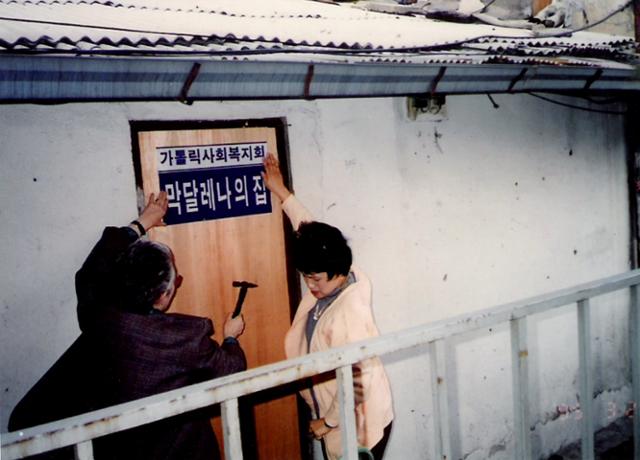
In 1985, Korea’s first shelter for sex workers, Magdalena House, was established in Seoul’s Yongsan red-light district. Courtesy of the Magdalena Community
Eating together, laughing together, mourning together
The women in the alleys were called “machines” or “pots” by their employers. Many were beaten, addicted or trapped in debt. At the time, the law punished only the women — not those who paid for sex. To avoid arrest, they often had to pay bribes to the police, deepening their debts.
Magdalena House offered a rare space of dignity. The women could share noodles, rest or simply talk without fear. Sister Moon never asked questions or imposed conditions. She accompanied them to hospitals when they were sick — from ectopic pregnancies to cancer — and mourned them when they died.
After each funeral, as she and Lee walked back through the alleys, residents would throw coarse salt behind them and shout, “You bring bad luck!” Still, they returned every time.
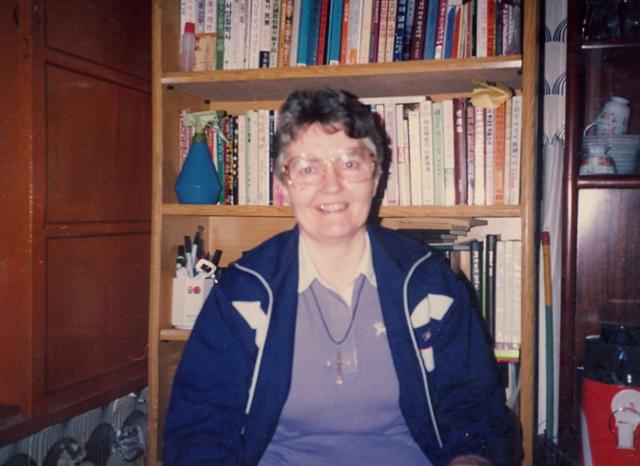
When asked why she chose to join Lee Ok-jung in founding the shelter, Sister Joanna Moon Ae-hyeon gave a simple answer: “I just want to be with them.” Courtesy of the Magdalena Community
A life of humility and humor
The small shelter had no bathroom, so every morning Sister Moon carried toilet paper to the public restroom at Yongsan Station. A fellow sister once wept upon seeing her do this, but Moon returned with a smile — often bringing a homeless person along for breakfast.
When someone teased her for buying the wrong fish, she would laugh and say, “That’s fine — it’s handsome anyway.”
At her 60th birthday party in 1991, a local gangster’s band played her favorite song, Cho Yong-pil’s “Come Back to Busan Port.” She sang along, laughing louder than anyone else.
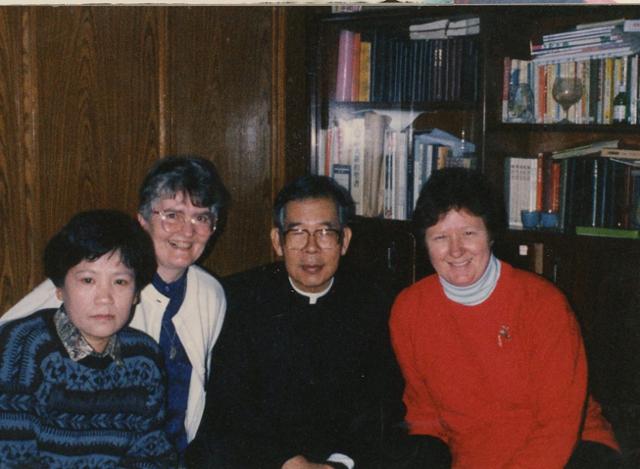
The late Cardinal Stephen Kim Sou-hwan visited Magdalena House five times during his life to encourage their work. From left: Lee Ok-jung, Sister Joanna Moon Ae-hyeon, Cardinal Kim and Sister Dolores. Courtesy of the Magdalena Community
The children of the alleys
The narrow alleyways were full of children — some living with their mothers who worked in the brothels, others left behind and taken in by the women around them. Many of the sex workers, lonely and childless themselves, raised these abandoned children as their own. Some carried infants on their backs while calling out to customers on the street. When possible, Sister Moon and Lee helped arrange adoptions for those without families.
Sister Moon was tireless when it came to children. She helped mothers who wanted to leave prostitution find new work in restaurants or as housekeepers and often showed up at their children’s events — camera in hand for a taekwondo test or a school play. Once, a five-year-old boy told her proudly, “I drank all the cola in the fridge so my mom couldn’t mix it with her pills,” a child’s desperate attempt to protect his mother from addiction.
In 1988, she and Lee opened Baeron Study Room, a small learning center for the neighborhood’s children. It came after a string of heartbreaking incidents — a teenage girl who died in a fire set by a client, another assaulted by a relative while her mother was out working. They wanted a place where kids could simply be safe.
About 40 volunteers took turns teaching there, offering lessons and care to every child — whether they were the son of a sex worker, a pimp or a brothel owner. The classroom became a haven, and pride in having a “study room” spread throughout the community.
“She was like a grandmother to all of them,” recalled former principal Park Se-ok. “She found funding, joined them on trips and sports days, and when she entered the room smiling, everything suddenly felt okay.”
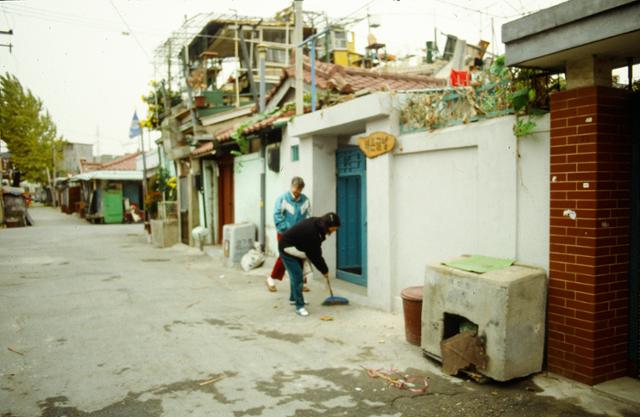
Sister Joanna Moon Ae-hyeon and a fellow clean the front of Baeron Study Room, a learning space for children in Yongsan District. Courtesy of the Magdalena Community
‘I didn’t sacrifice — I simply lived with them’
As more women sought help, Magdalena House expanded. Some women learned sewing or restaurant work, saving their first paychecks to proudly visit “Sister” and “Big Sister.”
A few even graduated from college.
Sister Moon retired from communal living in 1999 but remained active in women’s rights and Bible study groups. She joined movements such as the campaign to abolish Korea’s patriarchal hojuje family system.
Those who knew her described her serenity as “the lightness that comes after reflection, anger and forgiveness.”
In her later years, she often said she wanted to be buried in Korean soil. But when she became too frail to live independently, she quietly decided to return to the United States. “I don’t want to be a burden,” she said.
After nearly 70 years in Korea, she left in 2023. A year later, she died peacefully in New York. A memorial Mass was held in Seoul on Dec. 7, 2024.
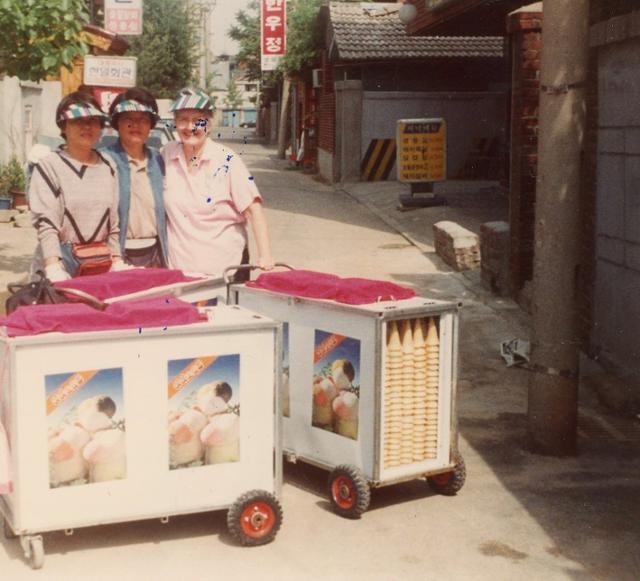
Members of Magdalena House tried various ways to make a living together with their neighbors — including selling ice cream. Courtesy of the Magdalena Community
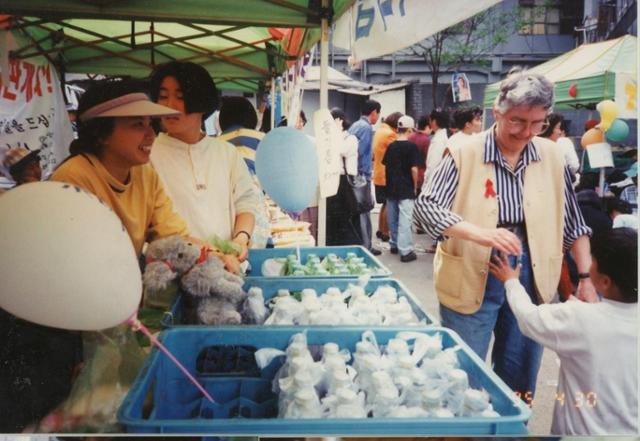
Sister Joanna Moon Ae-hyeon sells sesame oil during one of the community’s fundraising events. Courtesy of the Magdalena Community
Her light lives on
Forty years have passed since Magdalena House was founded. The red-light district in Yongsan is gone, and prostitution laws have changed. Yet new forms of exploitation — online sex trafficking, teenage abuse and overseas sex tourism — persist.
Father Hong Geun-pyo described Sister Moon as “a person who not only shared what she had but gave up her right to comfort, staying beside the cold and the suffering with profound respect.”
He recalled the words of a former sex worker who attended a recent memorial Mass: “I still remember Sister Moon’s warm smile. I’ll never forget her. I’ll help others, too — please call me if you need me.”
What Sister Moon left behind was simple — a life spent walking beside those whom the world refused to see.
This article from the Hankook Ilbo, the sister publication of The Korea Times, is translated by a generative AI system and edited by The Korea Times.