‘Shirtless runners’ and group running stir debate in Korea over freedom vs. public nuisance
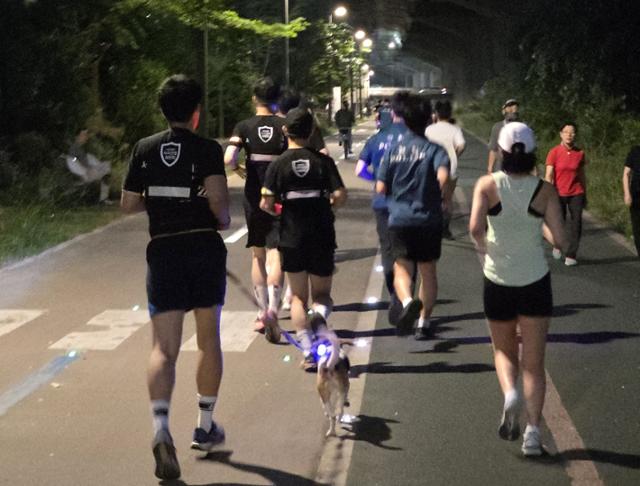
Members of Seoul’s “Running Patrol” team patrol along the Hongje Stream walkway in Seodaemun District, Seoul, Sept. 26. Courtesy of Seoul Metropolitan Government
As the running boom continues in South Korea, conflicts between runners and other city residents are intensifying. Critics say so-called “shirtless runners” and groups running recklessly through the city are disrupting public spaces and making pedestrians uncomfortable.
Seoul resident Son, a graduate student, often frowns during his neighborhood walks because of groups of people “running without shirts or in tight sportswear that reveal their bodies.” Son added, “Taking off one’s shirt in public makes others uncomfortable. People should show manners in shared spaces.”
In contrast, Lee, a 20-something office worker who recently took up running, said, “Running in a group motivates me far more than running alone. As long as we’re respectful, running crews can be a positive culture.” Still, Lee added that “safety should be prioritized when running in crowded city centers or on narrow paths.”
As the number of runners grows, some local governments are responding to a surge in complaints. In Seoul’s Yeouido Park, authorities recently installed a sign titled “4 Nos for Running Crews,” which bans four types of behavior: “No shirtless running,” “No clapping or shouting,” “No group running,” and “No yelling ‘move aside!’” A banner nearby reads, “Running crews must avoid inconveniencing other citizens using the park.”
Similar restrictions have appeared across the capital. Songpa District has hung banners near Seokchon Lake urging people to “refrain from running in groups of three or more,” while Seocho District’s Banpo Sports Complex limits group running to fewer than five people. “As running groups have grown and congestion on the track has worsened, general users have started to complain,” a Seocho District official said. “We made banners to help maintain order since there’s no clear legal measure to regulate group running.”
Ordinary citizens are voicing frustration. Jeon, a 25-year-old office worker who commutes along Cheonggye Stream, said, “Running is fine, but it’s uncomfortable when people blast music or demand that we make way on narrow paths.” Kim, a 45-year-old resident of Seochon, said, “I’ve had several close calls bumping into groups running through small alleys. Seeing people showing off in revealing clothes isn’t pleasant either.”
Runners, however, defend their hobby. Shin, a 22-year-old university student, said, “I understand that running crews can be inconvenient for pedestrians, but most of us try to be considerate. It’s unfair that a few impolite runners make everyone look bad.” Jung, a 43-year-old who runs with a local crew, added, “Public spaces belong to everyone. Restricting runners who don’t harm others isn’t right. These signs bother people who already follow the rules, while those who don’t simply ignore them.”
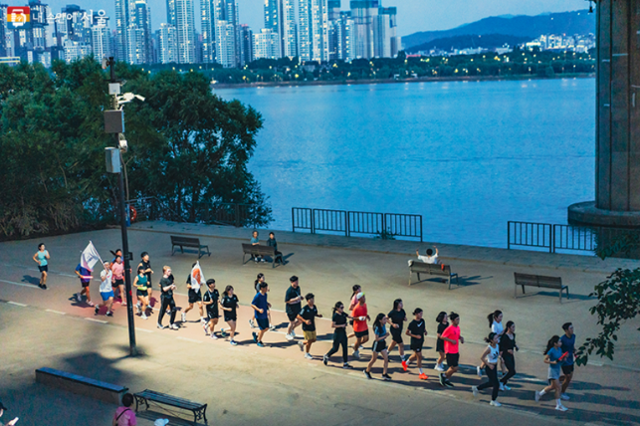
People run in groups along the Han River Park in Seoul. Captured from Seoul Metropolitan Government blog
No legal basis for punishment
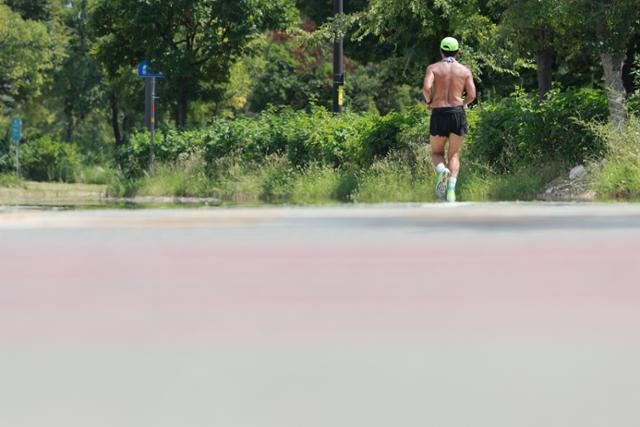
A man runs shirtless near Seogang Bridge in Yeouido, Yeongdeungpo District, Seoul, on Aug. 24 amid continued heatwave conditions. Yonhap
Despite the criticism, there are no legal grounds to punish “shirtless runners” or group running. The Minor Offenses Act once allowed fines of up to 100,000 won (about 70 dollars) for excessive exposure in public, but the Constitutional Court struck it down in 2016. The law was later revised to apply only to those who expose “major body parts such as genitals or buttocks in a way that causes shame or disgust.” In other words, running shirtless is not punishable.
Municipal park regulations also do not include rules against group running. They only prohibit actions such as “causing strong noise or odor that offends others” and “failing to clean up pet waste.”
Experts say social norms, not legal penalties, should guide behavior. Ku Jeong-woo, a sociology professor at Sungkyunkwan University, said, “Individual freedom and rights must be respected, but they should also reflect the perspective of the community. Rather than fines or punishment, members of society should voluntarily strive for maturity.”
To promote better manners, the Seoul Metropolitan Government has run the “Manners for Running in Seoul” campaign since last year. Its promotional guide encourages runners to “wear modest clothing,” “run in single file or small groups on narrow paths,” and “use earphones instead of loudspeakers.”
This article from the Hankook Ilbo, the sister publication of The Korea Times, is translated by a generative AI system and edited by The Korea Times.