Incheon highlights free economic zone for foreign investments

Kim Jong-hwan, the director general of Investment Inducement Bureau at Incheon Free Economic Zone, presents strategies to attract investments from foreign businesses during a roundtable meeting with foreign chambers of commerce in Korea at Gyeongwonjae Ambassador Incheon in Songdo, Tuesday. Korea Times photo by Choi Won-suk
Deregulation is key to fostering investments in Incheon: mayor
By Jung Da-hyun
While highlighting the pivotal role of a free economic zone, the Incheon Metropolitan City emphasized, Tuesday, its preparation to foster a mutually beneficial economic relationship between Incheon and the private sector and the necessity of implementing substantial deregulation to attract proper investment.
Since its designation as Korea's first free economic zone in 2003, the Incheon Free Economic Zone (IFEZ) has experienced rapid growth over the past 20 years. It has attracted a total of 428,066 residents, including 7,922 foreigners, a 16-fold increase from 2003.
Incheon has also drawn 206 foreign-invested companies, resulting in a substantial foreign direct investment (FDI) inflow of $14.67 billion (19.45 trillion won).
“With the IFEZ, Incheon has a more reasonable level of regulation and a business-friendly system than any other region in the country,” Incheon Mayor Yoo Jeong-bok said during a roundtable meeting with foreign chambers of commerce in Korea, held in Songdo, Incheon.
Incheon introduced IFEZ as a planned city for foreign investment, featuring amenities like a startup park in Songdo for high-tech venture firms, while offering dedicated research spaces, financial support and opportunities to highlight technological innovation.
As part of its strategic development, Incheon has built infrastructure to support biotechnology and an advanced industry-academia-research complex, known as the Songdo Bio Cluster. The city plans to expand this complex to 2 million square meters in order to attract more biotech firms. Notably, resident companies include industry leaders like Samsung Biologics and Celltrion.
Given that there are already 715 car parts suppliers in the city, Incheon also envisions creating a high-tech industrial cluster to bolster the future car industry by connecting car materials and parts certification centers.
It also seeks to drive innovation in robotics with the establishment of a robot demonstration support center, providing test bed facilities, equipment development and technological support.
Furthermore, Incheon plans to capitalize on its geographical advantage near Incheon International Airport by highlighting an aviation industrial cluster on Yeongjong Island.
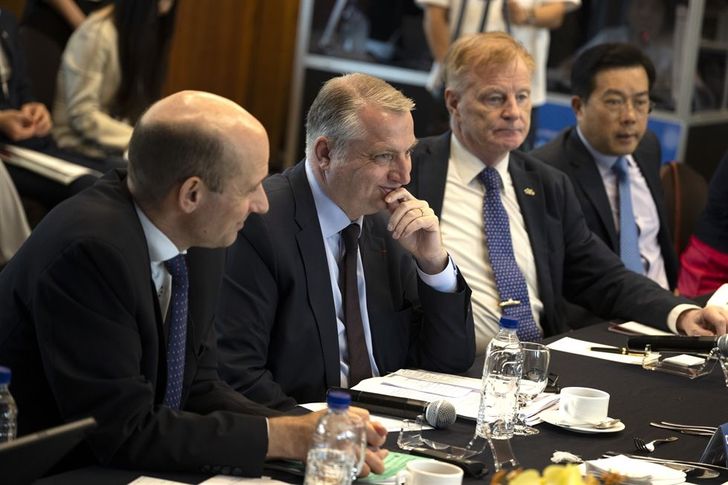
Officials from foreign chambers of commerce attend a roundtable meeting with Incheon Metropolitan City officials at Gyeongwonjae Ambassador Incheon in Songdo, Tuesday. Korea Times photo by Choi Won-suk
Incheon also underscores its competitive production costs, bolstered by free trade agreements (FTA) with 59 nations, resulting in approximately $860 billion in trade volume. Additionally, the city hosts 15 international organizations, including those affiliated with the United Nations.
To further enhance its attractiveness to foreign investors, Incheon is making efforts to become more English-friendly. The city government emphasizes the importance of facilitating communication and daily life in English for foreign companies arriving in the city.
Incheon's focus includes strengthening English education. Incheon already has five global campuses of foreign universities including the University of Utah and Stanford University, and three international schools. The city expects to revitalize English education by taking advantage of these educational institutions.
In addition, Incheon explained the investment privileges, which boils down to the removal of regulations.
In terms of tax incentives, the city plans to reduce taxes by up to 85 percent for a period of up to five years, based on the foreign investment amount ratio. Additionally, the city is considering financial aid initiatives and a comprehensive deregulation strategy, including easing labor regulations and supporting free foreign exchange transactions.
More detailed plans will be developed in consultation with foreign chambers of commerce in Korea, according to Incheon officials.