Seoul to launch 'Climate Card' unlimited transit pass next year

People pass through turnstiles at Jonggak Station on Subway Line No. 1 in Seoul, July 2. Yonhap
By Jung Da-hyun
Seoul is set to introduce an unlimited public transportation pass next year, the city government said Monday.
This initiative aims to not only promote eco-friendly travel but also provide financial relief to residents grappling with increasing living costs, according to the city government.
The transportation pass, named the “Climate Card,” will cover all subway routes in Seoul, including lines 1 to 9, as well as the Gyeongui-Jungang Line, the Bundang Line, the Gyeongchun Line, the Ui-Sinseol Light Rapid Transit (LRT) and the Sillim Line. However, the Shinbundang Line will not be included due to a different basic fare.
The pass will also be available for bus routes in the capital and Seoul's public bike-sharing service Ttareungyi for a monthly fee of 65,000 won ($48.72).
The pass will be also available for use on a commercial waterbus service, which is expected to begin next year connecting Gimpo in Gyeonggi Province to eastern Seoul's Jamsil.
The card will be available in the format of both a plastic card and a mobile app, but the mobile service is initially limited to Android devices due to technical issues. It can be purchased for 3,000 won.
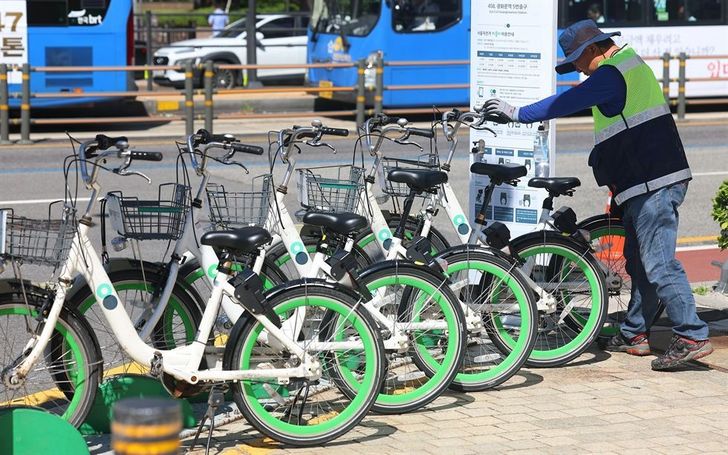
A rental station for Seoul's Ttareungyi public bike-sharing service / Yonhap
When commuters take subways or buses from Seoul to Gyeonggi Province or Incheon, they are allowed to use the pass, but not vice versa due to differing fare structures.
Regarding the city's public bike service, cardholders can enjoy unlimited one-hour rides.

Seoul Mayor Oh Se-hoon speaks during a press conference introducing the Climate Card at City Hall, Monday. Yonhap
With the introduction of the Climate Card, the Seoul Metropolitan Government anticipates more people to make use of public transit, which was avoided to some extent during the COVID-19 pandemic.
In 2019 ahead of the pandemic, public transportation ― buses and subways ― accounted for 65.6 percent of all transportation taken, but this dropped sharply to 52.9 percent in 2021.
Seoul aims to reduce the number of cars on the road by approximately 13,000 and curtail greenhouse gas emissions by 32,000 tons annually through the Climate Card.
Moreover, some 500,000 citizens are estimated to save 340,000 won per year thanks to the transit pass, thereby easing the financial burden of transportation expenses.
This move aligns with a global trend of prioritizing public transportation to address the climate crisis. For instance, Germany launched the Deutschland ticket (D-ticket), also known as the 49-Euro-Ticket, in May, resulting in 1 million car-dependent individuals switching to public transportation. Within three months, 11 million tickets were sold.
“The most critical response to the climate crisis in the transportation sector is activating the use of public transportation,” Seoul Mayor Oh Se-hoon said.
The Climate Card will undergo a test operation from January to May 2024 and is set to be officially launched on July 1 of the same year.
The city plans to ask for cooperation from Gyeonggi Province and Incheon to implement the system before the pilot operation begins, according to the Seoul Metropolitan Government.