INTERVIEW Jeju governor seeks diplomatic deals via ASEAN Plus Alpha, Jeju Forum

Jeju Special Self-Governing Province Governor Oh Young-hun / Courtesy of Jeju Special Self-Governing Provincial Government
Jeju pork export to Middle East signifies new era
By Ko Dong-hwan
Diplomatic events are part of Jeju Island Province Governor Oh Young-hun's broader agenda to build stronger network ties with international cities as diplomacy emerges as key to the survival of municipal governments here.
Last month, a delegation from the island province went to Okinawa Prefecture in Japan to attend the 10th Korea-Japan Cultural Caravan, during which the island's representatives showcased Jeju's traditional music, promoted its tourism and had promising conversations with Okinawa Governor Denny Tamaki. The visit came after Okinawa's vice governor joined the Jeju Forum earlier this year and expressed an intention to strengthen exchanges with the Korean island.
In the same month, the Jeju authority recruited some 20 local high school and university students who are interested in an annual music exchange program with the Chinese city of Ningbo and the Japanese city of Nara where they will travel and share their respective cultures.
However, when it comes to diplomacy, Jeju has two big stages now set for the state level: the Jeju Forum and ASEAN Plus Alpha. Both events connect Korea to global communities via the island making it pivotal for countries looking to work with Korea.
“The ultimate goal behind those events is to sustain the island's economy by promoting the island's symbolic values that are world peace and carbon neutrality and achieving more business diplomacy,” Oh told The Korea Times.
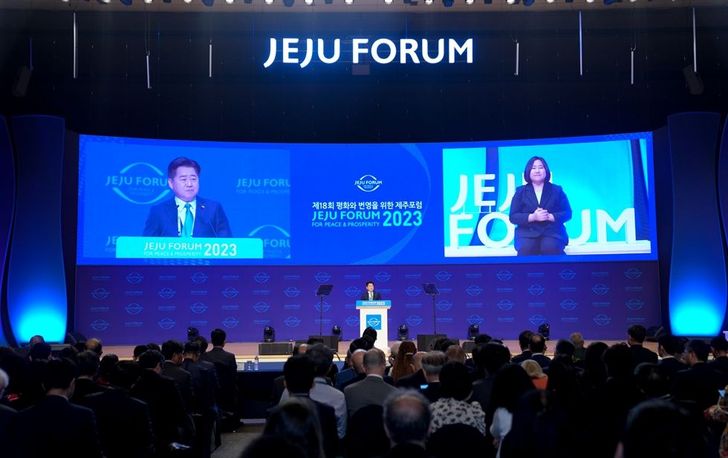
Jeju Governor Oh Young-hun speaks during the opening ceremony of the 2023 Jeju Forum at the International Convention Center Jeju, June 1. Courtesy of Jeju Special Self-Governing Provincial Government
The Jeju Forum has been a peace platform for global leaders since 1991 when former Korean President Roh Tae-woo met the Soviet Union's last leader Mikhail Gorbachev in Jeju. Now, it is one of the country's major roundtables where experts discuss not only global peace but also green growth, AI and other emerging global issues. In this year's 18th forum, participants voiced the need to expand the Global Peace Cities Solidarity, a network of peace-promoting local governments, from Europe to the Pan-Pacific region.
“The Okinawa government signed up for the solidarity pact at this year's Jeju Forum,” Oh said. “And I believe the bilateral tie will be even stronger through next year's Inter-Islands Tourism Policy Forum in the Japanese prefecture.”
ASEAN Plus Alpha is Korea's diplomatic initiative geared toward generating economic boons for both Jeju and its diplomatically partnered local governments overseas, according to the governor. On June 23, the Jeju government opened an outpost in Singapore to buttress the policy. It represents Jeju's latest hub for promoting tourism, bridging the island's local companies to Southeast Asia and creating cultural exchanges.
“We are living in an era where Jeju pork gets exported to Islamic markets in the Middle East, which was unimaginable before,” Oh said. According to the governor, the exported Jeju pork is consumed by non-Muslims.
“ASEAN Plus Alpha will boost Jeju's exports and expand the island's global targets,” he added.
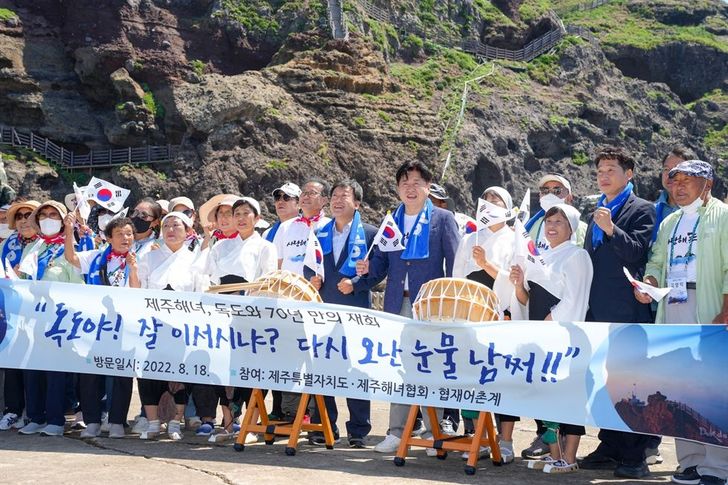
Female divers from Jeju and Jeju Governor Oh Young-hun pose at Dokdo Island, Aug. 18, 2022. Courtesy of Jeju Special Self-Governing Provincial Government
Female divers, or “haenyeo” in Korean, are another of Jeju's indigenous heritage that Oh is proud to present to the world.
Last February and June, the governor invited the ambassadors of China and Japan to Jeju to show them haenyeo culture. This unique tradition was already selected for the UNESCO Intangible Cultural Heritage of Humanity list back in 2016, and is now under Jeju's authority, aiming to be listed among the U.N. Food and Agriculture Organization's (FAO) Globally Important Agricultural Heritage Systems.
“An inquiry mission team from the FAO came to Jeju last May to study our haenyeo culture and see whether to include it in their Globally Important Agricultural Heritage Systems list,” Oh said. “The organization is expected to make its decision before next year. It will be the country's first marine heritage to be selected by the FAO. It means a lot.”
Climate crisis, aging society
Jeju saw its temperature fluctuate unusually last winter, marking the island's biggest temperature difference in its history (18.6 degrees Celsius). Last May, heavy hail with thunder confused the island's flora and fauna right in the middle of spring. Locals also experienced droughts, extreme downpours and typhoons in more irregular and frequent patterns.
Seeing the consequences of climate change, Oh is more committed to making the island carbon-free and his administration is more flexible so as to better support local agricultural households, which increasingly see damage to their crops due to natural disasters.
Last June, he launched a new control tower looking over damaged local agricultural sectors. In 2019 the island also started a seaweed forest plantation project on the seabed as part of its sea decarbonization efforts.
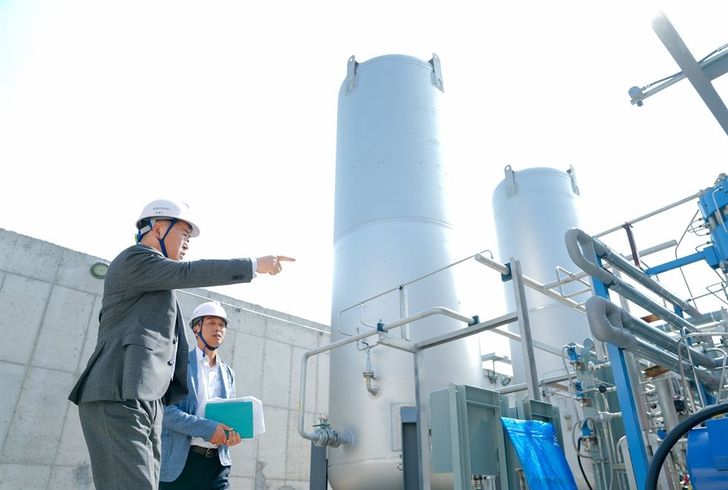
Jeju Governor Oh Young-hun, left, checks the green hydrogen manufacturing plant on Jeju, June 15. Courtesy of Jeju Special Self-Governing Provincial Government
“Jeju's renewable energy power ratio is over 19 percent, the highest in the country,” Oh said. “We'll likely reach the national goal of 26 percent by 2023 the fastest. We've been pushing forward with carbon neutrality for the past decade and we'll realize that goal by 2030, recycling plastic bottles and planting six million trees.”
Apart from these ambitions, Jeju is experiencing an ultra-aging society with over 17 percent of the population aged 65 or older. That's over 118,000 people. The authority is spending almost 210 billion won ($162 million) to make more children-friendly environments, improve infrastructure for senior citizens and strengthen tight-knit local communities.
“We cannot afford to be too frugal when it comes to boosting welfare for seniors who are becoming more and more,” Oh said. “Our new goal is for each household to have a fertility rate of 1.3 or higher so we can achieve at least 500,000 economically active people for Jeju who are aged 15 to 64.”