K-Family Festival seeks solutions to plunging birthrate

K-Family Festival organizing committee chairperson Lee Myung-sun, fifth from left in front row, and members of the inaugural edition of the festival's organizing committee in Seoul pose with the event's speakers after the opening ceremony at the Seoul City Hall's Citizen Hall, last Thursday. Courtesy of K-Family Festival in Seoul organizing committee
By Lee Hae-rin
The inaugural K-Family Festival kicked off at Seoul City Hall, Thursday, aiming to convey the value of Korea's traditional family culture as a solution to the aging country's record-low fertility rate and family dissolution.
Under the theme of “Universal Value and Ethics of Sex, Marriage and Family,” the four-day event ran through Sunday and was hosted by the Family Peace Forum and Global Peace Women.
It began with an opening ceremony and a two-session forum on policy and education held at the city hall building, while also holding exhibitions and cultural events at Cheonggye Plaza themed around traditional family culture.
“Korea can no longer depend on Europe's case studies in finding solutions to plunging birthrates,” Lee Myung-sun, professor of health convergence at Ewha Womans University who chairs the festival's organizing committee, said in her opening speech.
“Instead, the traditional value of marriage and family culture that have been passed down through generations within the Korean nation's long history can shed light in finding a way to overcoming the social crisis of a low birthrate and an aging society.”
Korea's birthrate hit a new record low last year, with an average of only 0.78 newborns expected per woman, falling further from the previous record of 0.81 in 2021. The figure is lowest among the OECD countries, where, beyond the outlier of South Korea, the total fertility rate ranges between 1.3 and 1.9 children per woman.
Professor Hwang In-ja of Hankuk University of Foreign Studies, the co-chairperson of the organizing committee, said in her welcoming address, “The K-Family Festival aims to suggest a peace-achieving model through cooperation, trust and responsibility among families.”
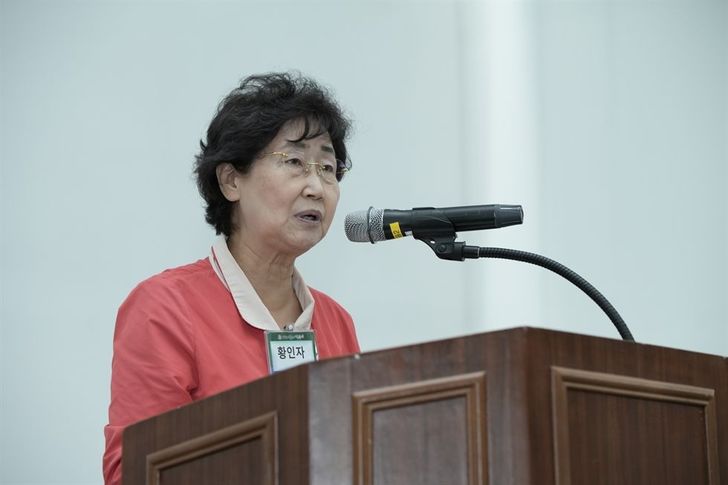
Professor Hwang In-ja of Hankuk University of Foreign Studies, who co-chairs the K-Family Festival's organizing committee, speaks during the opening ceremony of the event in Seoul, last Thursday. Courtesy of K-Family Festival in Seoul organizing committee
Hwang underscored that the solution to gender disparity lies in traditional family culture inherited through 50 centuries of Korean people's history.
Park Kang-soo, the chief director of the Service for Peace Foundation, welcomed the event for highlighting the value of traditional family culture, which he thinks is waning, and expressed hopes for the festival's overseas expansion in the future.
German writer and sociologist Gabriele Kuby said in her pre-recorded congratulatory speech, “Nothing is more important in our time than to rebuild the family … Family is the basic unit of the society on which the state is built. Family comes first and the state is second. If the family is destabilized, society will fall apart and the state will become totalitarian in response to the social chaos that is created by destroying the family.”
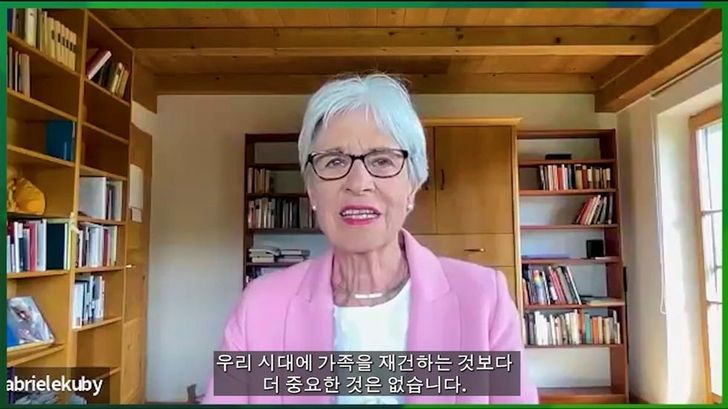
German writer and sociologist Gabriele Kuby speaks in a pre-recorded congratulatory speech during the opening ceremony of the K-Family Festival in Seoul, last Thursday. Courtesy of K-Family Festival in Seoul organizing committee
During the two sessions of forum, scholars, researchers and writers looked into the President Yoon Suk Yeol administration's population policies and urged the government to take an integral approach in rebuilding policy to turn around the plunging birthrate, while some speakers spoke up for tolerance for immigrants and multicultural families in Korea.
The festival also included talk shows, traditional wedding performances, booth events and campaigns at Cheonggye Plaza in central Seoul revolving around the traditional family culture.
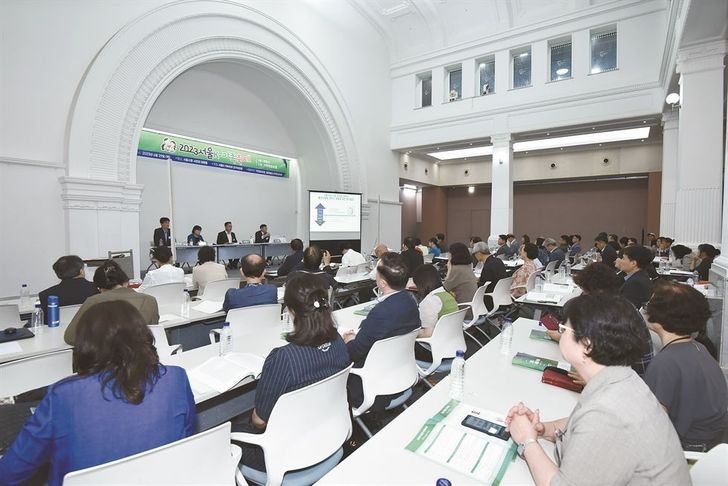
Participants attend the forum session led by scholars and writers during the K-Family Festival at the Seoul City Hall's Citizen Hall, last Thursday. Courtesy of K-Family Festival in Seoul organizing committee