Rainbow flags fly despite opposition at Seoul's queer festival

A rainbow banner is flown during the Seoul Queer Culture Festival in Seoul, Saturday. Thousands of people gathered on Saturday to enjoy the festival amid opposition from protesters. AP-Yonhap
Bumped from city square, Korea's LGBTQ communities keep celebrations going at downtown's Euljiro
By Lee Hae-rin
The 24th Seoul Queer Culture Festival (SQCF) was held Saturday on the hot asphalt roads in downtown Seoul's Euljiro area instead of its usual venue, the grassy Seoul Plaza in front of City Hall. Undeterred by the scorching heat and conservative opposition, tens of thousands gathered to celebrate the identity and diversity of sexual minorities.
Under the slogan “Rise up Queer up,” the annual event that started in 2000 saw a turnout of around 150,000 people including those who identify as lesbian, gay, bisexual, transgender and queer or questioning (LGBTQ) and their allies this year, according to the organizers. The figure is equivalent to the pre-pandemic record-high from 2019.
“This is a celebration of pride for sexual minorities and it's most important to show that we are here,” said Yang Sun-woo, chairperson of the SQCF organizing committee, explaining the reason behind hosting the event in the heart of Seoul.
“At home, at school and at work, we have no place to reveal ourselves as who we are,” she said. “Seoul Pride is the only place that allows us do that and that's why so many come and join in solidarity.”
She cited a recent survey that 68 percent of Korean LGBTQ people choose to hide their sexual identity and orientation out of fear, underscoring how sexual minorities seek visibility and acceptance through the festival.
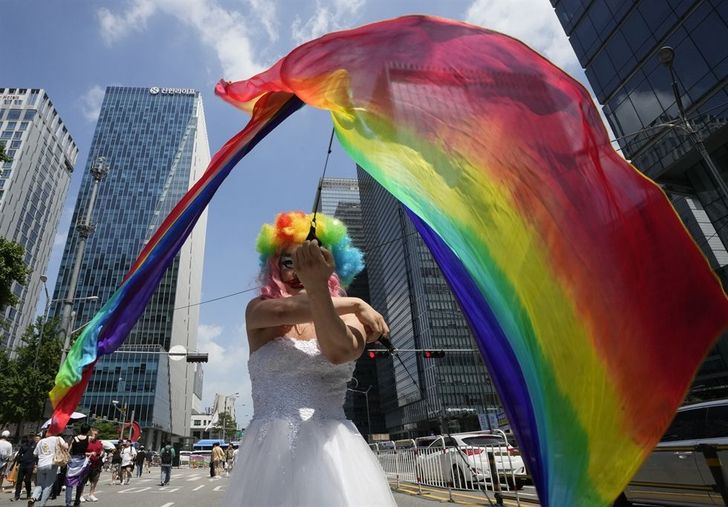
A participant waves rainbow flags during the Seoul Queer Culture Festival in Seoul, Saturday. AP-Yonhap
This is the first time for the event to not be held in Seoul Plaza, one of the biggest public squares in the capital, where it had taken root since 2015, except for the two-year hiatus due to the COVID-19 pandemic. The city government, giving priority to a youth concert by the Christian Television System (CTS) Culture Foundation, denied the organizers' request to use the square, citing its child- and youth-friendly nature.
Many participants expressed their regrets about the municipality's decision to reject the application for the event at the city square.
Kim Che-ah, a 16-year-old from Cheongshim International Academy, told The Korea Times she found the Seoul government's decision “offensive and outrageous” as a young person herself.
Kim and like-minded students from six high schools formed a coalition in March to operate a booth to speak up against the abolition movement on a student human rights ordinance, which the opposition claims “encourages homosexuality” among students.
Kim Sun-gyung, a Jeonju-based 39-year-old bookstore owner, told The Korea Times that she usually participates only in her local pride festival, but was so enraged by the city government's decision that she chose to rent a bus and bring a group of 30 people from the southwestern city to join the Seoul event.
“Seoul Mayor Oh Se-hoon made us so upset and we had no other choice but to come in solidarity… We exist here and nothing can erase us. Today is a happy pride day and no matter how hard they try to hate, oppress and eliminate us, we will come together to show love and support,” Kim said.
Meanwhile, a group of conservative Christians held another rally in front of Deoksu Palace across the street from City Hall, in opposition to the event, calling themselves the “holy seawall.”
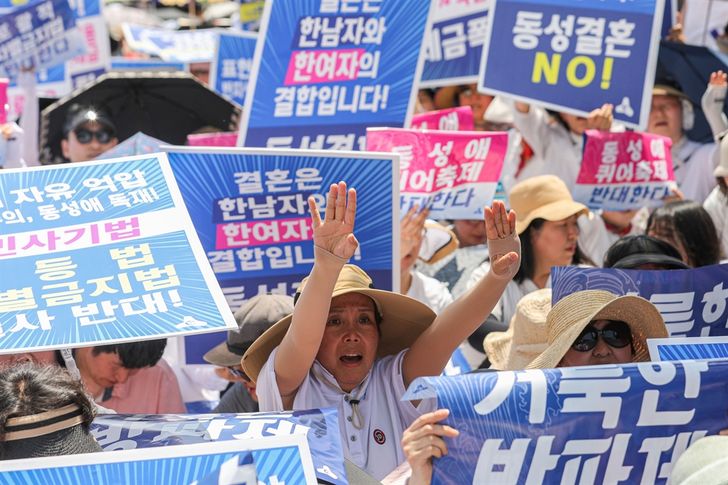
Conservative Christians denounce the Seoul Queer Culture Festival and protesting a pending anti-discrimination bill in a rally across the street from Seoul City Hall, Saturday. Newsis
The speakers at the conservative demonstration criticized the legislative movement on the anti-discrimination bill and denounced homosexuality. Around 12,000 protestant demonstrators, mostly aged between 30 and 70, responded to the speaker with punctuated “Amens” and sang Christian hymns in chorus.
Meanwhile, pro-LGBTQ religious groups participating in SQCF also operated booths to speak out against discrimination and show their support for sexual minorities. Several organizations for LGBTQ rights and solidarity advocacy ― including foreign embassies, global corporations and university and high school student groups ― ran a total of 58 booths.
The Jogye Order of Korean Buddhism, the largest Buddhist sect here, gifted participants with bracelets offering prayers, while Catholic priests and nuns wearing rainbow ribbons gave out rainbow stickers and introduced LGBTQ-friendly Mass and retreats they operate regularly. Protestant pastors wearing rainbow-colored shawls went around the event area offering blessings.
The parade, starting at 4:30 p.m., saw over 35,000 participants, hailing from various backgrounds and nationalities, marching through the city center, past Myeong-dong Market, City Hall and Jonggak Station.
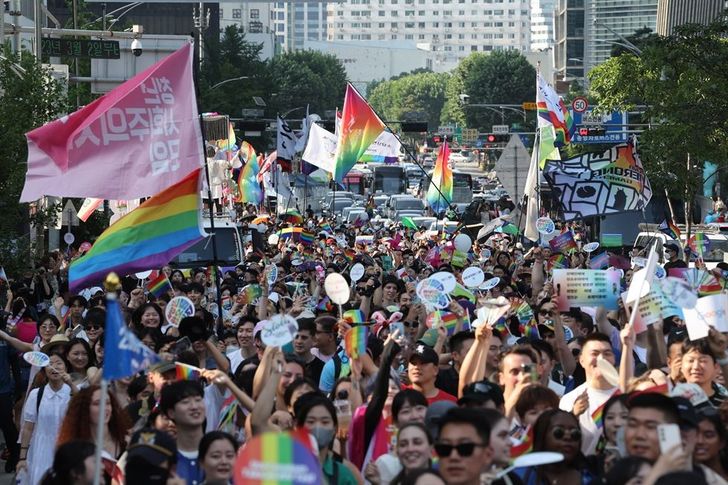
Participants march through the city center during the Seoul Queer Culture Festival in Seoul, Saturday. Yonhap
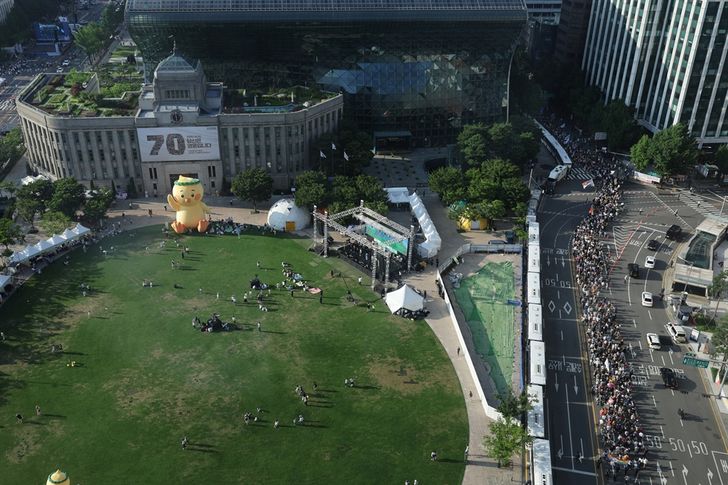
Participants of the Seoul Queer Culture Festival, right, march in a Pride parade passing by Seoul Plaza, the usual venue for the LGBTQ event, as a Christian event takes place there, Saturday. Yonhap
Some protesters' attempts to penetrate and stop the parade were thwarted by police in the area. “Homosexuality is a mental illness! You must repent!” screamed a man into a microphone amplified by a speaker that he was wearing. His shouts were soon drowned out by the crowd's cheers and the music of the parade.
Several pedestrians, drivers and people sitting in coffee shops along the course waved to and greeted the march, showing their solidarity.
Among the parade was a married couple in their 30s from Gyeonggi Province who wished to be identified only by their surnames Lee and Park. They walked the entire parade route with their three-year-old twins in a stroller.
The couple, who regularly participated in past events as Seoul LGBTQ allies, told The Korea Times they joined Saturday's march with their children “because we wish our children would live in a better world, a world of equality.”
For Saturday's event, the police stationed 60 squads consisting of 3,600 personnel around the event venue and along the parade course to prevent clashes with opposing groups and to ensure crowd control. No injuries were reported during the event.
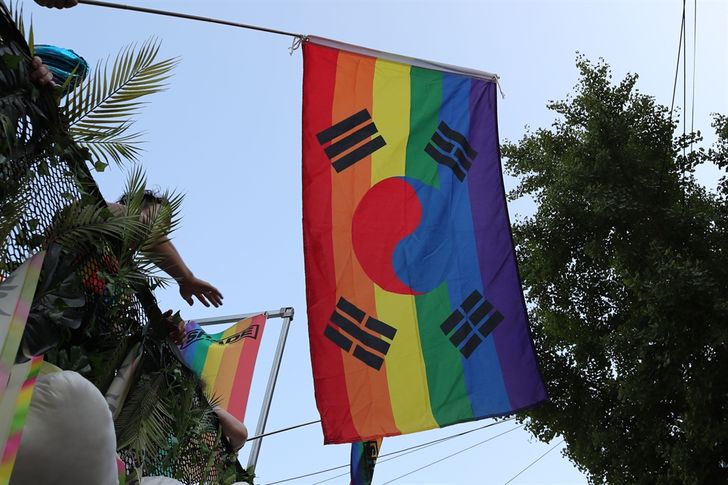
A rainbow-themed Korean national flag hangs during Seoul Queer Culture Festival in Seoul, Saturday. Newsis
Even as public awareness about sexual minorities is increasing, Yang mentioned the ongoing challenges posed by political and religious opposition in organizing the festival. Regardless of where next year's festival will be held, Yang affirmed its continued presence in the city center, where the LGBTQ community can be seen and heard.
“I hope everyone lives on with the energy from today's event. We will continue organizing the Pride festival so that one day, the world will accept and embrace us as who we are,” Yang said.