Move to revise anti-corruption law sparks dispute

A sign at a restaurant in Seoul displays the price of its “Kim Young-ran menu” at 30,000 won. Yonhap
By Jun Ji-hye
Opinions have been divided over the possibility of raising the price cap for meals under the country's anti-corruption law, after the presidential office said it was considering raising the limit from the current 30,000 won ($23) to 50,000 won.
The so-called Kim Young-ran Act, which came into effect in 2016, prohibits public officials, private school teachers and journalists from being treated to meals that cost more than 30,000 won or receiving gifts priced over 50,000 won.
The law, named after a former Supreme Court justice who also was the chief of the Anti-Corruption and Civil Rights Commission, was laudably aimed at eradicating corruption and bribery, but there have been calls for some restrictions to be revised due to steep inflation in recent years.
Presidential spokesman Lee Do-woon said the revision to raise the food price ceiling is being discussed as part of measures to stimulate domestic consumption.
“Broad discussions are going on to explore economic stimulus measures,” Lee said during a media briefing, Sunday.
Supporters of the revision cited a sharp increase in food and labor costs compared to the year when the law was implemented.
According to Statistics Korea, the consumer price index for dining out jumped 7.7 percent to 114.62 in January this year from a year earlier.
Lee Young, the minister of SMEs and Startups, said she had recommended the government to raise the limit on the food price, considering inflation and economic difficulties facing small business owners.
“The price cap stipulated in the Kim Young-ran Act has failed to meet inflation,” she wrote on Facebook, Monday. “Due to inflation as well as rising interest and labor costs, restaurant owners had to compromise in quality while developing menu items under the price of 30,000 won, and this resulted in a falling number of customers. When they didn't compromise in quality, they suffered declining profits, getting trapped in a vicious cycle.”
A similar claim was made by Rep. Kim Byung-wook from the main opposition Democratic Party of Korea. He submitted a bill to revise the law to ease some restrictions in January last year.
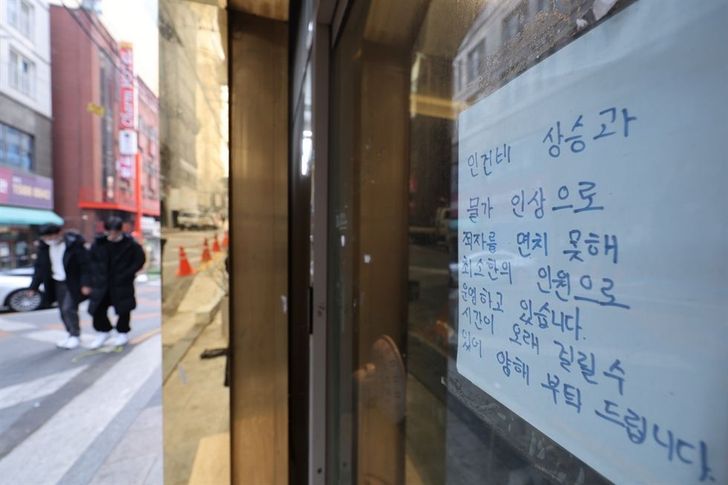
A notice is posted on the door of a restaurant in Seoul, Feb. 6, to inform customers of its closure due to increasing deficits resulting from inflation. Yonhap
The Korea Federation of Micro Enterprise (KFME) welcomed the possible revision, saying the food price ceiling has been frozen for eight years, although various expenses have sharply increased.
“We hope the revision will stimulate the food service industry and increase our sales,” the KFME said in its statement.
The Korea Food Service Industry Association also expressed its support for the revision, claiming that restaurant owners have suffered from years of declining sales.
But the move to revise the law is expected face resistance as Jeon Hyun-heui, who chairs the Anti-Corruption and Civil Rights Commission, has expressed opposition.
The commission is the competent authority of the law. The 30,000 won cap can be raised if the revision to the enforcement ordinance of the law is approved by the commission and then by the Cabinet.
Jeon called for a cautious approach toward the issue as “two values ― economic stimulus and anti-corruption ― come into conflict.”
“The government should cautiously look into public opinions and seek a social consensus,” she wrote on her Facebook.
Citizens are showing mixed reactions. Joo Ha-bin, 38, who works for a trade company in Seoul's Mapo District, said, “I think the revision is necessary as the law seems to lag behind the times.”
On the other hand, Kim Hee-joon, 37, who works as a teacher at a private crammer in Incheon, said, “I think 30,000 won is enough for a meal. The original intent of the law should be kept.”
As the issue has given rise to a variety of opinions, the presidential office appeared to have become a bit more cautious about pushing ahead with the change.
An official at the presidential office said, “There could be various measures to boost domestic consumption. We need to comprehensively review the issue. There will be a relevant announcement at an appropriate time.”