INTERVIEW Korea ramps up rehabilitation efforts to win 'war on drugs'

Kim Myeong-ho, deputy director-general for Narcotics Safety Planning Division under the Ministry of Food and Drug Safety, poses during an interview with The Korea Times at the newspaper's office in Seoul, Wednesday. Korea Times photo by Shim Hyun-chul
Drug ministry plans to increase resources for addiction treatment
By Lee Hyo-jin
As drug crimes have become a major concern in Korea, the Yoon Suk Yeol administration declared a “war on drugs” in October last year. Hence, related ministries, including the Ministry of Food and Drug Safety, are scrambling to develop countermeasures to regain the country's reputation as a “drug-free” nation.
Among the policymakers tasked with deterring drug offenses is Kim Myeong-ho, deputy director-general for the Narcotics Safety Planning Division under the drug ministry. The division was a temporary project team for four years, but in January, it earned the current position as a leading organization on drug policy.
When it comes to drug offenses, the government has so far prioritized punishment over rehabilitation. But Kim believes that Korea cannot win the war on drugs using only penalties and enforcement measures.
“In the last few months, there has been a major paradigm shift in our policies. Whereas previous measures were centered at tight monitoring and crackdowns on drug users, we are now focusing more on how to effectively treat and rehabilitate them,” he said during an interview with The Korea Times at the newspaper's office, Wednesday.
“If you look at the drug policies in developed nations, drug addiction is regarded as a health-based issue. In other words, they believe that people with substance disorders need treatment and medical attention. We should go in that direction too.”
The senior official said health-based policy measures should be carried out in line with existing criminal punishment measures.
Against this backdrop, the drug ministry will introduce comprehensive reduction measures in June, which will include support measures such as social integration and addiction prevention methods.
Moreover, the ministry is planning to establish one more state-run drug rehabilitation center by July ― either in Gyeonggi Province or Chungcheong Province. Currently, there are only two such centers nationwide, one in Seoul and the other in Busan.
“Our ultimate goal is to launch a center in every one of the 17 provinces and metropolitan cities, where people struggling with addiction can receive well-structured rehab programs,” Kim said. “We are also currently working to introduce integrated rehabilitation services in cooperation with the Ministry of Justice, the Ministry of Health and Welfare and the Prosecutors' Office.”
In the long term, the government is considering adopting a criminal justice system specifically handling drug offenders, similar to drug courts in the United States. The specialized courts offer individuals an opportunity to enter long-term drug treatment programs and court supervision, rather than receiving a jail sentence.
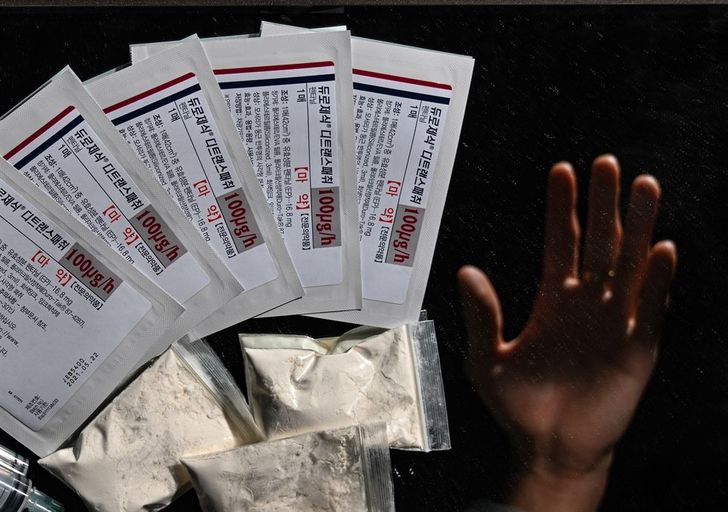
Fentanyl patches are seen in this illustration picture taken in 2020. Teenagers' misuse of fentanyl is among the most serious concerns for authorities. Korea Times file
Growing misuse of prescription drugs
In Korea, illicit drugs are classified into three categories: narcotic drugs, psychotropic substances and cannabis. Psychotropic drugs such as propofol and zolpidem, as well as certain types of narcotics drugs including fentanyl and morphine, require a prescription by doctors.
Between 2019 and 2021, psychotropic drugs accounted for an average of 55 percent of total drug offenses. Narcotics drugs such as cocaine and heroin made up 24 percent and marijuana accounted for 21 percent.
According to Kim, the drug ministry regularly monitors a so-called “comprehensive drug monitoring system,” a database that tracks prescriptions of controlled substances and drugs nationwide.
In the case of prescriptions that are suspected to be for non-medical purposes, the officials contact physicians and conduct on-site inspections of hospitals. Then, cases that are deemed as violations of the Narcotics Control Act are referred to law enforcement authorities.
This is how actor Yoo Ah-in was recently caught for alleged illegal use of propofol, Kim said. In a regular monitoring process, officials speculated that Yoo's prescription purchases, made from early 2021, for the sleep-inducing drug were “too frequent” to be considered as purely for medical purposes.
“Frankly speaking, we didn't know that the patient was Yoo before we sent the case to the police, because the monitoring system identified the actor by his real name,” Kim said. Yoo's real name is Eom Hong-shik.
Nonetheless, some people questioned why Yoo's alleged misuse of drugs had gone unnoticed by the authorities for nearly two years, pointing to the ministry's lax control over prescription drugs.
Regarding this, Kim said, “Unfortunately, due to a lack of personnel, it took some time for us to detect the case. In order to speed up the monitoring process, we are planning to increase manpower and increase the system's monitoring capacity with an improved algorithm.”
Kim also explained that a revision bill is under discussion at the National Assembly, aimed at obligating healthcare providers to check the comprehensive drug monitoring system before prescribing certain drugs.
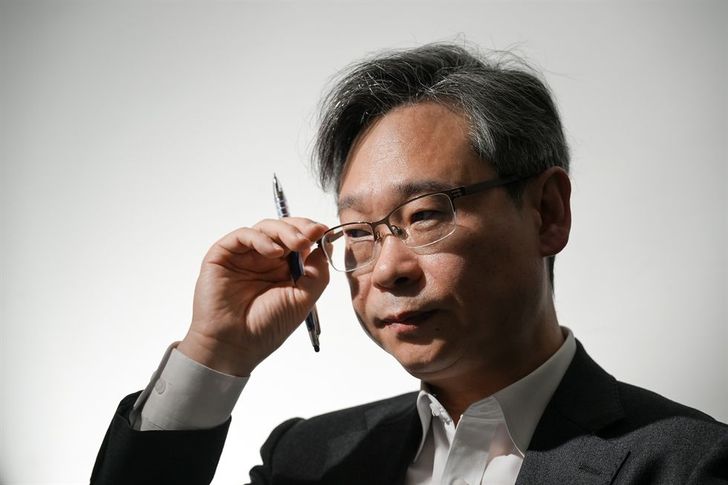
Kim Myeong-ho, deputy director-general for the Narcotics Safety Planning Division under the Ministry of Food and Drug Safety / Korea Times photo by Shim Hyun-chul
Soaring drug use among young people is another urgent issue Kim's division is trying to address. According to police data, the number of drug offenders in their teens to 30s has increased sharply in the past three years. It comprises 59 percent of the total convicted of drug crimes in 2021.
Teenagers' misuse of fentanyl is among the most serious concerns for authorities. Pharmaceutical fentanyl was developed as a pain management treatment for cancer patients and applied in the form of a patch on the skin. The synthetic opioid is 100 times stronger than morphine, and just two milligrams of it is considered a potentially lethal dose.
“Some teenagers seem to receive prescriptions by faking their symptoms, saying that they are in severe pain,” Kim said. “We are currently developing various education programs using virtual reality technologies for minors in order to warn them about drug abuse.”