Night shift mandate for male workers ignites controversy

gettyimagesbank
By Lee Hyo-jin
The human rights commission is facing a backlash from some men, as well as a ruling party lawmaker, after rejecting a petition calling for a change to the corporate practice of obligating only male employees to work night shifts. The commission said the practice is not seen as discrimination based on gender.
As the decision sparked controversy, the National Human Rights Commission of Korea (NHRCK) released a statement on Thursday to clarify its position, advising companies to rethink the decades-old practice as it could constitute discrimination against women.
Last week, the NHRCK dismissed a petition filed by a male worker at a bank, who complained that only men are forced to undertake night duty at his workplace.
The petitioner working at the IT department of NongHyup Bank lodged the complaint in August 2021, claiming that his company's policy of forcing men to work the night shift ― whereas female workers do daytime shifts on holidays and weekends ― is discriminatory.
About 14 months later, the NHRCK dismissed the petition, expressing its opinion that this particular case cannot be seen as discrimination based on gender.
“In this case, except for a night patrol, the work intensity of night shifts is similar to that of day shifts. It is hard to view that the night shifts are exceptionally harsh compared to working in the daytime,” it said in a statement.
“Also, given that the workers can take five hours of rest while on night duty and are compensated with four extra hours of rest afterward, it's hard to view night shifts as disadvantaging male workers.”
The commission also explained that it took into consideration that women are more vulnerable to dangerous situations such as violence at night, and that the fear and anxiety female workers may feel while on night shifts cannot be overlooked.
It added, “Under such circumstances, unilaterally requiring women to work on night duty can be seen as formal equality.”
Formal equality means that all individuals should be subject to the same rules and standards for fair treatment, while substantive equality refers to the idea that differences between individuals such as gender, race and age should be taken into account to achieve equality.
Such an opinion from the human rights watchdog irked some men who viewed it as “biased and contradictory.”
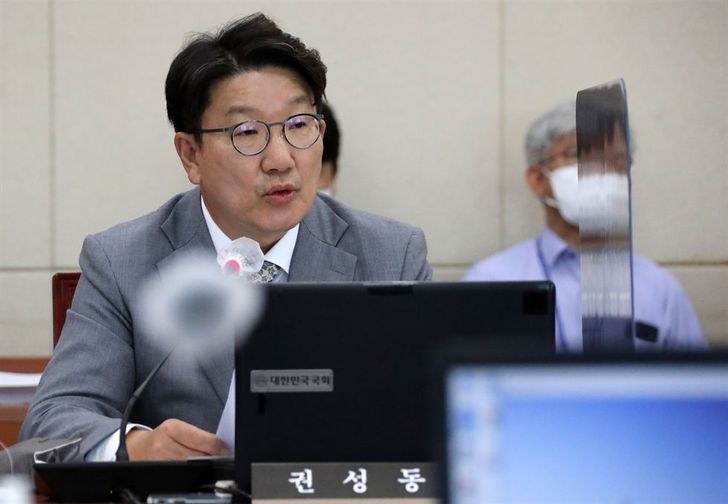
Rep. Kweon Seong-dong of the People Power Party speaks during a session at the National Assembly in Seoul, Oct. 7. Korea Times photo by Oh Dae-geun
Rep. Kweon Seong-dong, a ruling People Power Party (PPP) lawmaker, said, “I cannot accept the NHRCK's decision that making women work night shifts is formal equality.”
“Female civil servants at government departments and some local governments currently take turns on night shifts. If night shifts are required at the workplace, men and women should take equal responsibility,” he wrote on Facebook.
In an additional statement released on Thursday, the rights watchdog said the outdated practice of choosing night shift workers based on gender should be reviewed.
“Excluding women from night duties can create a sexist perception that women must be protected and thus could be used to exclude women in the public sector. Also, given that the number of female workers is on the rise and security measures are more advanced than in the past, night shift rotations should be carried out regardless of gender,” it said, adding that employers must ensure safety in the workplace.
Under current labor laws, it is illegal to require pregnant women and employees aged under 18 to work between 10 p.m. and 6 a.m. Employers may require women who are not pregnant and aged above 18 to work at night with their consent. Violators of the rules may face up to two years of imprisonment or up to 20 million won in fines.
Following debates that making only men work night shifts is sexist, the Seoul Metropolitan Government has since 2019 included women in night shifts. Beginning this month, Jeju Special Self-Governing Province has also included female workers in night duties, the first such move since the government office was established in 1955 on the island.