Migrant groups criticize Constitutional Court decision upholding ban on workplace change
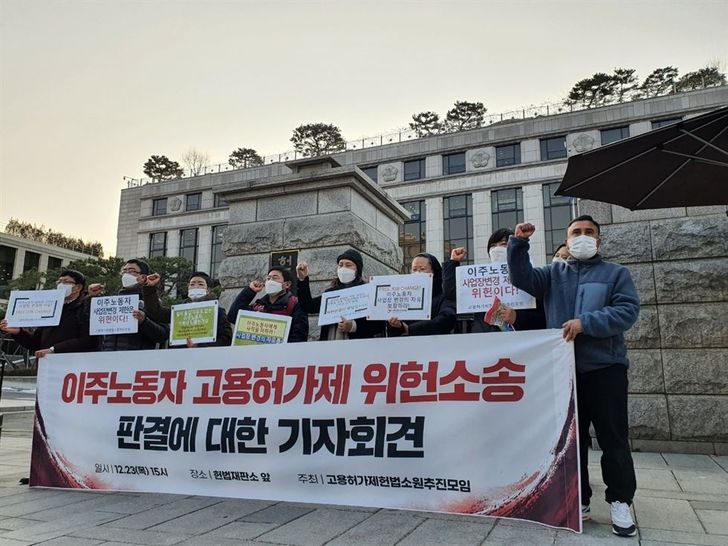
Members of a civic coalition against the work permit system hold a press conference in front of the Constitutional Court in central Seoul, Dec. 23. Yonhap
By Lee Hae-rin
Migrant workers' groups are criticizing the Constitutional Court's Dec. 23 ruling in favor of the government restriction on foreign workers changing workplaces, saying the decision is against international human rights norms to abolish racial discrimination and ban forced labor.
The court announced a 7-2 judgment against the petition by five migrant workers filed in March 2020, which claimed that restriction on changing workplaces infringes on migrant workers' freedom to human dignity and the pursuit of happiness.
Under the law, migrant workers who come here under the employment permit system (EPS) cannot change workplaces in principle during their stays lasting up to four years and 10 months. They can take a new job in only limited cases, such as when the employer wants to terminate the contract or closes the business, or when the employer treats the employee unfairly making the employee unable to continue working there according to social norms, such as sexual abuse. And they are limited to changing jobs no more than three times under the system.
For other causes, migrant workers wanting to change workplaces need to get approval from the previous employer or prove they are not responsible for the conditions under which they would seek to change jobs. This rule has made it difficult for migrant workers to change workplaces despite various forms of abuse and unfair treatment, virtually treating them as “forced labor,” according to civic groups.
The court, however, said the relevant clauses on the law do not infringe on migrant workers' basic rights. It said the system was adopted to relieve employee shortages in industries having difficulty securing workers, and if they are allowed to seek new employers, it could leave industries more vulnerable to worker shortages.
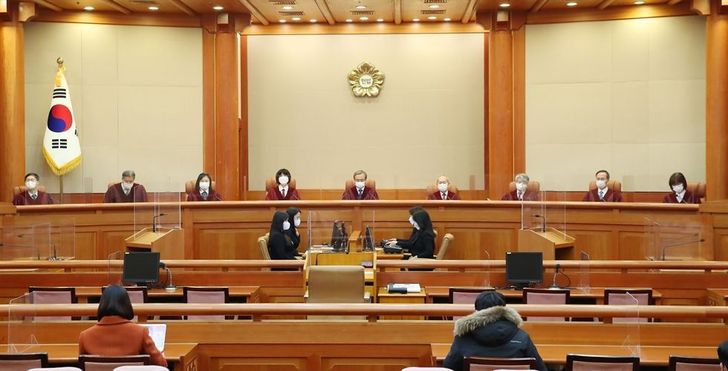
Justices sit at the Constitutional Court room in Seoul, Dec. 23, to decide on the petition filed by migrant workers on alleged human rights infringement by the employment permit system. Seven out of the nine justices voted in favor of the restriction on foreign workers' workplace change. Yonhap
“Granting foreign workers the freedom to change workplaces could present difficulties to employers in running their businesses and securing enough workers,” the court said. “Foreign workers have come to Korea due to employers' needs, thus there should be a legal restriction on their ability to change workplaces.”
But migrant groups and human rights lawyers who filed the petition criticized the ruling, saying it did not consider migrant workers' poor working conditions and denies the nation's constitutional values.
“The court ruling means that foreign workers should endure long hours of restless forced labor and low wages, discrimination and exploitation,” the groups said in an official statement, Dec. 24.
The Korean Confederation of Trade Unions also said, “The Constitutional Court ruling justifies violence and racial discrimination by the government and claims for legitimacy of forced labor. The ruling rouses doubts on the Constitutional Court's reason of existence.”
“It is almost impossible for migrant workers to collect and submit evidence of sexual assault, violence and discrimination they experience and file to change workplaces. The language barrier makes it even more difficult for them to file their cases to the police,” Song Eun-jung, head of the Hope Center for Migrant Workers, a human rights group that supported the petition, told The Korea Times, Monday.
“Most migrant workers wish to maintain stable jobs during their stay. Those who file for changing workplaces have no other option because their current working conditions are harsh and unbearable,” Song explained. “The fact that they are not given the right to change workplaces leads to more exploitation and human rights violations by employers.”
The EPS, since its enactment in 2004, has been criticized for infringing on human rights and falling short of international standards on labor conditions by international organizations including the International Labor Organization and Amnesty International.
The Korea Labor Institute, a governmental research institute on labor issues, also advised lifting limitations on the frequency and conditions in which migrant workers can seek new jobs in its report published in August 2020.