Korea raises 2030 emissions reduction goal to 40% below 2018 level

President Moon Jae-in speaks during a leaders' dialogue at the P4G Seoul Summit at Dongdaemun Design Plaza in Seoul, May 31. During the summit, Moon pledged to raise Korea's emissions cut target, and the government, on Friday, announced a strengthened goal of reducing greenhouse gas emissions by 40 percent compared to their 2018 level by 2030. Courtesy of Cheong Wa Dae
Businesses raise concerns over market impact
By Nam Hyun-woo
The government has strengthened its 2030 emissions cut target by promising to reduce greenhouse gas emissions by 40 percent of their 2018 level, up from the earlier goal of 26.3 percent. The enhanced target is expected to result in an additional reduction of 100 million tons from Korea's existing plan.
The government will announce the new goal as the country's nationally determined contribution (NDC) during the 2021 United Nations Climate Change Conference (COP26) scheduled for between Oct. 31 and Nov. 12 in Glasgow, the U.K.
The NDC refers to respective countries' long-term goals to contribute to the 2015 Paris Agreement, which is aimed at limiting global warming in this century to well below 2 degrees Celsius ― preferably to no more than 1.5 degrees ― compared to pre-industrial levels.
According to the government, Friday, it made a “sharp increase” in the country's 2030 NDC to 40 percent, up 13.7 percentage points from 26.3 percent. Since Korea first set up its NDC in June 2015, there have been a number of changes in setting the goal and year on which to base the cut, but this year is the first time that the government made a major increase in the overall target.
The new target, which is a middle step toward the goal of achieving carbon neutrality by 2050, is even higher than the 35 percent stated in the Carbon Neutrality Act passed at the National Assembly on Aug. 31.
The government described Korea's enhanced NDC as “a challenging and ambitious goal,” because the country's emissions have to decline on average 4.17 percent every year until 2030, which is far higher than the U.S.'s 2.81 percent, the U.K.'s 2.81 percent and the European Union's 1.98 percent.
In 2018, Korea's emissions stood at 727.6 million tons of carbon dioxide equivalent (a measure for comparing various greenhouse gases and their global warming potential) and the enhanced NDC seeks to reduce this amount to 436.6 million tons, down 291 million tons from 2018 and 99.5 million tons from the previous NDC.
The government plans to achieve the target mostly through an energy transition and controlling industries so as to reduce coal-fired power generation, expand renewable energy and increase energy efficiency through new technologies.
The government will hold online debates to gather opinions on its proposed NDC, and will finalize the target in a Cabinet meeting on Oct. 18. Korea will announce the enhanced target at the COP26 and submit it to the United Nations in December, according to the Prime Minister's Office.
Businesses, however, are expressing concerns over the government's enhanced NDC, as they believe that the pace of transition outpaces that of eco-friendly technology development, and thus, that the new NDC could affect their operations negatively.
According to a survey announced by the Federation of Korean Industries (FKI) on Monday, 68.3 percent of 350 businesses here said that the government's NDC drive is excessive, and 84.1 percent said that such an initiative will affect their management negatively. The survey assumed that the government will set 35 percent as its new NDC target, which was 5 percentage points lower than the actual target announced on Friday.
Kim Yoon, Chairman of Samyang Holdings and the chair of FKI's subgroup for environmental social and corporate governance (ESG) management, said Thursday, “Carbon neutrality is the path we should pursue, but it also requires proper studies on the appropriate pace of cutting emissions and the potential impact to the market.”
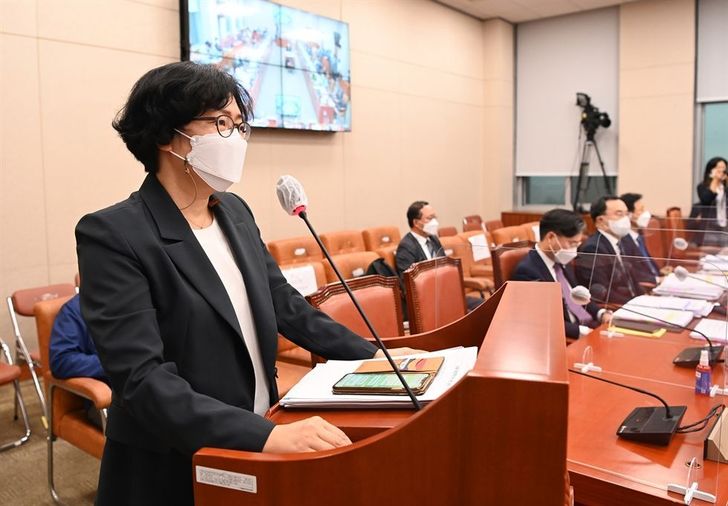
Yun Sun-jin, co-chairperson of the presidential committee on carbon neutrality, answers lawmakers' questions during a parliamentary audit into the trade, industry and energy ministry at the National Assembly, Seoul, Oct. 5. Korea Times photo by Oh Dae-geun
Regarding these concerns, Yun Sun-jin, co-chairperson of the presidential committee on carbon neutrality, said that achieving carbon neutrality by 2050 has become a norm in the international community which we can't avoid.
“We have to achieve carbon neutrality not because we can, but because we must,” she said at the beginning of the meeting between members of the committee and relevant government organizations.
“Without a swift change (towards greenhouse gas reduction), Korea may face economic consequences arising from the change in the global economic system,” she said, stressing that the initiative is a means for Korea not to lag behind in the global trend of strengthening regulations for environmental protection.
Indeed, some environmental and civil society organizations called on the government to increase the target further.
“The government should consider the environmental disasters that will likely take place if we fail to carbon neutrality, as well as damage from a potential global food crisis,” a member of the civic group, Energy Transition Korea, said.