How COVID-19 has affected campus life in Korea

A college student in Seoul attends an online lecture via Zoom in this March 2020 photo. Korea Times file
Prolonged pandemic disrupts social, academic lives of college students
By Lee Hyo-jin
Freshman year of college in Korea usually begins with meeting new friends during orientation. New students are also invited to engage in various extracurricular activities, while enjoying energetic and vibrant campus life by attending festivals and other events that get people together.
But for those who entered university after the COVID-19 outbreak in early 2020, their freshman year was very different from that anticipated. Meeting and making new friends has been tougher than ever at a time when the pandemic has forced students to socially distance from each other.
“Before entering university, I dreamt of hanging out and drinking at bars with friends after class and having fun at festivals on campus,” said Jeong Jee-hee, a sophomore at Sookmyung Women's University majoring in business administration.
But her dreams have been left unfulfilled for the past three semesters, after she began her first semester at home sitting in front of the computer attending online lectures via Zoom.
“It's been a year and half since I entered college, but I barely know my fellow students. I've hardly had any chances to meet them in person, let alone hang out with them.”
Jeong is not alone. A survey conducted by Alba Cheonguk, a part-time job search website, showed that seven out of 10 freshmen in 2020 missed out on the new experiences of campus life.
Of the 3,129 respondents, the vast majority at 96 percent said that they had been looking forward to enjoying campus life. However, among them, 73 percent replied that they had been unable do so due to the coronavirus pandemic.
When asked which experiences they had been looking forward to, 31 percent replied “freshmen orientation and overnight trips,” followed by “on-campus festivals” (19 percent), “blind dates” (10 percent), along with “parties marking the start and end of the semester involving drinking” (9 percent).
“I wanted to make new friends who share the same interests with me and engage in various club activities. I also wanted to participate actively in contests in and out of school,” said a college student surnamed Seo in Seoul, who finished his freshman year online. “But with everything having switched to online, I found it very difficult to do so.”
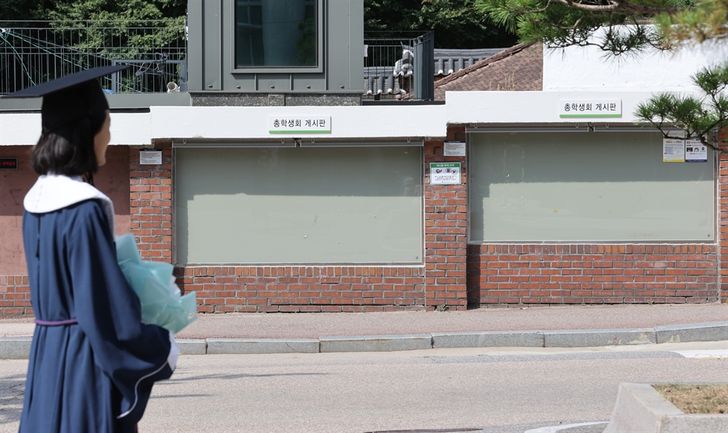
A student wearing a graduation gown stands on Sungkyunkwan University's campus in Seoul, Monday. Yonhap
In addition to the disruptions in social activities, the pandemic has also impacted the students' academic lives.
Seo said, “Communication with professors was highly limited during online lectures even when the classes were conducted in real-time. Asking questions and receiving feedback would have been much easier in regular in-person classes.”
“Once, the screen froze due to a connection failure during a lecture.... I got very anxious, as the material we were covering could be on the exam. I had to ask the professor to upload a recorded version of the lecture later,” Jeong recalled.
These two are among many students across the country who are unhappy with online classes.
Since the COVID-19 outbreak, many students here have been insisting that it is unreasonable for schools to charge the full amount of tuition, as the quality of the online classes is inferior to that of in-person ones, and as the students are not using on-campus facilities such as lecture halls, libraries, gyms and cafeterias.
In July 2020, some 3,500 students across the country filed a lawsuit against the Ministry of Education and 42 universities seeking refunds due to the disruptions in learning. They demanded a 1 million-won ($855) refund for students attending private universities and 500,000 won for those at public universities.
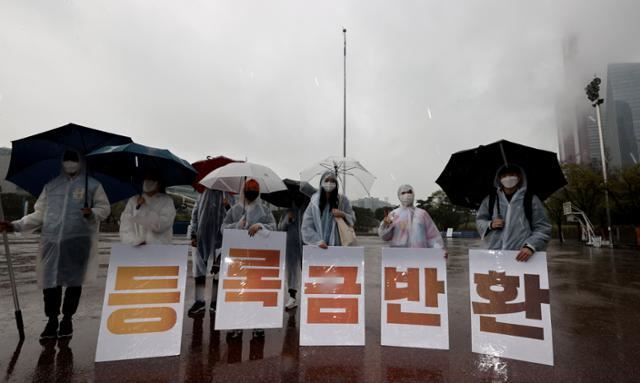
Students hold a protest in Seoul, April 3, demanding a tuition refund from universities, as they insist that the quality of online classes is inferior to that of in-person ones. Yonhap
The prolonged pandemic has not only affected freshmen and sophomores, but also juniors and seniors.
“I was looking forward to my junior year in order to apply for an exchange student program. I think the chance to study abroad is one of the best experiences offered to a college student,” said a junior at Korea University majoring in Russian language and literature, who wished to be identified only by her surname Lee.
But the coronavirus outbreak derailed her plans to go to Moscow last year, as the exchange program was cancelled.
“It was very discouraging. It's very difficult to study Russian without being able to communicate with native speakers in person,” Lee said.
Due to the COVID-19-induced disruptions in campus life, a growing number of students are choosing to take time off from school, according to a recent survey conducted by Job Korea.
Of the 1,470 respondents, 44 percent said they were planning to take leaves of absence during the upcoming fall semester, up from 19 percent on the same survey in 2019.
While more than half, or 60 percent, of seniors said that the main reasons were to acquire certificates and licenses or to participate in internship programs, 30 percent of the freshmen said that they did not want to attend online classes.
Nevertheless, the struggles experienced by college students are expected to continue in the fall semester, as universities have decided to maintain online classes amid the fourth wave of infections here.
Seoul National University announced that it will keep classes online until the end of September, while many other schools in Seoul, including Yonsei University and Korea University, said that they will continue with online classes dependent on the Level 4 social distancing measures.