Debate ignited over statues in Songdo park of boys urinating

Statues of three boys urinating into the lake stand at Songdo Central Park, Incheon. Yonhap
By Bahk Eun-ji
A controversy has arisen over three statues of boys urinating in the middle of a large park in Songdo, Incheon, with some residents and visitors calling the pieces showing the boys' genitalia inappropriate as a public artwork.
According to the Incheon Free Economic Zone Authority, Friday, two complaints have been filed with the Anti-Corruption and Civil Rights Commission, asking for the removal of the statues installed in Songdo Central Park.
The statues, which are also fountains, depict three boys with their pants down urinating toward the lake. Installing it in 2011, artist Kim Young-gul said he created them based on his childhood memory that children wandering around mud flats in Songdo to catch clams used to urinate in the middle of mud flats when they couldn't go to a bathroom.
However, those who filed the complaints said it is unpleasant and uncomfortable to see the statues exposing their private parts, saying they don't understand why visitors to the park need to watch such statues of boys urinating.
Early this month, a members of an online community in Songdo, All That Songdo, wrote a similar complaint and said her son attending elementary school began to feel embarrassed about the statues, and she saw many couples on dates around the area startled when they saw them.
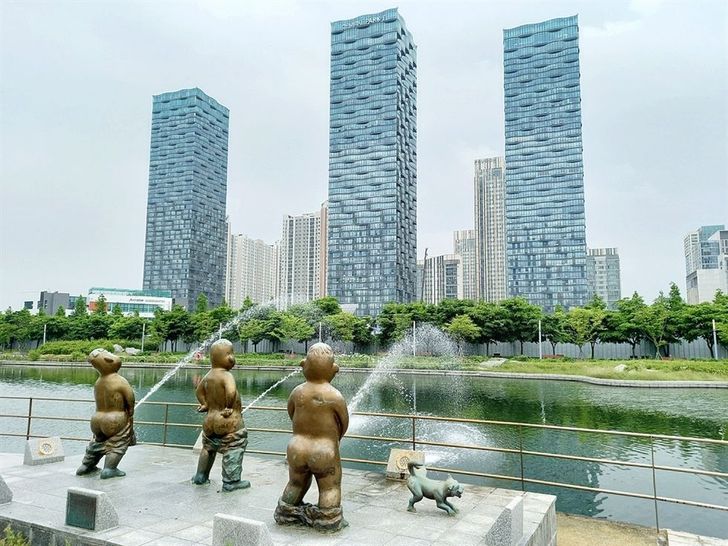
Statues of three boys urinating into the lake at Songdo Central Park, Incheon / Yonhap
“Unlike 10 years ago when they were installed, the social atmosphere has changed, and such artwork seems inappropriate in a public place,” the resident wrote. “The memory of urinating in public is irrelevant to Incheon's history and doesn't match the park's image. I hope other artwork symbolizing Songdo can be installed instead.”
The posting raised controversy over to what extent public art can be allowed, with more than 100 comments being made in just two days.
“It is natural that public perspectives on art change as time goes by,” Lee Dong-yeong, a professor of applied art education at Hanyang University, told The Korea Times.
“Some people can feel uncomfortable, but it can be also accepted as the role of artwork,” Lee said.
Lee also said that just as the statues were socially accepted 10 years ago, they may become acceptable again in the future.
“As the artist created the statues based on his specific memory, if there is an additional explanation about it, people may be able to understand it more easily,” he said.