Shinheung Market renovation underway in Haebangchon

On the left is an existing view of the Shinheung Market in Haebangchon, central Seoul, and on the right is a rendering of the proposed market after undergoing Seoul City's urban regeneration / Courtesy of Seoul Metropolitan Government
By Bahk Eun-ji
Haebangchon, a multicultural hillside neighborhood in Seoul's Yongsan District, has been a trendy spot to hang out. The area is known for its high foreign population and proximity to Itaewon, which is popular for nightlife and diverse foreign foods.
“Haebang” means “liberation” in Korean. The name came as people returning from abroad or fleeing from North Korea settled there after both the country's liberation from Japanese colonial rule in 1945 and the 1950-53 Korean War.
Between the 1960s and 1970s, the neighborhood was bustling with knitting factories. But the textile industry has since waned, and Shinheung Market, located along a topographical high point in the area, has been losing its luster.
Later in the 2010s, relatively lower rents attracted artists looking for studio spaces as well as foreign nationals who needed accommodations at reasonable prices. It then became a trendy new spot with many cafes, eateries and art spaces. The market, located just off the Haebangchon five-way intersection, has also become a popular filming location for Korean dramas, such as “When the Camellia Blooms” and “Itaewon Class.”
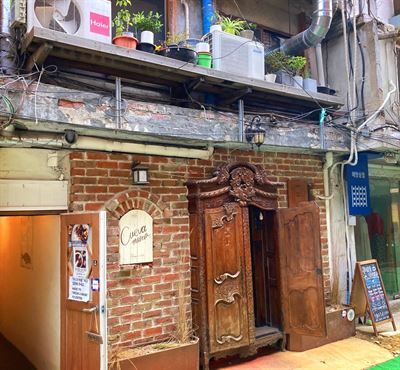
A coffee shop located near Shinheung Market in Seoul's Haebangchon. Courtesy of Seoul Metropolitan Government
The Seoul Metropolitan Government announced an urban regeneration project for the Haebangchon area in 2014 to revive the residential area and the market. It said last week that the project will be completed within this year, with the market's remodeling being the last stage of the multi-year project.
It plans to remove the old slate roofs that have given the market a dreary ambience and set up arched roofs to let in more lighting by the second half of this year. The plans also call for renovating the old public restrooms and installing surveillance cameras.
The city government said that although the development began in December 2019, residents and merchants asked to change the location of support pillars during the construction process, so the renovation period has been extended for an additional eight months to collect their opinions.
Before the market renovation began, the city refurbished stairs and slopes in the neighborhood, installing more streetlamps and surveillance cameras in the alleys and renovating 127 houses.
“Shinheung Market, the center of Haebangchon's history, has undergone ups and downs for 70 years,” said Ryu Hoon, head of the urban planning division in the city government. “Through the renovation, we hope that the neighborhood and market will regain its vitality as an economic and cultural base of the area.”