After years of teaching in Kenya, Park is still hungry about promoting Korea

Park Yuhjin, second from right, a visiting professor of Korean studies at the University of Nairobi's Department of Linguistics and Languages, joins her students during a Korean food festival at the Korean ambassadorial residence in the Kenyan capital of Nairobi, April 8, 2017. Park initially planned to teach for two years after arriving in Kenya in 2013 but has extended her stay because she loved teaching the students. Courtesy of Park Yuhjin
By Yi Whan-woo
Park Yuhjin, a visiting professor of Korean studies at Kenya's University of Nairobi, says the school has a long way to go in promoting Korea after becoming the first East African university to offer such courses in September 2013.
“I would not say that Korean studies has contributed significantly in raising the awareness of Korea in Kenya and the region,” Park, 39, told The Korea Times in a recent email interview.
But she implied its contribution is insufficient only when compared to her far-higher standards and vision for setting up East Africa's first center for Korean studies. In fact, Korean studies education has expanded in Kenya since her arrival although she remains the only teacher.
The number of students taking Korean studies classes grew from a single digit to as many as 70 in 2016 and 2017.
“The increase was too much for me to cope with,” Park said, adding the school has since then restricted the maximum number of course takers to 35 per semester.
The courses being offered range from Korean language to history, culture, literature, economics, politics and translation, with some being offered online with the support of the Korea Foundation. Operated under the wing of the Ministry of Foreign Affairs, the foundation sent Park to Kenya in accordance with its task of public diplomacy.
Among East Asian countries, Korean studies at the University of Nairobi may fall short of Chinese studies but lead Japan studies, she said.
In cooperation with the Chinese government-affiliated Confucius Institute, the Chinese studies course was founded seven years before the Korean studies one, and has more than 10 professors and lecturers, both from China and Kenya.
The school also has the Center for Chinese Studies that is run separately from the Department of Linguistics and Languages where the Korean studies program belongs.
For Japan studies, a Japanese professor who teaches English literature attempted to open Japanese language and other courses but it did not work out.
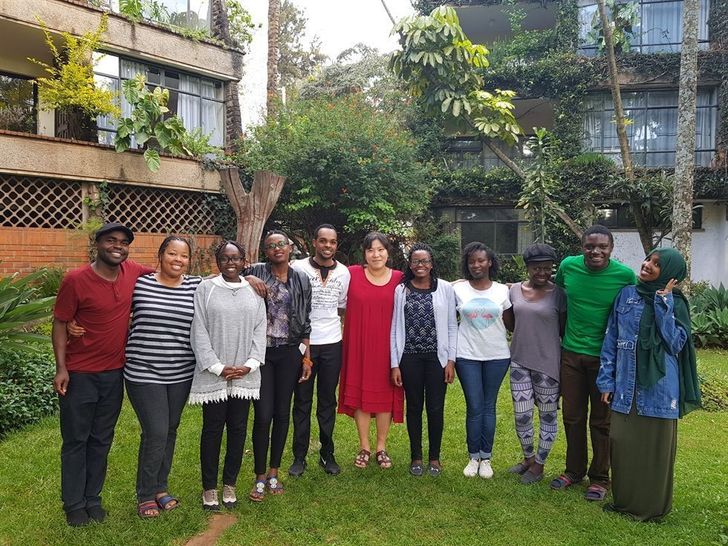
Park Yuhjin, center, a visiting professor for Korean studies at the University of Nairobi's Department of Linguistics and Languages, poses with her students while inviting them to her house in the Kenyan capital of Nairobi, June 6, 2018. Courtesy of Park Yuhjin
“I can see that the students, through me, get to know about Korea, love Korea and broaden their perspective on the world,” Park said. “It makes me proud and think of my life worthwhile … and I look forward to seeing students and other graduates contribute to society in relation to their knowledge and positive views on Korea.”
She viewed that nurturing accurate knowledge and information on Korea is becoming more important, with more Kenyans becoming familiar with the country.
“I often hear people greeting me by saying 'annyeonghaseyo,' not 'nihao' (Chinese greeting) which I frequently heard when I first arrived. I also hear BTS songs when I go to the shopping mall. And all these changes, although not led by the university and its Korean studies program, make me try harder at my job.”
After finishing graduate studies in Korean language education, Park applied to be a visiting professor recruited by the Korea Foundation, and she had choices of Kenya, Paraguay or the United Arab Emirates as destinations.
She picked Kenya because she “wanted to go as far as possible from Korea.”
She initially planned to teach there for two years, but extended her stay because she “loved to teach the students who were full of passion and curiosity.”
Among her goals during her open-ended stay are creating a Korean-language textbook “customized for Kenyans” and making efforts for Koreans to correct any stereotypes or biases toward Kenya.
“Regarding the goal of establishing the first center for Korean studies in East Africa, I at least want to lay groundwork if the establishment is not possible during my time here,” Park said.