Zero-waste lifestyle draws attention during pandemic

The zero-waste movement calling for eliminating trash output completely has attracted attention here as plastic waste has been piling up at an alarming rate amid increasing delivery service use during the prolonged COVID-19 pandemic. / gettyimagesbank
By Jun Ji-hye
Jeong Hyun-mi, a 37-year-old office worker in Seoul, used to buy kimchi packed in a plastic container at a traditional market near her home at least once a week, because both she and her husband are lovers of the country's favorite side-dish.
But now, she has started to take a personal food container to the market when buying the traditional fermented cabbage dish, ever since she learned about the zero-waste movement last year.
“I felt uncomfortable about throwing away single-use plastic containers after I watched the news. I learned that plastic waste has been piling up at an alarming rate during the COVID-19 pandemic, because people stuck at home have come to depend more on online shopping for food and daily necessities,” Jeong said.
According to the Ministry of Environment, the amount of plastic waste in Korea increased year-on-year by 14.6 percent between last January and August amid the pandemic. The country confirmed its first COVID-19 case Jan. 20 last year.
“I believe the COVID-19 outbreak is a crisis caused by environmental problems, so I decided to do what I could do to stop these,” she said.
The zero-waste campaign has attracted the attention of a growing number of Koreans, as environmental problems such as waste collection and climate change have come to the fore amid the pandemic. Many communities around the world have already been working toward eliminating waste.
Though the zero-waste movement has been defined in various ways by different entities, the Zero Waste International Alliance defines it thus: “The conservation of all resources by means of the responsible production, consumption, reuse and recovery of products, packaging and materials without burning and with no discharges to land, water or air that threaten the environment or human health.”
Amid a growing awareness of the zero-waste drive, which calls on both manufacturers and consumers to adopt these practices, an increasing number of people have begun to use personal cups instead of disposable items at coffee shops, as well as eco-friendly bags at supermarkets. People have also opted for goods made of materials that are less harmful for the environment.
Park Mi-young, a 36-year-old elementary school teacher in Gyeonggi Province, has been using food waste bags made of corn starch, instead of plastic bags, for the past two years.
“I heard that food waste bags made of corn starch decompose naturally, unlike plastic bags,” she said. “It is almost impossible for us not to produce waste, but at the least, I wanted to break my plastic habit,” she said.
For consumers willing to participate in the zero-waste drive, several eco-friendly shops are helping reduce waste by selling plastic-free items.
Almaeng Market, which opened last June in Seoul's Mapo District, sells cosmetics, shampoo, detergent, coffee beans and various kinds of grain without containers. Visitors are asked to put the amount they need into reusable containers that they bring, and pay for the products per gram. Almaeng means “substance” in Korean.
The store has gained in popularity, especially among those in their 20s and 30s, with the number of daily visitors reaching 40 to 70.
“We wanted to be able to use stores like Almaeng Market, but there have been few such stores. Almaeng Market realized our dream,” Koh Geum-sook, an environmental activist and one of the three co-owners of the store, said during an appearance on the YouTube channel, “discourselong.”
“Consumers should move more actively to participate in the zero-waste drive, as doing so can change production and distribution processes, as well as eventually change policies.”
Large companies are also moving to promote the zero-waste campaign.
Korean cosmetics powerhouse Amorepacific opened a “refill station” at the Amore Store in Gwanggyo, Suwon, in October, a first among domestic cosmetics firms.
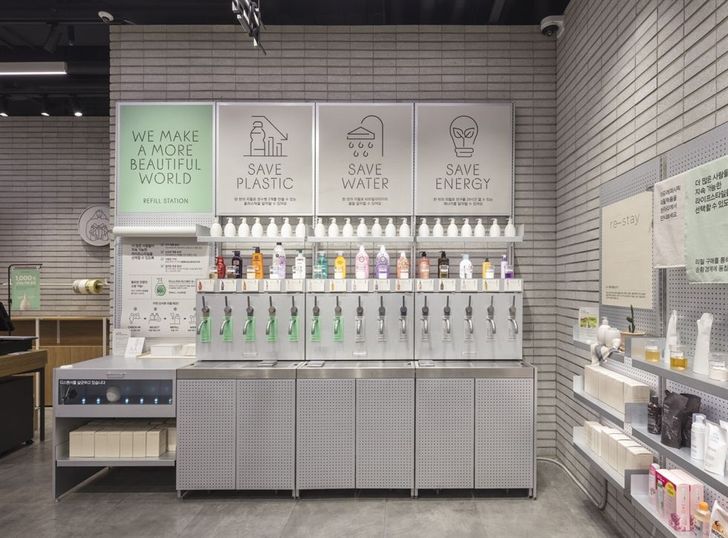
Amorepacific's “refill station” located within the Amore Store in Gwanggyo, Suwon, sells shampoo and body wash products in the amounts customers want, by filling up reusable containers made of coconut shell. / Courtesy of Amorepacific
The refill station sells 15 shampoos and body washes in the amount customers want by filling up reusable containers made of coconut shell.
The containers are recyclable, and products sold there are about 50 percent cheaper than products that come in containers.
“We opened our refill station in line with growing demand for refill products and the need for a change in the way we sell products,” an Amorepacific official said. “We have received positive responses from our customers in delivering this new experience, while promoting eco-friendly values and high-quality service.”
Environmental activist Heo Seong-eun, who works for Green Korea, said reducing waste is an urgent task facing Korea as it has become more difficult to find landfill sites. The search for such new sites sometimes causes regional conflict and concerns over pollution.
“The spread of the zero-waste movement is meaningful in that more people are showing a willingness to participate in activities to reduce waste,” Heo said. “But I think the government and large companies have been way behind. They have failed to keep up with these changes in the view of citizens. The government should create policies aimed at discouraging companies from using plastic, rather than asking citizens to reduce their use of plastic.”