Gangdong's ice pack reuse program receives positive response from residents
By Bahk Eun-ji
Many people have been using delivery services instead of shopping outside due to the prolonged pandemic, and the surge in demand for parcel deliveries has inevitably pushed up the use of cold packs.
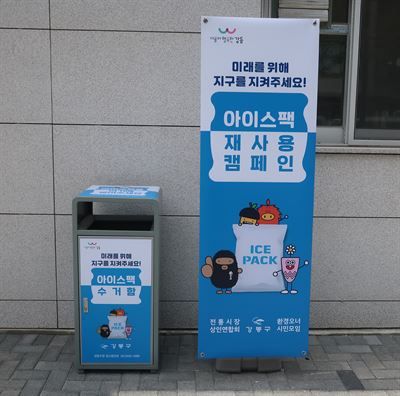
A collection box for cold packs set up at Gangdong District Office in Seoul / Courtesy of Gangdong District Office
These cold packs are filled with super-absorbent polymers, a type of micro-plastic, and have sparked concerns over environmental and health risks, as the substances inside can release harmful gases such as dioxins when incinerated and their decomposition in landfills can take up to 500 years.
According to data from the Ministry of Environment and Statistics Korea, the number of cold packs used in Korea is estimated to be over 250 million annually, and most of them are dumped into the garbage.
In order to solve the problem, Gangdong District Office established a cold pack collection system in February last year based on the idea that the packs can be reused as much as possible. Gangdong was the first local government to do so across nationwide.
Collection boxes for the packs have been installed in 18 places, including the district office, so that any resident can easily participate in the eco-friendly practice. After cleaning, sterilizing and packaging, the collected packs are supplied for free to anyone who wants them.
This year the district office signed an agreement with civic groups, merchants at traditional markets in the district as well as small business owners to provide them with the cold packs.
“After collecting 70,000 cold packs last year, we collected 123,900 this year, which was equivalent to reducing 62 tons of waste and 32 tons of greenhouse gases,” a district official said.
In addition, the district office is also carrying out another type of recycling program using the packs. It is encouraging residents to make air fresheners or mosquito repellent with the abandoned packs and distribute them to senior citizens living alone.
As the eco-friendly collection system became popular, other local governments across the country have begun benchmarking Gangdong's system, which also won the Policy of the Year award in 2019 from a local daily, and another award for innovative policy for residents from the Ministry of Interior and Safety this year.
“Protecting the environment begins with small actions. We ask citizens to participate in such small environmental protection activities such as reusing cold packs, sorting plastic bottles for recycling and reducing the use of disposable products,” said Lee Jung-hun, head of Gangdong District Office.
“We will actively pursue policies that enhance the quality of life of our residents based on eco-friendly programs that lead the district to transform into a green area.”