Gov't to provide financial support for children born abroad amid pandemic
By Bahk Eun-ji
The government plans to provide financial support to parents with pre-school and elementary-age children regardless of their “nationality” amid a controversy over the exclusion of foreign nationals from the “special childcare support fund,” according to the minister of education. The fund has been created to reduce the public burden during the COVID-19 pandemic.
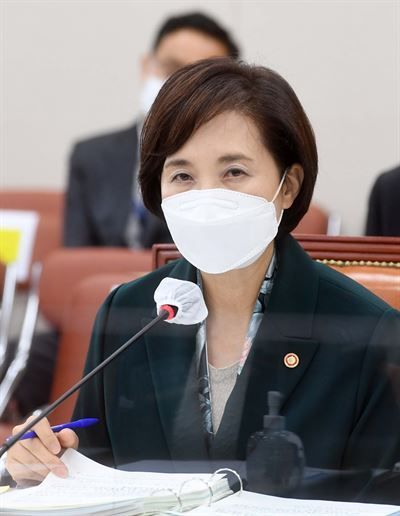
Education Minister Yoo Eun-hae /Yonhap
In response to a question from Rep. Kang Min-jung of the ruling Democratic Party of Korea (DPK) during an audit by the National Assembly Education Committee on what the government will do to support students of parents with foreign nationality, Deputy Prime Minister and Education Minister Yoo Eun-hye said the ministry has been reviewing the matter at the request of municipal and provincial education offices.
“But the National Election Commission said it could not be done by the education office itself because it could violate the Election Law, and that it would be possible if the central government gives guidelines for children with foreign nationality,” Yoo said. “We are making practical preparations so that they can give the funding at the same time to parents of middle school students.”
Under the government's fourth supplementary budget aimed at assisting the unemployed and parents, the amount of special childcare subsidies to be offered is 200,000 won ($173) per preschool and elementary school student, and 150,000 won per middle school student. Subsidies for middle school students will be paid in October.
However, some pointed out that students with foreign nationality were excluded from the list of beneficiaries. On Sept. 29, Cho Hee-yeon, superintendent of the Seoul Metropolitan Office of Education, wrote on Facebook calling for the education ministry's cooperation.
“The government should also provide the 200,000 won subsidy to Seoul students with foreign nationality,” he said. “In Seoul alone, about 5,000 students with foreign nationality attend school, and their parents are obligated to pay taxes. It is discrimination against them and doesn't make sense.”
Cho then said it is unjust to impose obligations and deny rights, as families of students of foreign nationality are also responsible for paying taxes, such as income tax.
He also criticized the government, citing the Seoul Student Human Rights Ordinance which states that students have the right not to be discriminated against due to their country of origin and ethnicity.