Clean air not a given but a result of cooperation
By Jun Ji-hye
Improving the quality of the air we breathe has been of major public interest in recent years amid mounting concerns about the potential health risks posed by worsening fine dust pollution.
Environment Minister Cho Myung-rae stressed that government and citizens, together with the international community, should cooperate in reducing the level of fine dust particles, because clean air is never a given, but only attained by mutual effort.
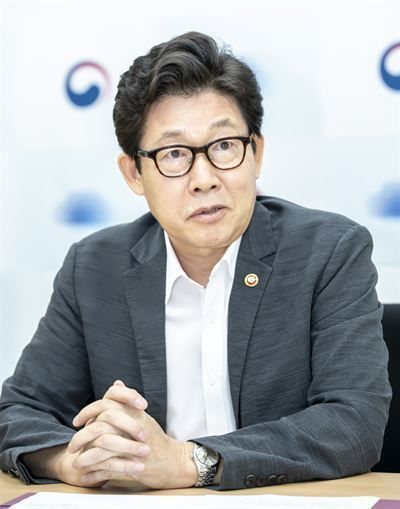
Environment Minister Cho Myung-rae speaks during an interview with The Korea Times at the Greenhouse Gas Inventory and Research Center in Seoul, Sept. 2. / Courtesy of Ministry of Environment
The minister made the remarks during a recent interview with The Korea Times on the occasion of the International Day of Clean Air for Blue Skies, falling on Monday, which is being observed starting this year.
“Removing or reducing factors that result in fine dust is the key to improving air quality. All of us should make every effort to have breathable clean air, because it is not a given, especially these days,” Cho said. “For its part, the government has worked hard to establish a variety of policies aimed at reducing fine dust levels and enhancing cooperation with other countries such as China.”
A resolution to set Sept. 7 as the International Day of Clean Air for Blue Skies was endorsed at the 74th session of the U.N. General Assembly in December last year.
The endorsement was the result of the country's diplomatic efforts that were given after President Moon Jae-in had proposed the designation of a clean air day during a keynote speech at the U.N. Climate Action Summit in New York last September.
It is the first U.N. commemorative day to be designated at the proposal of the Korean government.
“The nation's policies aimed at resolving the fine dust problem are expected to gain momentum following the designation of a clean air day,” Cho said. “In addition, it will help strengthen international cooperation with other Asian countries such as China, as well as other nations around the world, in addressing the air pollution issue.”
The U.N. in New York, the U.N. Environment Programme in Nairobi and the U.N. Economic and Social Commission for Asia and the Pacific in Bangkok have prepared various events and web seminars to commemorate the day.
Domestically, the National Institute of Environmental Research is planning to invite ambassadors of 13 countries including Indonesia, Friday, to share information about Korea's air quality monitoring platform that utilizes the geostationary environmental monitoring satellite launched for the first time in the world in February.
Regarding arguments that the COVID-19 pandemic, which has significantly slowed down human activities, has brought back clear skies this year, the minister said, “The pandemic could have partially contributed to lower fine dust levels this year, but other factors such as the government's policies and weather situation are also believed to have contributed to cleaner air.”
According to government data, the number of days when the level of ultra-fine dust was “good” was 74 between January and July, up by about 70 percent compared to the same period over the past three years.
“We cannot say COVID-19 was not a reason for the improved air quality this year. But we cannot say we saw clearer skies just because of the pandemic, either,” he said. “What is important is that we need to step up efforts to improve air quality as the fine dust problem could get worse at any time.”
Cho said the government will put a top priority on reducing greenhouse gas emissions by 24.4 percent by the end of 2030 from the 709 million tons in 2017, while complying with the Paris Agreement.
“In the long term, the government is aiming to be carbon neutral by 2050,” he said.