Epidemiologists raise concerns over gov't's CSAT plan

Students take a practice university entrance exam in this July 8 photo. Korea Times file
By Bahk Eun-ji
Epidemiologists raised concerns Wednesday over the government's safety measures against COVID-19 for the national university entrance exam on Dec. 3, calling them “inadequate” and “ill-prepared.”
On Tuesday, the Ministry of Education announced the plan for the College Scholastic Ability Test (CSAT), Tuesday, including safety measures for the test which nearly 480,000 students will take amid the COVID-19 pandemic.
Although the safety measures were jointly made with the health authorities, infectious disease specialists pointed out that additional measures are needed for the sake of students' safety. They say that stronger measures should be taken to prevent the spread of infectious diseases among students due to the nature of the CSAT, in which hundreds of thousands of exam-takers stay in one place for more than eight hours.
According to the guidelines, 1,185 test sites will be set up in accordance with quarantine protocols. The number of test-takers per classroom will be limited to a maximum 24, down from the usual 28. Plastic partitions will be also installed on all desks in the test rooms. All test-takers should wear face masks and have their temperature checked.
Infectious disease experts said, however, downsizing the number of test-takers per room from 28 to 24 will not be much help in keeping sufficient distance between students. In addition, all invigilators should be tested as a preemptive measure.
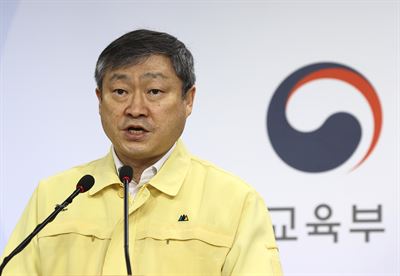
Vice Education Minister Park Baeg-beom announces measures to carry out this year's college entrance examination amid the pandemic, at the government complex in Sejong, Tuesday. Yonhap
“The reduction in the number of applicants for each test room by four is not very helpful in easing the density in the test rooms. We understand it will not be easy to secure additional test rooms and personnel who can monitor and supervise test-takers on the day, but the government should really allocate more money so that we can reduce the number of applicants by three to four more per room to keep the distance,” said Kim Woo-joo, a professor of infectious diseases at Korea University Guro Hospital.
Kim said when the weather gets cold, it will be more difficult to tell the difference between people with influenza and COVID-19 due to their similar symptoms. “In that sense, more space is definitely needed for those who show symptoms,” he said.
In a press briefing on Tuesday, Vice Education Minister Park Baeg-beom said it is difficult to further reduce the number of students per test room because when the number is reduced by four people, at least 17 percent more personnel will be needed for monitoring and supervising.
In response, Eom Joong-sik, an infectious disease specialist at Gachon University Gil Medical Center, said if students can keep adequate distance in classrooms, the partitions will not be needed.
“But if keeping distance is difficult due to the limited space, installing a three-sided screen which blocks the front and both sides of the test-takers can also increase the effectiveness of preventing the virus spreading,” Eom said.
The experts also raised concern that supervisors could possibly spread the virus to students. In order to prevent this, it was pointed out that all exam supervisors should undergo COVID-19 tests before the test day, and supplementary supervisors should also be secured.
“We have observed many confirmed patients who didn't show any symptoms, so the supervisors should be tested in advance. We also need to secure supplementary proctors in preparation for the possibility of anyone being replaced in the middle of the test day,” said Cheon Eun-mi, a pulmonologist at Ewha Womans University Mokdong Hospital.
The education ministry said all students will be divided into three groups ― general exam-takers, test-takers under self-quarantine measures and those who were confirmed with infection. Students infected with the virus are allowed to take the test in hospitals or other government institutes. Those in self-quarantine should travel by car or ambulance to take the exam in separate testing sites. If a student has a fever at the test site, they will take the test in a separate room inside the test-site building.
The size of the separated test rooms will be decided in November, considering the situation by region, the education ministry said.