Public housing to be increased for singles
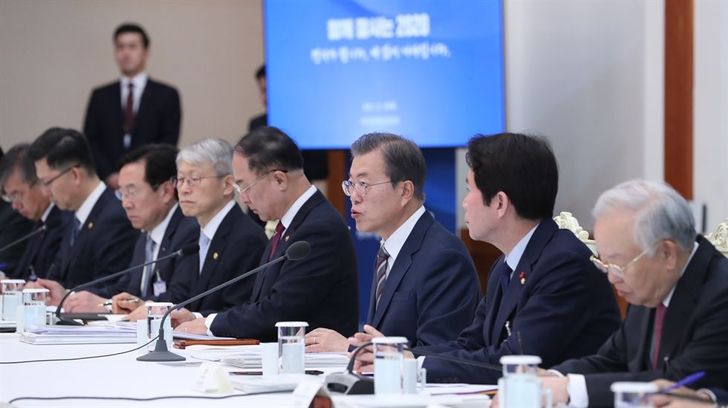
President Moon Jae-in speaks during an economic policy meeting with ministers and senior secretaries at Cheong Wa Dae, Thursday. / Yonhap
By Lee Suh-yoon
The government will ramp up public housing and other social services for single-person households next year, according to President Moon Jae-in's economic policy meeting with ministers and senior secretaries, Thursday.
The announcement follows the President's call for comprehensive housing and welfare measures for this demographic group earlier this week. According to a recent report by Statistics Korea, four in 10 households will be comprised of just one occupant. Currently, single-person households make up 30 percent of registered family units.
“Housing policy must now move away from using the four-person household as the standard to offer a specialized housing supply to one-person households,” President Moon said during a policy meeting on Monday.
The most concrete measure the Moon administration put on the table Thursday is public housing. The government plans to expand construction of public housing units designed for one occupant. Such units built by Korea Land and Housing Corporation (LH) charge occupants only half of the market-price rent. Currently, a one-room studio of around 23 square meters in an LH residence building in Seoul costs about 250,000 won ($215) per month.
Numbering almost 5.8 million last year, single-person households make up a tenth of the population. However, 35.9 percent of them earn less than 2 million won a month, according to recent government stats. The government hopes providing subsidized housing can meaningfully lighten the economic burden for low-income earners in this group, especially in Seoul where housing prices have risen way above most residents' income level.
A special taskforce has been set up to flesh out details on the public housing expansion and other recommended policies. The taskforce will also look into building 77,000 more dwelling for newlywed couples and 550 more state childcare facilities, in hopes the support will translate to a higher birthrate. The figure ― the number of expected babies per woman ― fell below 1 this year, scoring the lowest among OECD nations.
At Thursday's meeting the participants also agreed on increasing social services for elderly citizens who live alone, expanding existing social services to provide care to 450,000 persons, from the current 350,000. The government demographic researcher expect over half of single-person households to be over 60 by 2047.