ANNIVERSARY Climate change threatening everyday life

This Aug. 3, 2018 image captured from the website of Earth Nullschool, a provider of global visualized weather information, shows the sea surface temperature around the Korean Peninsula is similar to that of areas in the Tropic of Cancer. Dark red and purple indicate the temperature ranges from 28 degrees to 31 degrees Celsius, while Orange and red mean 23 degrees Celsius to 28 degrees Celsius. The average temperature of the Korean Peninsula from 2015 to 2019 was 13.3 degrees Celsius, up 0.3 degrees from the previous five-year period. / Yonhap
By Kang Seung-woo
Until recently, climate change had often been perceived as happening “over there” and to “someone else.”
Melting glaciers in the remote Arctic threatening the habitat of polar bears, and El Nino and La Nina were believed to be topics for climate scientists to deal with.
However, the time has arrived when the environmental woes are having an impact on the Korean Peninsula ― and much more frequently.
More frequent typhoons
With 21 typhoons forming this year, seven of them directly affected the peninsula, tying 1950 and 1959 for the largest number in any given year. More noticeably, three made landfall here in September alone ― the first time since 1904.
“Due to climate change, sea surface temperatures in the paths of the typhoons have increased to 29 degrees Celsius, leading to more tropical cyclones,” said Jung Jong-woon, head of the Jeju Island-based National Typhoon Center.
According to him, high ocean surface temperatures that help storms intensify and the expansion of the North Pacific anticyclone system resulted in this year's high frequency of typhoons.
“More than half of the typhoons that formed in August and September hit the peninsula,” Jung said.
According to the Korea Meteorological Administration (KMA), six out of 11 typhoons that formed in August and September this year affected the peninsula, compared with four out of 13 last year.
In addition, the number of typhoons that reached the peninsula in October has quadrupled over the past 10 years, leading experts to forecast that Korea will see more intense and frequent storms in that month due to climate change.
In addition to the climate crisis increasing the chances of strong typhoons, it has also brought heavier rainfall.
“Nowadays, we have increasingly had torrential rain of over 100 millimeters per hour and this is due to higher temperatures and humidity, caused by climate change,” a KMA official said.
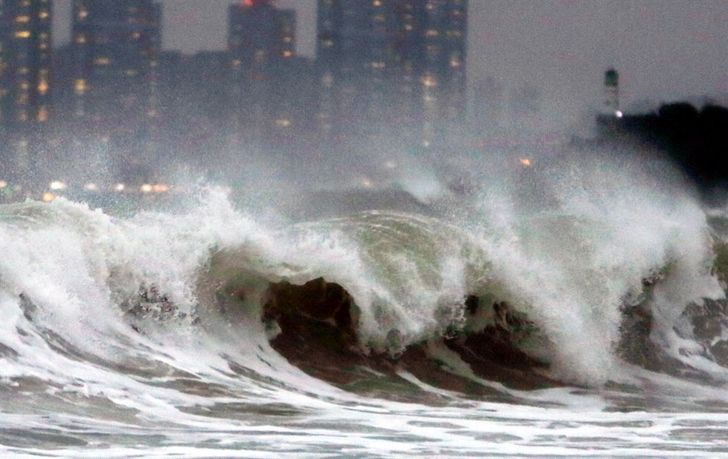
High waves roll off the coast of the southeastern city of Busan, Oct. 2, as the approaching Typhoon Mitag dumped heavy rains in the southern parts of Korea. In September alone, three tropical cyclones hit the Korean Peninsula ― the first since 1904 ― and climate experts believe climate change has affected the high frequency of typhoons. / Yonhap
Heat wave
In September, the World Meteorological Organization (WMO) forecast that the five years from 2015 to 2019 will have been the hottest five-year period ever recorded.
“The five-year period from 2015 to 2019 is likely to have been the warmest of any equivalent period on record globally, with a 1.1 degrees Celsius global temperature increase since the pre-industrial period and a 0.2 degrees increase compared to the previous five-year period,” the WMO said in a report.
“Compared to the previous five-year assessment period from 2011 to 2015, the current five-year period 2015 to 2019 has seen a continued increase in carbon dioxide (CO2) emissions and an accelerated increase in the atmospheric concentration of major greenhouse gases (GHGs), with growth rates nearly 20 percent higher.”
Worse, Korea is warming more rapidly than other countries as its average temperature rise and increased greenhouse gas emissions are above the global average.
According to the KMA, the country's average temperature for the five-year period was 13.3 degrees Celsius, up 0.3 degrees from the previous five-year period.
Its CO2 concentration last year, measured at the KMA's Global Atmosphere Watch Observatory on Anmyeon Island in South Chungcheong Province, was 415.2 parts per million (ppm) ― the global CO2 concentration is on track to reach 410 ppm by the end of 2019. The CO2 concentration has grown by 2.4 ppm per year here over the past decade, compared with the global average of 2.3 ppm.
Last year, Korea recorded the longest period of extreme heat when the mercury hit 40.3 degrees Celsius in the northeastern town of Hongcheon, Gangwon Province, Aug. 1, the highest temperature since 1907 when the country began measuring weather activity. In addition, the temperature in Seoul also soared to its highest level in 111 years.
Last August, the environment ministry announced that the dangers of extremely hot weather will increase nationwide rapidly over the next decade if the government's efforts to reduce greenhouse gas emissions fall through.
“The nation's increasing CO2 concentration and temperature rises were higher than the global average, prompting the need for the government to take aggressive actions to fight climate change,” KMA Administrator Kim Jong-seok said.
Fish catch
Climate change has taken a toll on fish populations globally, with the East Sea also falling victim to the climate crisis, according to a recent study.
Scientists from Rutgers University published the study in March saying that warming ocean waters had led to an estimated 4.1 percent drop on average in sustainable catches for many species of fish and shellfish from 1930 to 2010.
The greatest loss was found in the East Sea, or the Sea of Japan in the study, with an estimated decline of 35 percent.
According to a Statistics Korea report on climate change-related fishing, released in June 2018, rising ocean temperatures have changed what kinds of fish are caught around the peninsula.
In general, warm-water fish, including mackerel and anchovy, are being caught more as the populations of cold-water species such as pollack and Pacific saury are falling.
In the East Sea, the amount of pollack caught in 1970 was 11,411 tons, but it drastically declined to 1 ton last year. That of Pacific saury also decreased by 97 percent from 22,281 tons to 725 tons during the same period.
On the other hand, catches of anchovy increased from 400 tons to 47,874 tons in the West Sea.