2 wild boars found dead with traces of African swine fever
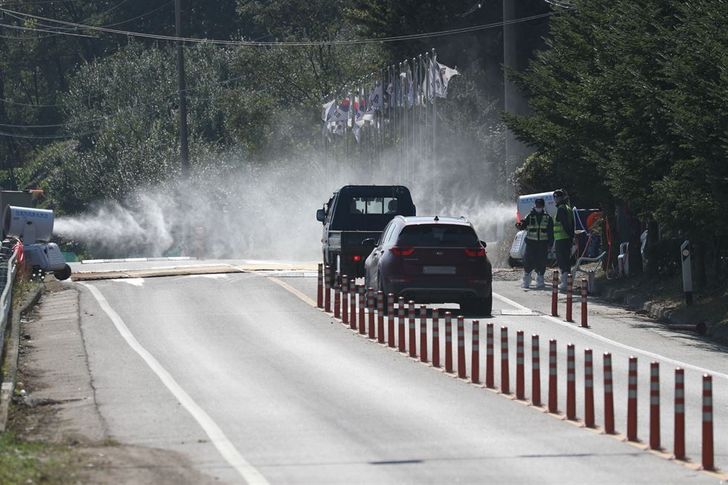
Staff of the Animal and Plant Quarantine Agency, who have been battling the spread of African swine fever for weeks, fumigate vehicles on the road bordering Gyeonggi Province's Yeoncheon and Cheorwon counties. Yeoncheon is one of the regions where the disease has been confirmed. Yonhap
The Animal and Plant Quarantine Agency found two dead wild boars with traces of African swine fever (ASF) north of Seoul, Saturday, raising concerns over the spread of the deadly disease.
One of the boars was found in Cheorwon, 90 kilometers north of the capital, according to the Ministry of Environment, and the first time a possible ASF vector has been discovered in Gangwon Province.
The other was found in Yeoncheon County in Gyeonggi Province that has seen two cases of ASF at pig farms. Earlier, another boar was found dead in the Demilitarized Zone in the area.
The government has confirmed 14 cases of ASF at local pig farms since mid-September, when the country experienced its first-ever outbreak of the disease.
All of the cases were reported in Gyeonggi Province and Incheon, adjacent to North Korea, which experienced its own outbreak earlier this year.
The disease is not harmful to people, but is fatal for pigs, and there is no cure currently available.
How the virus arrived in South Korea remains unknown, although some suspect that it came from the North. The disease is spread through direct contact with animals carrying the virus or by contaminated feed.
The environment ministry said that although it is unlikely the wild boars traveled into the country straight from the North, it is possible the infection came from there indirectly.
"We urge local farms to check their fences to prevent possible contact between pigs and wild boars," Agricultural Minister Kim Hyeon-soo said during a meeting at the Sejong Government Complex.
Quarantine officials have been implementing all-out operations to tackle the virus, especially focusing their efforts on preventing it from traveling south.
The ministry, which earlier decided to slaughter all pigs within a 3-kilometer radius of infected farms, has culled more than 150,000 animals since the outbreak was detected.
Additionally, the ministry is currently purchasing pigs from other farms outside of that range in selected towns ― Paju, Gimpo, and Yeoncheon ― to be slaughtered and inspected before their meat is released on the market. Pigs that are not purchased will also eventually be culled. (Yonhap)