Talks on 2019's minimum wage face bumpy road
By Kim Hyun-bin
Discussions about next year's minimum wage are not going smoothly, as a reform plan for the decision-making process has been pending at the National Assembly and one third of the current members of the Minimum Wage Commission are quitting.
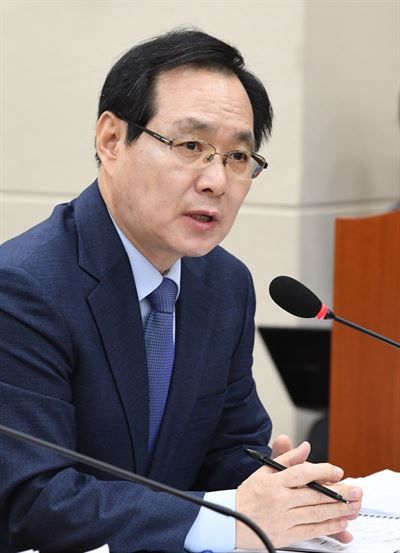
Ryu Jang-soo
Commission Chairman Ryu Jang-soo said, Thursday, he and other members representing the public sector ― the government and experts ― would resign.
They offered to resign in March as the commission was expected to undergo structural changes according to the reform plan. But the reform bill has been pending at the National Assembly amid strife among political parties, and the changes have been delayed accordingly.
“In March, we submitted our resignations (to the Ministry of Employment and Labor) and our plan to resign is still valid,” Ryu said in a media briefing at the Government Complex in Sejong. Their resignation offer has not yet been accepted.
The discussion on 2020's hourly minimum wage has already been going on for about a month, as the commission has been waiting for the Assembly to pass the revision bill. But with the mass resignations and the need to select new public sector members, the talks are likely to be delayed even more and may not meet the Aug. 5 deadline.
The tripartite commission initially hoped to set next year's wage with the new process, but has to follow the existing process for now due to the Assembly's situation.
Currently the commission is comprised of 27 members ― nine each representing labor, management and the public sector.
Under the reform plan proposed by the ministry, the commission will be divided into two sub-bodies ― the range determination body that sets the upper and lower thresholds of a wage hike, and the decision-making body that decides on the hike within the range.
The range determination body will consist of nine experts including professors and researchers, who will provide a suitable wage hike range for the following year's minimum wage. The ministry says the range body will be more objective and fair as the members do not involve unionists or employers, although they will recommend the candidates.
The decision-making body will have seven members each from labor, management and the public sector.
The Moon Jae-in administration had promised to increase the minimum wage to 10,000 won ($8.5) by 2020. To meet the goal, the government raised the minimum wage by 16.4 percent in 2017 and 10.9 percent in 2018.