Preventive manual on sexual assaults at schools released
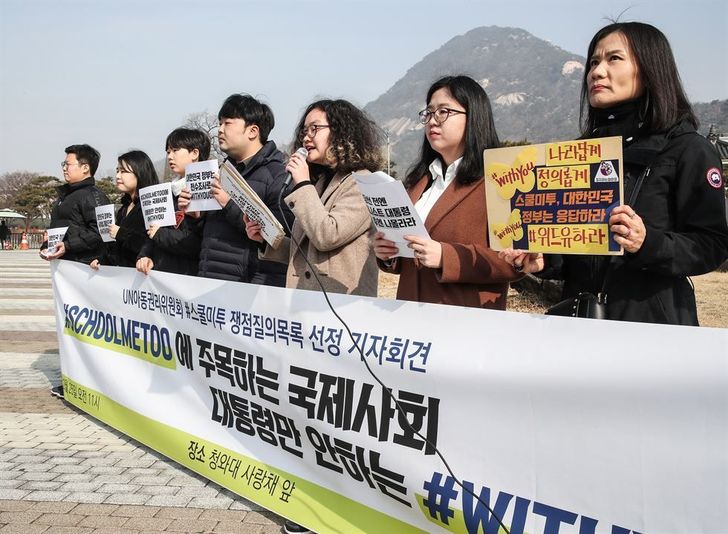
Members of the Feminism for Youth group call for a stronger government response to sexual harassment occurring at middle and high schools in front of Cheong Wa Dae, Monday, after the United Nations Committee on the Rights of the Child included Korea's #SchoolMeToo on its main agenda for its September conference in Geneva, Switzerland. / Yonhap
By Lee Suh-yoon
With just days before the new spring semester, the Ministry of Education has distributed a new manual on how to deal with gender-based violence to schools and educational institutions.
The 80-page manual ― detailing common cases of sexual harassment on campus as well as how to report and investigate them ― is being given out after the ministry came under heavy fire for its inadequate response to the outburst of #MeToo claims at middle and high schools last year.
The ministry's inaction and failure to protect victims who spoke out prompted
two young activists to take their cases to the United Nations
directly last month. Following their visit, Korea's #SchoolMeToo movement ― of a scale and organization unseen in any other country ― was included as one of the main agenda topics for this year's conference run by the United Nations Committee on the Rights of the Child.
In the opening section, sexual harassment is described as “any form of verbal, psychological or physical abuse that encroaches on the sexual self-determination of others,” citing commonly reported cases by female students such as male teachers lifting their skirts too check its length or making inappropriate sexual jokes. Dating violence and online grooming were also categorized as forms of sexual violence female students are subjected to at school.
The manual also includes hotlines for relevant government agencies.
“This manual was made to better protect victims on campus and set up a more systematic response to such cases,” Jung In-sun, a ministry official charged with school innovation policies, said in a press statement Thursday. “We hope that through this manual, a culture of mutual respect and better gender sensitivity can take root between members of the school community.”