Discontent rises over flexible work hour deal
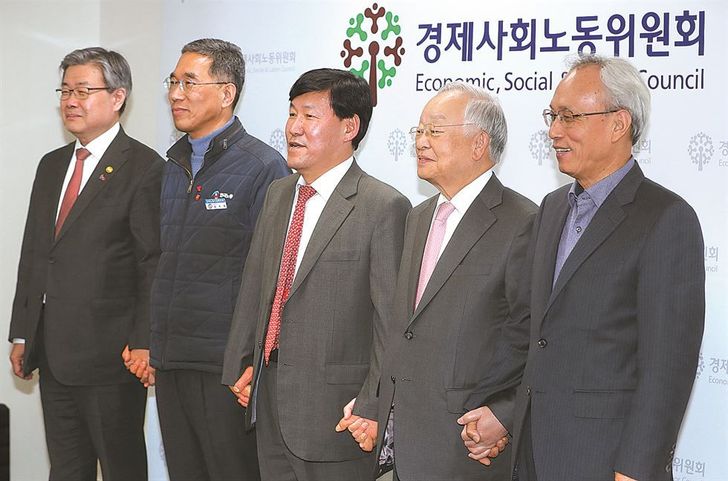
Representatives from the Economic, Social and Labor Council pose for a picture at the council office in Seoul, Tuesday, after an agreement was made to extend the introduction of flexible working hours to six months from the current three months. / Korea Times photo by Bae Woo-han
Labor, management agree on 6-month flexible system introductory period
By Kim Hyun-bin
Representatives from labor and management have agreed to revise the flexible work hour system to further increase its scope.
Although this is the first agreement made following talks and concessions between both sides, neither is fully satisfied ― management says the six-month period for calculating average working hours is not enough for effective business operation, while labor representatives worry it would justify overwork. This has resulted in one of the country's major umbrella unions scheduling to stage a strike.
After two days of marathon discussions, the Economic, Social and Labor Council said Tuesday that the two sides agreed to expand the application period for the flexible work hour system, which allows companies to adjust employees' average daily working hours en masse within six months from the current three.
The agreement came about two months after the presidential advisory body was launched with representatives from labor, management and government, as well as scholars and law experts.
The measure aims to lessen the burden on companies from the recently implemented government policy to cut the maximum work hours to 52 per week.
Currently, businesses can adjust working hours so that employees can work longer during busy periods and fewer hours when things are slower, as long as it does not exceed an average of 52 hours a week over a three-month period.
That period will be extended to six months, the first expansion of the flexible work hour system in 16 years since the three-month period was set in 2003.
However, businesses, which have called for an extension to one year, say the new rule will not have a great effect.
“Many of the mid-sized companies have a continuous peak season of five to six months, so they cannot make the average weekly work hours stay at 52 even with the extended period of six months,” an official at the Korea Federation of SMEs said. “Most advanced countries that implemented a 40-hour workweek made the flexible work hour calculation period to one year for companies that have long peak seasons.”
The Korean Confederation of Trade Unions (KCTU), one of two umbrella labor organizations in the country, slammed the deal, calling it a “change for the worse,” and announced it would hold a strike March 6. It has been refusing to participate in the council's talks, expressing concerns that the revision could offset the effects of the reduced working hours. Only the other organization, the Federation of Korean Trade Unions (FKTU), has been active on the council.
The KCTU says the six-month period would open the possibility the working hours could be extended to 64 hours a week for three consecutive months, exceeding the country's overtime standard of 60 hours a week for 12 consecutive weeks.
“The government, the FKTU and the Korea Employers' Federation have colluded,” the KCTU said in a statement. “The agreement has expanded flexibility to a great extent but it is unclear how overtime work will be paid.”
The KCTU delayed the council meeting for hours Monday by staging a rally nearby to protest the extension of the flexible work hours calculation period.