Finding little support at home, young #MeToo activists take their case to UN

Yang Ji-hye, 21, front, and Baek Kyung-ha, 17, from the Feminism for Youth group which has led the #MeToo movement in Korean classrooms since last year, at The Korea Times office on Jan. 18. The two testified about sexual harassment of students by teachers at the U.N. office in Geneva, Switzerland, over the Lunar New Year holiday. Korea Times photo by Shim Hyun-chul
A year after #MeToo, fight continues against sexual harassment at schools
By Lee Suh-yoon
Three weeks after Yang Ji-hye, now 21, entered middle school, her homeroom teacher rounded up the female students and told them to walk along the outer wall when going up the stairs. Some of the male students had been seen taking “upskirting” photos of their female peers, the teacher said.
“It was a perfect example of how gender-related crimes were treated at school,” Yang recalled in an interview with The Korea Times earlier this month. “Victims were told to be more careful and the issue was just swept under the table.”
It wasn't just male students; sexual harassment by teachers was just as rampant, said Yang, now the representative of Feminism for Youth.
“There was one teacher who everyone knew about. Whenever the new semester started and we had to go to him for one-on-one meetings, we took blankets and thick textbooks to cover our legs and chest,” Yang said, “to make it harder for him to touch us.”
Baek Kyung-ha, 17, currently a student at a private high school in Seoul, says verbal forms of sexual harassment are an everyday occurrence in the classroom.
“The geography teacher would suddenly stop lecturing and ask everyone to imagine a woman in a sexy bikini on a beach that was displayed in a picture on the board,” said Baek, also a member of the group. “An elderly physical education teacher also used to demand we call him oppa.”
Oppa is Korean for older brother, but girls also use it to address male friends and romantic partners.
Revelations like this finally broke through to the surface when the #MeToo movement caught fire at middle and high schools throughout the nation last spring. #SchoolMeToo was the most tweeted phrase in Korea last year.
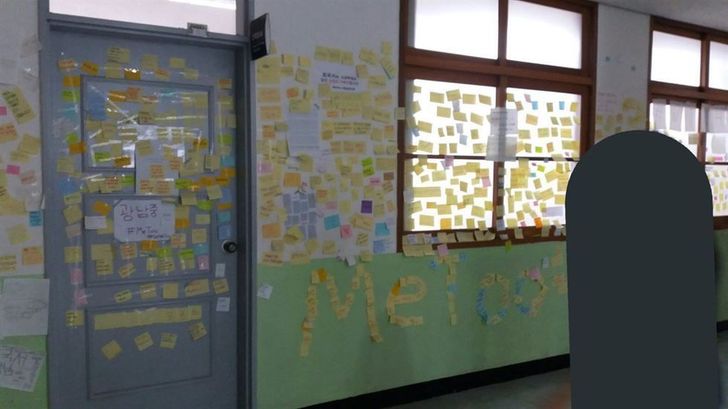
Students' notes call out verbal sexual harassment by teachers at a middle school in Gwangjin-gu, eastern Seoul. Captured from Twitter
“The internet was the only way for students to voice their victimhood, as they could not trust the school administration or the Ministry of Education,” Yang said.
What made it worse was the way the school administration ― and government authorities ― handled the problem.
Prosecutors recently dropped sexual harassment charges against a male teacher at Yonghwa Girls' High School for “a lack of evidence” despite testimony from over 180 students. Graduates and students at the high school led the first round of school #MeToo activism with a flood of shocking revelations last March.
Almost a year later, sexual harassment revelations have continued to surface from middle and high schools. The Ministry of Education, however, has stopped short of carrying out a comprehensive investigation, merely carrying out surveys of a small sample of students and teachers.
“They're afraid the results are going to be too horrendous to handle,” Yang said. “That's why they are holding off a full-fledged probe despite repeated calls.”
The Korea Federation of Teachers' Associations asked the ministry recently for a manual specifying the “extent of physical contact” allowed between teachers and students, saying a complete lack of contact “disrupts educational procedures“ like physical discipline.
Parents ― often known to work up a fury against school administrations for grade scams or school food ― were of little support during the revelations of sexual harassment.
“My parents don't really understand why I participate in school #MeToo activism,” Baek said. “Many parents consider these sexual harassment issues to be personal matters that individual students have to bear through for a few years until they can leave with their university acceptance letter.”
So Baek and Yang decided to make their appeal global.
Over the Lunar New Year holiday, Yang and Baek traveled to the U.N. office in Geneva, Switzerland. They are now testifying before the Committee on the Rights of the Child on the various forms of sexual harassment and violence Korean teens are subject to in classrooms.
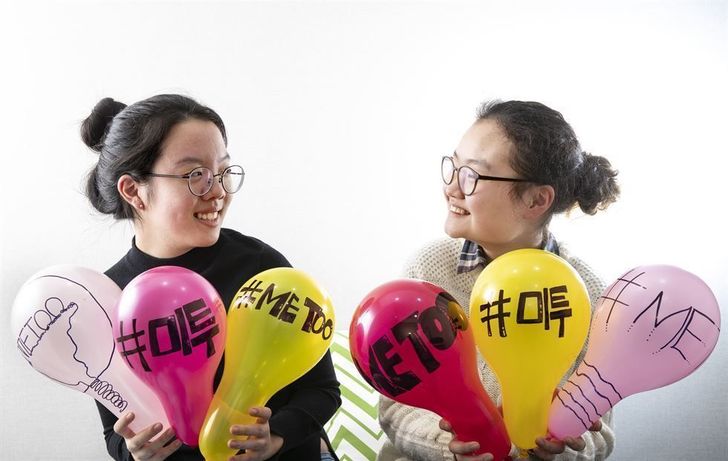
Baek Kyung-ha, 17, left, and Yang Ji-hye, 21, pose with balloons signed with #MeToo messages. Korea Times photo by Shim Hyun-chul
They hope their testimony will help the international community pressure the Korean government for its inaction, pushing it to better protect the identity of #MeToo whistleblowers while punishing the perpetrators.
But Yang, too, admits the problem won't go away with just stricter legal punishment.
“When a teacher makes a misogynistic comment, everyone just breaks out in laughter,” Yang sighed. “In fact, it is so-called witty and ingenious teachers who make jokes that border on sexual harassment. How can we even start a conversation about ending this in such a context?”
Baek says change of a meaningful scale will hinge on better gender equality and human rights education of faculty.
“It's too hard to punish teachers' misogynistic comments one by one ― especially since they are thrown at the entire class instead of directed at an individual,” she said.
Both Baek and Yang say they found many parallels between their cases and the recent burst of #MeToo in sports, which also took place in mentor-student relationships.
“Frankly, I'm afraid of what my current homeroom teacher will write in my university recommendation letter this year due to my participation in the #MeToo movement,” Baek said. “I can't imagine what it must have been like for those athletes, tied to a coach who has real power over their future career path for years.”