Gwanghwamun Square to be expanded by 2021

A rendering of an expanded Gwanghwamun Square in central Seoul / Courtesy of Seoul Metropolitan Government
By Kang Seung-woo
The size of Gwanghwamun Square will be drastically expanded, and feature an underground plaza and transit hub serving five subway lines, the city government said Monday.
Plus, the symbolic statues of King Sejong and Admiral Yi Sun-sin may also be relocated.
The Seoul Metropolitan Government announced a detailed plan to expand the square after it first floated the project last April. To this end, the local government held a competition to collect ideas on how to effectively yet meaningfully broaden the areqa and announced the winner among 70 entrants from 17 countries.
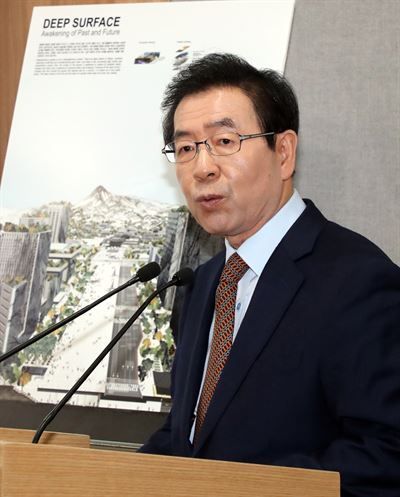
Seoul Mayor Park Won-soon speaks during a press conference at City Hall, Monday, unveiling the city's plan to expand Gwanghwamun Square. / Yonhap
The 104 billion won ($92 million) expansion is scheduled to begin early next year and wrap up in May 2021.
“In 2021, Seoul will have a symbolic space like Trafalgar Square in London and the Arc de Triomphe in Paris,” Seoul Mayor Park Won-soon said.
“People from various fields will participate in the Gwanghwamun project, so it will be a place for every citizen. In addition, Seoul City is seeking to make it a global attraction.”
The main draw of the plan is that the vehicle lanes running in front of the Sejong Center for the Performing Arts will be transformed into a pedestrian area, meaning the 10-lane streets on either side of the existing square will be redesigned to a two-way six-lane road in front of the U.S. Embassy, KT headquarters and the Kyobo Building.
This will increase the total size of the square from the current 19,000 square meters to 69,000 square meters.
The expanded area will be divided into two sections, each featuring the capital's traditions and historic civic movements, while current installations that were poorly planned will be rearranged.
When the Seoul mayor initially mapped out the expansion project, he took into account the relocation of the statues of King Sejong and Admiral Yi to nearby places, allowing visitors to enjoy the view of Gyeongbok Palace and Mount Bugak from anywhere in the square.
However, the city government is now considering moving only the king's statue closer to the Sejong Center for the Performing Arts.
“We will make a final decision on the issue by the end of the year after fully collecting public opinion,” Park said.
There will be also a huge transformation below the square, as an underground space will be built with cultural and educational facilities. It will be linked to Seoul City Hall, and Dongdaemun via a 4-kilometer underground path.
Taking advantage of the connection, the city government plans to create a super large-scale subway station serving five lines.
Along with current Gwanghwamun Station on Line 5 and City Hall Station on lines 1 and 2, it will complete a station for the Great Train Express (GTX) Line A linking Unjeong in Paju, northwest Gyeonggi Province, to Dongtan in the southeast, by 2023.
Plus, it also believes it is possible to service the Shinbundang Line at the envisaged mega station. This would mean extending its currently planned route from Yongsan to Goyang, Gyeonggi Province, because the GTX Line A and the Shinbundang Line would share tracks.
“It will serve as critical momentum to accelerate balanced development on the northern and southern sides of the Han River,” the mayor said.