Paid weekend to be included in minimum wage calculation
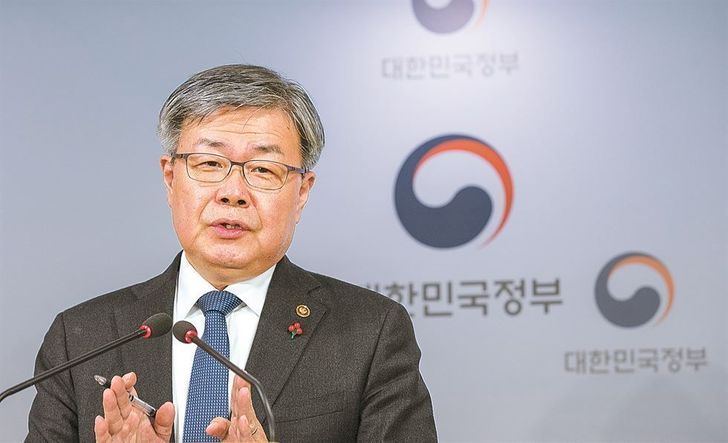
Labor Minister Lee Jae-kap speaks about the changes in minimum wage calculation during a press briefing at the Seoul Government Complex, Monday. / Korea Times photo by Shim Hyun-chul
By Kim Hyun-bin
The government has decided to revise an enforcement ordinance of the Minimum Wage Act, to include the weekend as working hours when calculating the minimum wage, according to the Ministry of Employment and Labor, Monday.
“As we originally planned, we will include weekend work hours when setting our minimum wage,” Labor Minister Lee Jae-kap said at the Seoul Government Complex after a Cabinet meeting.
The government will endorse the ordinance at next week's Cabinet meeting slated for Dec. 31. Once endorsed, it will take effect starting Jan. 1. The ordinance does not need prior approval from the National Assembly as it is not a bill.
Under the Labor Standards Act, when employees work for an agreed time during weekdays, they are given eight hours of salary on the weekend every week. Most companies set Sundays as the paid weekend day, and for those who receive wages on a monthly basis, payment for the paid weekend is included in the monthly salary.
Without including the weekend payment, considering next year's minimum hourly wage is 8,350 won ($7.42), when a person works for 40 hours a week, it comes out to 174 hours per month on average and the worker will receive around 1.4 million won.
However, when including the weekend payment, an additional eight hours will be added into the calculation every week, increasing the workweek to 48 hours and for a month, 209 hours, and the monthly salary will surge by an additional 17.6 percent to 1.7 million won.
Some large companies recognize not eight hours but 16 hours for the paid weekend by including Saturday as well, through collective bargaining with unions. In such case the total work hours will increase to 243 hours a month and the monthly salary will be 2.03 million won.
After meeting a strong backlash from companies that claimed the rule will drastically raise their personnel costs, the government decided to exclude the additional eight hours set by such labor-management agreements when calculating the minimum wage.
The government announcement drew backlash from companies, which said the inclusion of the paid weekend will become a hefty burden to those who are already struggling under the slowing economy.
“The revised enforcement ordinance will virtually increase the hourly minimum wage 20 percent to 40 percent higher than the 2019 minimum wage, becoming a great burden on companies,” the Korea Employers Federation said in a statement. “We are strongly against the ordinance.”
The labor ministry also announced to prolong the grace period of the regulation forcing a maximum workweek of 52 hours, as many companies are having difficulty implementing the fixed work hours.
Initially the policy was scheduled to take effect Jan. 1 for companies with more than 300 workers after a six-month grace period. But the government extended it to March 31.
“Some companies are having difficulty implementing the shortened work hours. Considering our ongoing discussions on flexible work hours, we have decided to extend the grace period,” Lee said.