Yongsan US Army Garrison opens up to Korean public

Yoo Hong-jun, former head of the Cultural Heritage Administration, explains the history of U.S. Army Garrison (USAG) Yongsan site in central Seoul, in front of a Japanese military prison building on the compound, during a bus tour, Nov. 2. / Yonhap
By Lee Suh-yoon
U.S. Army Garrison (USAG) Yongsan finally opened its gates to the Korean public last week.
Several Seoul residents and academics, accompanied by the mayor and the land minister, as well as Yongsan-gu and USAG officials, took a 90-minute bus tour of the formerly off-limits military garrison last Friday. This is the first time Korean citizens were officially allowed to step inside the 3.9-million-square-meter base in the heart of Seoul, after the area was first marked off to station Japanese troops in 1904.
As symbolic as the move was, a handful of journalists — including this reporter of The Korea Times — were allowed to tag along on the nationally televised tour. Five more tours are planned in November and December, with more expected to follow next year.
The headquarters of the U.S. Forces Korea (USFK) moved south to Camp Humphreys in Pyeongtaek, Gyeonggi Province, in June, in step with the plan to turn Yongsan Garrison into a national park. The plan was announced in 2005 during the Roh Moo-hyun administration. With around 10,000 of its 21,000 residents having moved to Pyeongtaek in the last two years, the U.S. army has closed down 20 percent of the buildings so far. If things go as scheduled, 80 percent of the camp's buildings will be shut down by 2020.
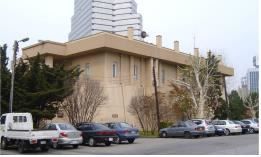
The South Post bunker at Yongsan Garrison, Seoul / Courtesy of Ministry of Land, Transport and Infrastructure
“After 114 years, Yongsan Garrison is finally being returned to the people,” Kim Hyun-mi, the minister of land, transport and infrastructure, said in a speech before boarding the bus. “It will be reborn as Yongsan Park, a symbol of daily life and peace where people can mingle and experience nature and history.”
Once inside, Yongsan Garrison feels like a small suburban U.S. town, with its low-rise buildings spread over grassy patches. The camp is fitted with its own hospital, hotel, school and even a driving range for golfers.
Immediately to the right of gate 14, is the South Post bunker where the decision to blow up the Hangang Bridge was made during the Korean War. Further down the road is U.S. Embassy employee housing.
The bus made its first stop at a Japanese military prison, built in 1909 straight after the notorious Seodaemun Prison. Bullet holes — remnants of the Korean War — still remain on its 16-foot-high red-brick wall enclosing its yard.
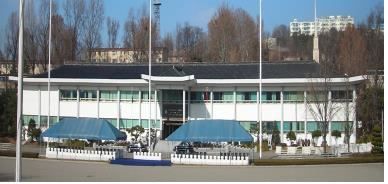
The ROK-U.S. Combined Forces Command building at Yongsan Garrison, Seoul / Courtesy of Ministry of Land, Transport and Infrastructure
“Different parts of Korean history are left here,” Seoul Mayor Park Won-soon said during his short walk around the military prison. “These sites need to be explored further as they are worthy of registering as UNESCO cultural heritage sites.”
At the short commencement ceremony before the bus tour, Park called Yongsan Garrison the “symbol of Korean suffering,” referring to its role during the Japanese occupation, North-South separation and the Cold War.
Starting around 1884, Yongsan was the official hub for religious and commercial exchange with France, China and Japan. But after the 1894-1895 Sino-Japanese War, it also became the door to Japan's colonial ambitions. Newspaper records from 1908 show hundreds of villagers were forcibly evicted from the site to make way for a camp to host Japanese forces stationed in Korea. U.S. forces replaced them after Korea's liberation from Japan in 1945.
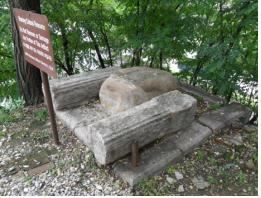
Namdan Altar at Yongsan Garrison, Seoul / Courtesy of Ministry of Land, Transport and Infrastructure
Despite its painful history, experts say the site can now become the green heart of Seoul.
“It can now become the green belt that functions as the lungs of Seoul,” Yoo Hong-jun, former head of the Cultural Heritage Association (CHA), told visitors during the tour. “If it wasn't for the military facility, this area would probably be packed with apartment complexes. Now we have the option to turn it into a green space rivaling Central Park in New York.”
The tour ended with a stop at Namdan, a stone altar where ancient Korean kings performed rain calling ceremonies. The area had been fenced off to preserve the site but parts of it, like the stone stairs, were buried under weeds. The city government and the ministry plan to preserve such sites within the future park.
Environmental issues remain
Though the land's return to the public is welcomed, environmental concerns remain. Like other U.S. military sites in Korea, Yongsan Garrison has had numerous cases of oil leaks.
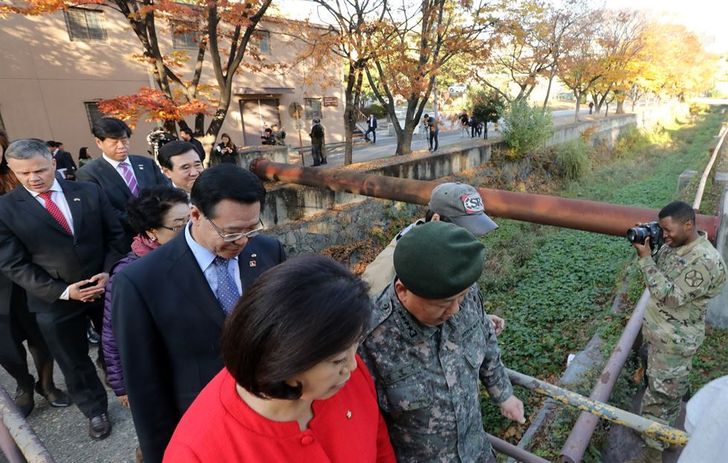
Bus tour guests walk across Mancho Stream inside Yongsan Garrison, Nov. 2. This is the only natural stream in Seoul that was not cemented over. / Yonhap
It was revealed last year, via documents received by NGOs from the U.S. government through the Freedom of Information Act, that the USFK covered up 84 oil spill accidents from the Korean government between 1990 and 2015. According to a joint study by the Ministry of Environment and the USFK in 2015 to 2016, 60 percent of measured sites within the camp showed harmful levels of the cancer-causing compound benzene — 671 times the safety standard limit at one site.
Regarding the issue, the USFK has not issued a formal apology or offered to share the cleanup costs after moving out.