The last shoemakers of Seongsu

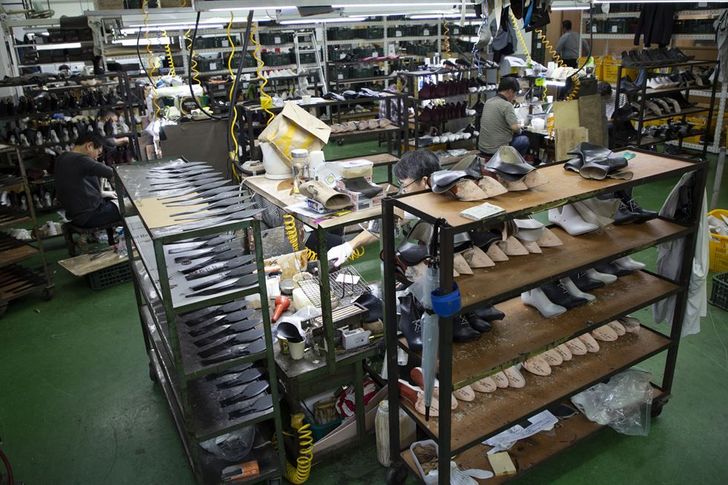
A worker makes leather shoes at one of Seongsu's 300 shoemaking factory workshops, Monday. This factory supplies its shoes to Kolon, a brand better known for outdoor apparel. / Korea Times photo by Choi Won-suk
By Lee Suh-yoon
Seongsu, an old factory town in Seongdong-gu, eastern Seoul, is no longer the affordable safe haven for the working class of Seoul. Its shoemakers — their numbers now down to 2,500 from 6,000 five years ago by industry estimates — are the first to feel the pinch.
“All these fancy cafes and bars down the street, they don't really help us,” says Choi Kyung-jin, a shoemaker who has worked here since 1979. “The rising rent is slowly pushing out factories — like the one just in front of our building recently — to the outskirts like Gwangju and Seongnam in Gyeonggi Province. If this factory too is moved, commuting to work will become much more difficult for me.”
Choi works at one of the 300 workshops stacked inside the neighborhood's signature red brick buildings. These factory workshops are run by subcontractors that supply handmade shoes to high-end shoe brands like Tandy and Saera.
Facing Kim's workplace, a factory building with its industrial clutter scooped out is being revamped into an open-air cafe. The red brick walls are left intact to create a retro mood for the cavernous space.
A one-floor shoemaking factory workshop in a red brick building in Seongsu, eastern Seoul / Korea Times photo by Choi Won-suk
Just five minutes away is an entire street of such cafes and bars, equipped with large art installations and tattooed baristas.
Starting in the late 1960s, shoes, auto parts, and printing factories flowed into the area. A wave of residential buildings followed in the 1980s and 90s to host these factory workers and the poorer residents of the capital. Around the same period, shoemakers at Yeoncheon Bridge near Seoul Station — home to the first handmade shoes street — and fashion hub Myeong-dong began relocating to Seongsu, attracted by its cheap rent. At one point, Seongsu was producing over 80 percent of all the handmade shoes in the country.
Business declined slowly with the competition from cheaper Chinese goods from 2000. Around 2010, young artists, attracted by the cheap rent and the neighborhood's unique vibe as a manufacturing hub, began moving into vacant factory buildings, turning them into galleries or hip cafes. Seongsu is now often referred to as "the Brooklyn of Seoul."
In 2013, Seoul Mayor Park Won-soon pledged to develop the area into a fashion hub for footwear rivaling Bologna in Italy. Following the announcement, nearby Seongsu Station on Seoul Metro Line 2 was covered with shoe-themed designs. “Seongsu Handmade Shoes Street” signs were put up and small cubicles selling shoes by various shoemakers were set up.
The area was widely advertised as a place one could get a pair of customized handmade shoes at affordable prices. President Moon Jae-in and first lady Kim Jung-sook also had their shoes made at a workshop of a well-known craftsman here last year.
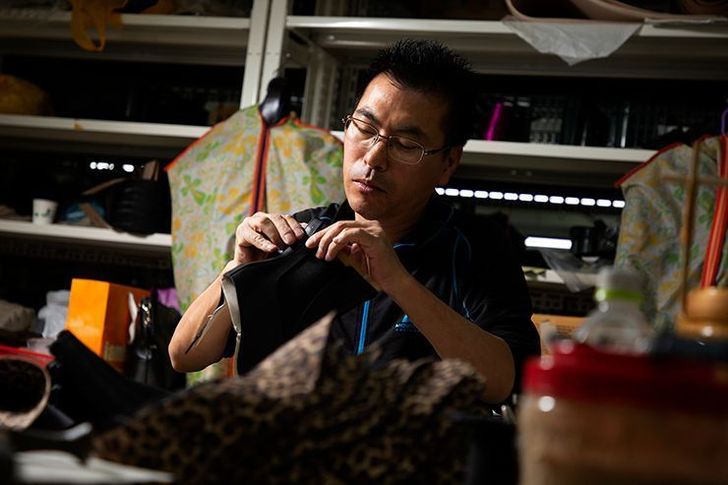
Choi Kyung-jin, 56, the youngest shoemaker at a Seongsu factory workshop, folds and stitches together fabric to create the upper body of a shoe. / Korea Times photo by Choi Won-suk
These efforts have brought in more shoppers, but have done little to improve the lives of the majority of the shoemakers who toil away inside hidden workshops.
“Only a few of the shoemakers and workshops are supported by the local government plan,” Kim Jong-min, the head of the shoemakers' union, told the Korea Times recently. “The local authorities just focus on bringing in more visitors from the outside, and not enough on improving the livelihood of the vast majority of shoemakers in Seongsu.”
And there is a lot to be improved. The shoemakers' earnings, for one, have not kept up with the steep rise in living costs. In fact, their fees — they are not given wages but paid per shoe — have stayed the same since the Asian financial crisis 20 years ago, which trimmed labor costs and took away benefits like severance pay.
Each worker is considered an independent contractor, and paid per shoe instead of by the hour. Because they are not considered regular employees of major shoe brands or their subsidiary suppliers, they are not protected by hourly minimum wage laws or provided the basic insurance plans usually required of employers, including health insurance, employment insurance, industrial accident insurance and the national pension.
For every pair of shoes, the suppliers pay two shoemakers — one who creates the shoe's upper body, and the other, the bottom soles — 8,000 won ($7) to 8,500 won, each. The process takes a little less than an hour for each shoemaker.
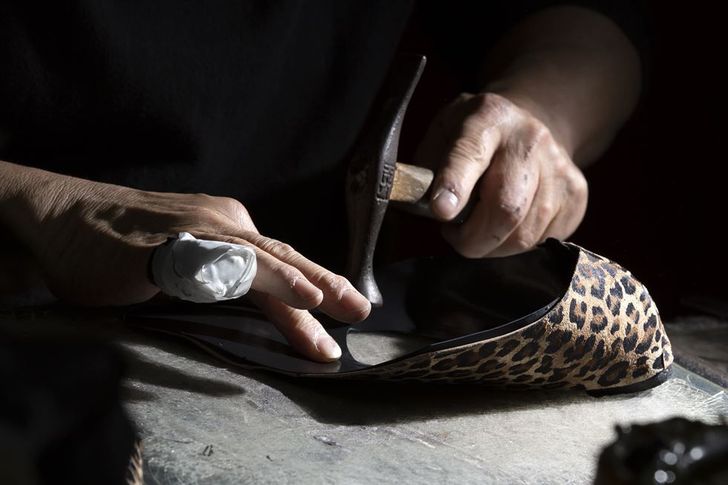
A shoemaker uses a hammer to create the upper shape of the shoe. / Korea Times photo by Choi Won-suk
The shoes — touted as handmade works of art — are sold for 200,000 won to 300,000 won at department stores which take around 35 percent of the revenue for each sale.
To make a living from such a piecework arrangement, the shoemakers work around 15 hours a day, six days a week, allowing them to take home about 3 million won a month.
“We come and leave work every day with the moon,” Choi said with a chuckle. “Fall and winter are peak seasons so I'm working from 7 a.m. to 11 p.m. right now. Many other shoemakers in the area start work at dawn.”
During low season, about six months every year, more regular working hours are possible. The only problem is that their earnings are also halved during this period. Many have families to support.
Apart from being too low, the fixed rate per piece does not differentiate between shoes that require more work and shoes that require less.
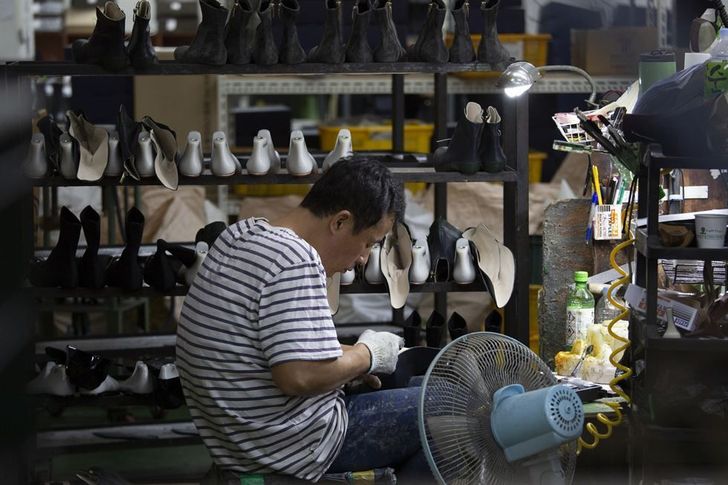
A shoemaker bent over on his stool as he finishes making the bottom soles for a shoe. / Korea Times photo by Choi Won-suk
“In Japan, I heard the fee per piece is determined by the number of accessories and stitched seams. Here, the fee is fixed at about 5 percent of the sales prices,” Choi said with a frown. “So even if the shoe takes more work and time, it pays the same as a cheaper piece.”
Considering such characteristic of the job, coupled with the fact workers have to finish everything the factory demands rather than picking and choosing, the shoemakers say they deserve a regular employer-employee relationship with the factories.
The shoemakers union accuses the firms and the big shoe brands of keeping the subcontracted pay-by-piece relationship with workers to avoid paying them proper compensation.
Until earlier this year, before a series of the first major union strikes by shoemakers, the fee per shoe was even less — around 7,000 won — and many workshops still maintain it as workers and the suppliers have not reached a deal yet. Some are jobless, as factories closed down, saying they cannot competitively bid for orders with their client shoe brands with the increase in labor costs.
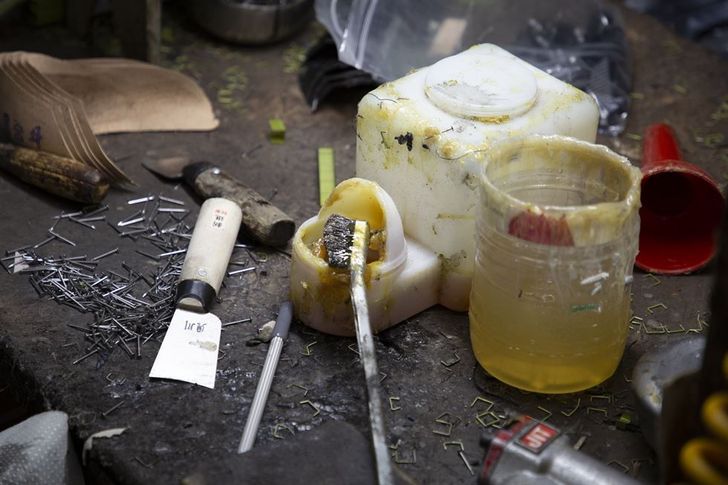
The factory workshop is filled with the toxic fumes from industrial-strength glue. / Korea Times photo by Choi Won-suk
Choi, 56, is the youngest worker on the entire floor.
“Young people do not want to learn this craft, so the trade is dying and there's no helping it,” said an older worker, barely looking up from his task of fixing soles into shoes. He refused to give his name. “Who would want to take up this little paying job?”
And he's right.
The factory, located on the second floor of a square red building, reeks of toxic fumes from industrial glue. No one takes their eyes off their fingers as they hammer, sew and staple leather bits. Time is money here. Their backs and necks remain in a crouched position for hours on end.
“My shoulders, arms and fingers do ache a lot,” Kim Joong-jin, a fellow worker of Choi, said with a shrug, when asked how he copes with long hours of such taxing work. “I just wallpaper my body with those pain relief plasters every night.”