Korean children long for 'YouTube stardom'
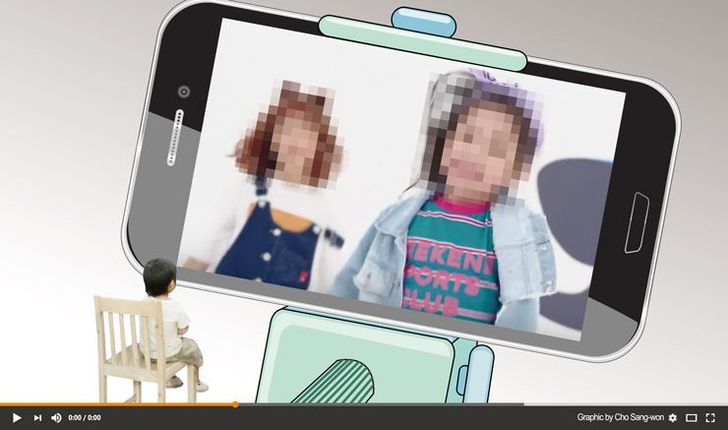
By Lee Suh-yoon
The generation that longed to become the next K-pop idols has moved on. Becoming a YouTube star is now the new craze among Korean children.
Many have already set themselves up to realize this goal, uploading videos that mimic the content of established YouTube celebrities who specialize in children's content.
By tracking down users with nicknames that start or end with “TV” in the comments section of popular kids content videos, people can soon find a parallel universe filled with these young entrepreneur hopefuls.
Here, the channels boast only around 10 to 30 subscribers – mostly the classmates of the channel's owner.
Children, most of whom look or sound younger than 12, intimately chat about their lives or talk to viewers through a story book or mobile game. Their voices reflect a level of confidence one usually expects from a talk show host, even if they trip over long words or unexpected thoughts.
“Today's a sad day because it's the day my grandmother died. I'll be visiting her graveyard with presents and nice clothes tomorrow,” a boy who goes by the YouTube nickname Nikounni and looks about 10 years old, tells viewers in one video.
“Oh no I'm crying now, can you see the tears in the corners of my eyes?” he says as he suddenly leans closer to his smartphone camera. “If you want to help me out, please click subscribe or like.”
Kwon Eun-yeong, 24, a teacher at a middle school in Sangdo-dong, Seoul, says YouTube is the central conversation topic among students.
“The students are always talking about the latest videos from this YouTuber called BJ Bokyum, not Korean drama or K-pop singers,” Kwon said. “They also use new expressions like 'hairu' (meaning 'hello') that was created by this BJ in their daily conversations with each other.”
One of the students in Kwon's homeroom class is currently running his own YouTube channel with about 700 followers, Kwon added.
The boom of personal YouTube channels has come after the success of some child Youtubers who have between 500,000 and 2.4 million subscribers.
Often accompanied by their parents or siblings, these young YouTube stars play, dance, eat and do other activities that entertain their audience.
The success of a handful of child YouTubers is attracting too many hopefuls, said an operation manager of Lime Tube, where an eight-year-old main character, Lime, is shown playing in a setting created by her father. The channel has more than 1.2 million subscribers.
“I know many parents are still trying to break into the market with their children,” he said. “But this market for children-focused digital content is very saturated right now. It is almost impossible for latecomers to break into this market unless they have some truly original content.”
The excessive competition seems to lead some channels to disregard moral standards in the quest to create the most entertaining content.
One channel
– boasting over 2.4 million subscribers – featured a video of a five-year-old girl driving inside a toy car on an actual road alongside real vehicles. Other controversial videos showed the girl being made to steal money from her father's wallet or watch her favorite toy get squashed under a car.
Another channel, with around 90,000 subscribers, showed a girl crying and shaking from fear during a hidden camera prank where her father dressed up as a threatening robber.
Save the Children Korea sued both channels last September for repeatedly exposing the children to “immoral, dangerous, and psychologically painful” situations. In the case of the first-mentioned channel, the Seoul Family Court recently recognized the actions as “child abuse” and ordered the child's parents to undertake counseling sessions.
“The videos included scenes that could cause young children psychological pain and hinder their emotional development,” Kim Eun-joeng, the rights protection officer at the organization, said. “The children who were featured in these videos were less than six years old, an age where it is still difficult to distinguish between reality and acting, thus causing more damage.”
The channel has since taken down the problematic videos and issued a formal apology.